Showing posts with label Fall of the House of Usher. Show all posts

Saturday, October 31, 2009

A Very Poe Halloween

Looking for ways to celebrate this Halloween the Poe way? Here are my top five* recommendations (I'm hoping it's a good mix of "the classics" with a couple lesser-known ones sprinkled in).

"Metzengerstein" (1832) — Poe's first published tale features a long-standing family rivalry. When the patriarch of one family dies, a young man becomes the rightful heir to his estate. However, the mischievous young man is known for his "shameful debaucheries — flagrant treacheries — unheard-of atrocities." Compared with Caligula, we are told this man "out-heroded Herod." When he finds a mysterious, ill-mannered, rogue horse, he obsesses into breaking it in — no matter the cost.

"Berenice" (original 1835 version, before the more "repulsive" section was self-censored) — "Misery is manifold," the narrator (Egeaus) says at the beginning of the story. As he prepares to marry his cousin Berenice, he tells the reader how both are afflicted with disease — she, a physical one, he a more mental one. When Berenice's disease kills her, or so the narrator thinks, his monomaniacal obsession over the one part of her that never shrivels from disease (her teeth) leads him to one final repulsive act.

"The Fall of the House of Usher" (1839) — A true haunted house in the strictest sense, Roderick Usher is overcome by feelings of dread and doom, while his twin sister Madeline is sick and dying. The narrator rides up to visit in the middle of all of it. Soon, Madeline dies and is locked in the family crypt. Trying to cheer up Roderick is fruitless, until finally: "Not hear it? — yes, I hear it, and have heard it. Long — long — long — many minutes, many hours, many days, have I heard it — yet I dared not — oh, pity me, miserable wretch that I am! — I dared not — I dared not speak! We have put her living in the tomb!"

"Life in Death" (later "The Oval Portrait," 1842) — A wounded traveler makes his way into a mysterious castle to rest in a room with walls covered in paintings. Arrested by one particularly striking portrait, he reads a book which explains its origins. "But it could have been neither the execution of the work, nor the immortal beauty of the countenance, which had so suddenly and so vehemently moved me." Indeed, the provenance of the portrait is much more horrible than the traveler imagined.

"The Masque of the Red Death" (originally 1842, but I'm recommending the 1845 version) — When a plague sweeps over the land, the "sagacious" Prince Prospero invites scores of his friends to escape sickness in his abbey. There, he throws a masquerade throughout seven large chambers to celebrate their success at staving off death. But, as the clock chimes midnight, a strange uninvited guest arrives daring to imitate the disease which rages outside the castle walls. "His vesture was dabbled in blood — and his broad brow, with all the features of the face, was besprinkled with the scarlet horror."

"The Facts in the Case of M. Valdemar" (1845) — Mr. Valdemar is dying of tuberculosis and volunteers for his friend's experiments with Mesmerism, specifically an attempt at putting a person in a trance just as he is at the edge of death. He is successful and, in his trance, Valdemar reports he no longer feels pain but is still dying. "I now feel that I have reached a point of this narrative at which every reader will be startled into positive disbelief. It is my business, however, simply to proceed." I leave it up to you, the reader, to proceed. This story probably has the single most memorable ending of any story ever written.

Happy Halloween reading!

*Okay, so I had trouble choosing only five. Choosing only six wasn't too easy either, but that's what I did.

Friday, September 11, 2009

The clouds hung oppressively low

September is a busy month for Poeists. Some heavy-hitters from Poe's collected works were first published in September or September issues of periodicals. The earliest was a mostly-forgotten poem published on September 15, 1827, when Poe was 18 years old, referred to as "The Happiest Day, The Happiest Hour."

His prose works which first see circulation in September include "King Pest" (1835), "Shadow — A Parable" (1835), "Ligeia" (1838), "Never Bet the Devil Your Head" (1841) and "The Oblong Box" (1844). Perhaps the most famous, however, is "The Fall of the House of Usher," published in the September 1839 issue of Burton's Magazine (the cover of that issue is pictured at left).

Regarded by some as the most perfect Gothic story ever written, "The Fall of the House of Usher" features all the tropes of that genre. The most important image, of course, is the decaying castle. The story follows an unnamed narrator who serves no purpose in the action of the story (unlike more involved narrators which play pivotal roles as main characters, like those in "The Tell-Tale Heart" and "The Cask of Amontillado"). Instead, through the eyes of this narrator, the reader meets Roderick Usher — a man broken down by his own sense of foreboding and impending doom. When Madeline Usher, Roderick's sister, dies after an illness, his feelings of doom turn to guilt. He loses his reason and goes mad (or so we assume), believing he has buried his sister before she was truly dead. Whether he was right or not is debatable — but, whether it's his undead sister or his own emotional instability, Roderick dies, leading to a very literal fall of the "house of Usher."

The story is nearly perfect. Poe's literary theory tells us that emotional response is the most important. In this story, emotions run rampant throughout and the reader feels the same sense of foreboding that Roderick does. We are left to ponder and question many aspects of the story, including its symbolism. The most alluring might be Roderick's library and his decision to recite the story of "The Mad Tryst." Somewhat distracting is the possibility of incest in the Usher family. The evidence lies only in the following lines:
I had learned, too, the very remarkable fact, that the stem of the Usher race, all time-honored as it was, had put forth, at no period, any enduring branch; in other words, that the entire family lay in the direct line of descent, and had always, with very trifling and very temporary variation, so lain.
Incest, though possible, is not certain (I read it only to say there are no remaining heirs of the Usher estate) — not that it matters. The story stands strong either way.

What amazes the most about "The Fall of the House of Usher" is its composition. Poe clearly put substantial effort into the story and, following his own literary theory, did not distract with unnecessary details. Scott Peeples, of the Poe Studies Association, notes the genius in the first line of the story which sets the tone (and buries the subject — the nameless narrator who does little to push the plot of the story forward):
During the whole of a dull, dark, and soundless day in the autumn of the year, when the clouds hung oppressively low in the heavens, I had been passing alone, on horseback, through a singularly dreary tract of country; and at length found myself, as the shades of the evening drew on, within view of the melancholy House of Usher.
More on another of my favorite September stories in my next post.

Friday, July 31, 2009

Silence like a sea that overwhelms

Perhaps the quintessential Poe short story that few have read, "The Premature Burial" was published for the first time in the July 31, 1844 issue of Philadelphia's Dollar Newspaper. Only a few of Poe's works feature the concept of being buried alive, yet, for some reason, I often read that Poe was obsessed that he would be buried prematurely. It's hard to say if this is true but I have yet to find any evidence at all that Poe was personally concerned with being buried alive.

Instead, Poe was responding to the popular concern about premature burial among his readers. Poe was, after all, a pop culture writer trying to appeal to a mass audience (the most obvious piece of evidence is that "The Premature Burial" was published in a cheap newspaper, not a high-end book). Even Poe's only novel was a direct response to the common interest of the masses.

I could argue that the reason American readers were suddenly interested in stories about premature burial is based on a general interest in death at the time. Concepts of death shifted from a Puritan "dirty death" point of view to a more romantic Victorian idealism. Medical science, however, was beginning to help define the moments where life and death meet at the same time that Spiritualism, galvanism, and similar movements were becoming popular. All of this created, I think, a sort of anxiety over death. Coffins in Poe's time could be affixed with bells and other emergency devices in case the "deceased" suddenly awoke after burial, organizations like the "Society for the Prevention of People Being Buried Alive" were formed, and it was reported that hundreds of people were mistakenly pronounced dead while, in fact, still living.

Can you blame Poe for writing a story like "The Premature Burial"? As Poe writes in this tale,
It may be asserted, without hesitation, that no event is so terribly well adapted to inspire the supremeness of bodily and of mental distress, as is burial before death. The unendurable oppression of the lungs — the stifling fumes from the damp earth — the clinging to the death garments — the rigid embrace of the narrow house — the blackness of the absolute Night — the silence like a sea that overwhelms — the unseen but palpable presence of the Conqueror Worm — these things, with thoughts of the air and grass above, with memory of dear friends who would fly to save us if but informed of our fate, and with consciousness that of this fate they can never be informed... We know of nothing so agonizing upon Earth — we can dream of nothing half so hideous in the realms of the nethermost Hell.
In addition to being written specifically to appeal to popular tastes, what makes the story so quintessentially Poe? Well, its vaguely frightening storyline is not based on blood, guts, violence, or the supernatural. Instead, it's a psychological story that creeps you out more than scares you. And, also very Poe-like, the story turns out to be a comedy at the end. Who knew??

By the way, Poe's other stories which feature premature burial are "Berenice," "The Cask of Amontillado" and, most notably, "The Fall of the House of Usher."

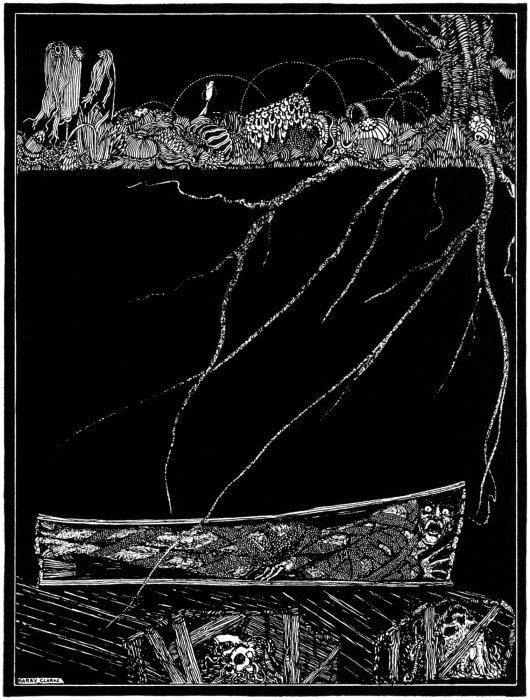
*Above, "The Premature Burial," as illustrated by Harry Clarke, 1919.

Sunday, June 28, 2009

The purchase of the house of Allan

At an auction held on June 28, 1825, merchant John Allan purchased a Richmond estate. Actually, he purchased parts of three lots from the late Joseph Gallego and the late John Richard.

One of those lots included the mansion nicknamed "Moldavia." The name was granted by earlier owners, Molly and David Randolph. The brick house included a large porch, a mirrored ballroom, an octagon-shaped dining room, and a wide mahogany stairway. It stood on the southeast corner of Main and Fifth Streets in Richmond (it is no longer standing). Allan's purchase totaled $14,950 — equal to about $270,000 today. He paid for it using much of the inheritance from his uncle William Galt.

Allan's young ward Edgar Poe was 16 years old at the time. It would not be long before he moved out and tried to make it on his own, at the University of Virginia, in the United States Army, and elsewhere, occasionally coming back to Moldavia to await his next opportunity. Poe would live an ironic adulthood, perpetually struggling financially, despite having spent a few of his teenage years living in a mansion owned by a millionaire. When Allan died, not a penny was left for his foster-son.

Perhaps not coincidentally, many of Poe's fictional works reference oversized mansions, including his earliest story "Metzengerstein." Other works that seem to reference Moldavia in their setting include "Ligeia" and, of course, "The Fall of the House of Usher."