Showing posts with label Oliver Wendell Holmes. Show all posts

Saturday, November 21, 2009

In not the most gentle manner

Poe began a lecture tour on November 21, 1843 in Philadelphia. The broad topic was "The Poetry of America." This was an era of oratory and many writers knew that lectures and public readings would greatly boost their income. Other writers turned lecturers included James Russell Lowell, Oliver Wendell Holmes, and, of course, Ralph Waldo Emerson, who was so successful as a lecturer it qualifies as his full-time job.

The purpose of this particular lecture was for Poe to discuss the state of American poetry and his literary theories. However, he couldn't resist wielding his tomahawk as a critic. He focused on the poor taste of his critical rival Rufus Wilmot Griswold, whose book The Poets and Poetry of America was published a year earlier and was clearly referenced in the lecture title. One periodical later noted "this book and its author were handled by the critical Lecturer in not the most gentle manner" (what a great euphemism!).

This could be yet another minor reason why the two men would build a major rivalry/enmity for one another. It was shortly after this, in January 1844, that Griswold wrote to Poe about "some cause of personal quarrel with you, which you will easily remember."

One review later remarked that the lecture "placed all the pseudo-critics, the Rev. Mr. Rufus Griswold, Esq. among others, to the blush."

Poe's lecture in Philadelphia was very successful. The Saturday Museum noted it had "quite a large, and certainly highly intelligent audience." According to the United States Gazette, "hundreds" were turned away, "unable to gain admission." The Saturday Courier noted that "it was a very learned critique, marked by the severity of illustration for which the author is so ably known."

Over about four months, Poe also lectured on the same topic in Reading, Pennsylvania and Baltimore, as well as Wilmington and Newark, Delaware. He begins another lecture tour on a similar topic in 1845, culminating in his strange appearance at the Boston Lyceum.

Tuesday, November 17, 2009

Fate that once denied him

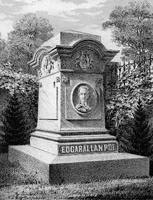
After over two decades buried in an unmarked corner of the cemetery at Baltimore's Westminster Church, Poe’s body was re-buried where people could see it from the street. A new memorial marker was dedicated on November 17, 1875.

The monument was substantial. Money for it was raised by several parties, including a Baltimore schoolteacher named Sara Sigourney Rice. Rice kicked off a "pennies for Poe" campaign and even asked her students to perform public speeches to raise funds. The final $650 came from Philadelphian George William Childs. The design came from architect George A. Frederick, built by Colonel Hugh Sisson, with a stone medallion of Poe by artist Adalbert Volck (later replaced). The total cost of the new monument was equal today to over $28,000.

Despite all the hard work on the monument, Poe's birthday was incorrectly chiseled as January 20 instead of January 19. It has never been corrected. On his birthday ten years after his reburial, Poe's long-dead wife Virginia Poe was buried with him. Maria Clemm was buried there too, bringing the family trio together for their eternal rest.

The ceremony to dedicate the new monument included speeches from Neilson Poe, Poe's oft-maligned cousin. Several famous poets were invited to attend. The only one that made it was Walt Whitman, then age 56, who was still recovering from a stroke.

Letters, poems and remembrances were contributed his one-time fiancee Sarah Helen Whitman and his occasional enemy James Russell Lowell. Other acknowledgments came from John Greenleaf Whittier ("The extraordinary genius of Edgar Poe is now acknowledged the world over"), William Cullen Bryant (Poe is "distinguished alike for originality in the conception, skill in word-painting, and power over the mind of the reader") and even Henry Wadsworth Longfellow (who noted: "The fever called Living is conquered at last"). Some of the greatest lines in honor of Poe came from fellow 2009 bicentennial poets Alfred Lord Tennyson, who later said that "neglected spot" would be the first place he would visit on a trip to the United States, and Oliver Wendell Holmes. As Dr. Holmes wrote:
His monument shall be his gentle verse,
Which eyes not yet created shall o'er read.
And tongues to be his being shall rehearse,
When all the breathers of this world are dead.
* People still leave "pennies for Poe" at this memorial today. This has become a tradition at the graves of famous figures, particularly writers. Poe did not originate the tradition, however.

Wednesday, October 7, 2009

Death of Poe

On October 7, 1849, Edgar Poe died. He was 40 years old. Thus ended his struggle for financial success, his foibles (whatever they were), and his genius. Thus begins his greatest mystery.

Perhaps it is fitting (or ironic, depending on your point of view) that the man who invented the modern detective story left such a strange question unanswered: What killed Edgar Poe?

Rising to the challenge, several have offered their theories — some inspired by personal bias, others based on scientific evidence; some a posthumous attempt to malign his character, others an attempt at further fictionalizing the man's already-fascinating story. Besides the cooping theory, and the theory that Poe was drugged/beaten by the brothers of Sarah Elmira Royster, there have been suggestions that Poe was murdered (some even dare to suggest Rufus Griswold) or that he committed suicide. I tend to disagree with those violent suggestions (and even the quote from Baudelaire that says Poe's death was a suicide which was long time in coming).

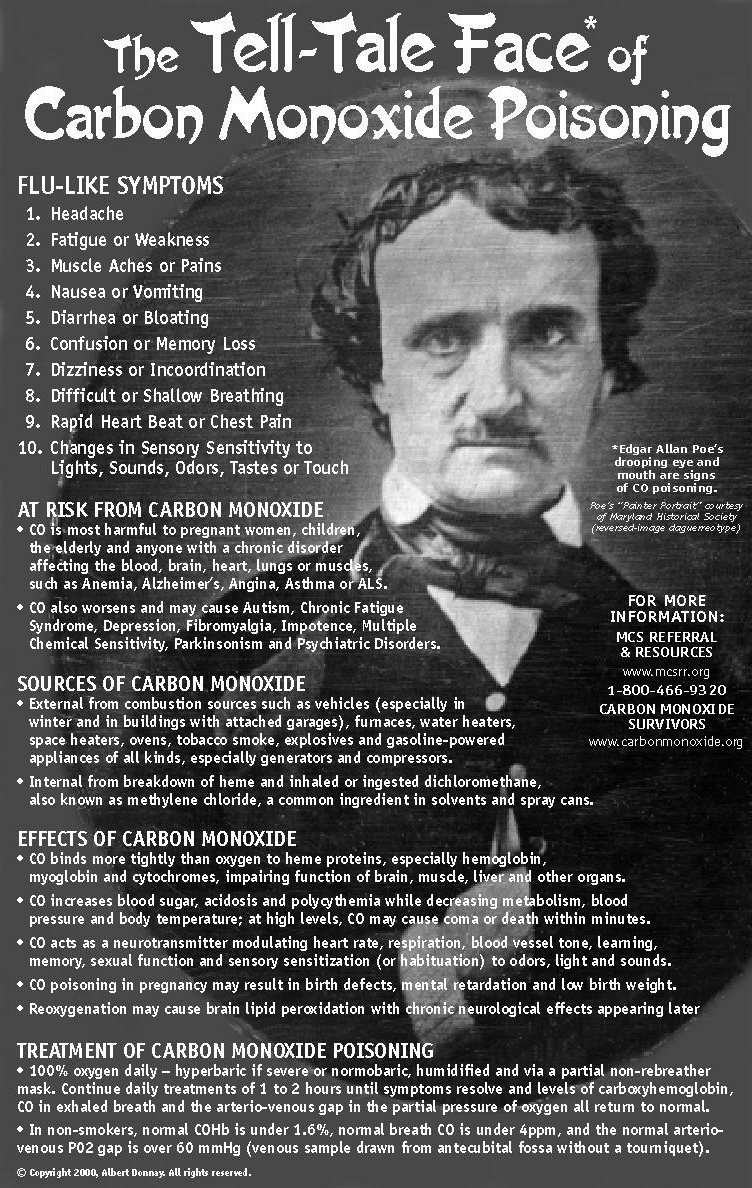
Is it mundane to think that Poe died of medical reasons? Perhaps it is too simple for people that want a more titillating story but the reality seems to be that people were more likely to die by disease than violence in the 19th century (excluding the Civil War). If Poe's death was because of a medical condition, theories include the following (deep breath): diabetes, epilepsy, tuberculosis, heart attack or heart disease, brain tumor, carbon monoxide poisoning, arsenic, lead poisoning, alcohol poisoning (still popular despite contrary evidence), cholera, syphilis, meningitis, and rabies.

Rabies? Yes, and for a time the theory had fairly substantial support. Though most biographies mention the cooping theory, it seems few take it seriously and many point to medical theories instead.

Regardless, one of the greatest imaginations in all of American writing died this day in 1849. Though his death remains a mystery, I am thankful to know that I can enjoy his works any time. It is unfortunate that today, for the first time in about five years, I will not be able to visit Poe at his grave in Baltimore (his original burial plot is today marked, as shown in the photo above).

*As a footnote, on this same day 45 years later, fellow bicentennial poet Oliver Wendell Holmes died. He was 85 years old.

Saturday, August 29, 2009

Bicentennial of Dr. Holmes

Also celebrating his bicentennial in 2009 is Dr. Oliver Wendell Holmes, the doctor-writer who was born in Cambridge, Massachusetts on August 29, 1809.

Through Holmes's lengthy life and career (he was alive in every decade of the 19th century), he would be a doctor, professor, medical reformer, poet, author, essayist, lecturer... a true Renaissance Man. However, many of his major works were not published during Poe's lifetime. His Autocrat of the Breakfast-Table series far off, Holmes's early literary career hinged on only one poem: "Old Ironsides." It was an auspicious beginning; the poem's publication in 1830 is directly responsible for the preservation of the U.S.S. Constitution. At the time, it was in serious danger of being scrapped; today, because of Holmes, it remains the oldest commissioned ship in the United States Navy and the oldest afloat anywhere in the world. It was an early blossoming that Holmes had trouble living up to for a time.

Poe included Holmes in his "Autography" series and acknowledged a side of Holmes which would later become his legacy: his humor. Elsewhere, Poe offered substantial praise to Holmes — no small feat, considering the rarity of Poe's praise for New England writers. In fact, it's rare to find unqualified praise from Poe at all; most of the writers he lauded were also the on the receiving end of Poe criticism. Holmes, however, never seems to have earned any negative commentary from Poe.

In particular, Poe enjoyed Holmes's poem "The Last Leaf" (another admirer was Abraham Lincoln, who also celebrated his 200th birthday in 2009) — a seriocomic poem which mentions Thomas Melvill (grandfather of Herman Melville). Melvill was a remnant of the Revolutionary era and still wore 18th-century fashions, including a tricornered hat. Holmes found it comical to see the man so out of place but, somewhat romantically, mused would it would be like if he himself were the last of his own generation:

And if I should live to be
The last leaf upon the tree
In the spring,
Let them smile, as I do now,
At the old forsaken bough
Where I cling.

The poem turned out to be prophetic. Holmes outlived all of his writer-friends, including Longfellow, Lowell, Emerson, Hawthorne, and others. Holmes was, in fact, "The Last Leaf," just as he predicted. He died October 7, 1894 — exactly 45 years after the death of Edgar Poe, but not before contributing a poem for the dedication of a new Poe monument in Baltimore in 1875.

Not to worry, folks — Holmes is not being forgotten on his birthday. The city of his birth is hosting a pretty substantial birthday party for him this morning.

Friday, August 14, 2009

Poe's place in literary history

Poe's place in literary history is occasionally questioned. Should he be considered a master of American literature? Does he deserve a place in the canon? Is he really important? I might be biased so take my opinion with a grain of salt (this post will shift away from my more academic tone and may, in fact, turn into starry-eyed gushing over my favorite author). Here's my argument: even if you remove the quality of Poe's work from the equation, Poe is one of the most important writers in American history.

The real evidence for this comes on August 14, 1835. It was on that date that the Trustees of the Richmond Academy began selecting their new English teacher. The fact that it was not Poe should solidify Poe's role in American literary history. Excluding his military stints, Poe only applied for two jobs outside of literature. The first was the job with the Richmond Academy teaching English. The second was a job with the Customs House in Philadelphia in 1841, hoping that a connection to Robert Tyler (brother of President John Tyler) would secure his employment. Neither role worked out. That means that Poe never had a job outside of literature; for his 40 short years, he would have no source of income besides his pen.

This is significant because no other major American writers in the first half of the United States were able to sustain themselves in such a manner. Washington Irving had a couple government jobs and was, for a time, part owner in a mercantile business. Henry Wadsworth Longfellow, James Russell Lowell, Oliver Wendell Holmes, and others held full-time teaching positions (at Harvard, in the case of all three). Nathaniel Hawthorne attempted to make a living as a farmer for a time before taking government jobs at two different Customs Houses (one in Boston, another in Salem, Massachusetts). Ralph Waldo Emerson had his ministry for a time and, later, a public lecturing career (he was also supported by an inheritance from the family of his first wife). Margaret Fuller struggled as a teacher in Providence before become a full-time journalist (and, then, nearly all of her writing was not literature but nonfiction).

Poe's financial failure is obvious. Nevertheless, his attempt is nothing less than historical, if not extraordinary. The fact that he stood the test of time is minor (so did the other writers I mentioned above) but, coupled with his lack of any other job outside of literature, Poe should be considered a trailblazer.

Odds were stacked against him, of course. The country was young, its literature younger, and the economy was not established for professional authors. Poe's critical work emphasized that the quality of American literature needed to improve and, as such, he fought against the puffing system which inhibited proper growth. He also railed against the lack of copyright (suggesting authors may as well slit their throats), the culture of republishing without authors' permission, and the tastes of American audiences which, he believed, did not recognize quality over popularity. All of these factors needed to change before an American could make money solely as an author. Poe missed out on those ideal conditions and did not survive into the American Renaissance of the 1850s. Even with all that, when he died at age 40, he showed no signs of turning away from his desired path.

For the sake of full disclosure, Poe was also hampered by bad decisions. He married before he had an established income and, in doing so, inherited not only a young wife but also a mother-in-law who needed his financial support (though, to Maria Clemm's credit, she occasionally provided minor assistance through odd jobs and, of course, begging). He also didn't stay in one place for too long, constantly moving when he needed to escape overdue rent payments or in an optimistic pursuit of greater opportunities — all the money he spent on rent and moving expenses could have been saved to buy a house. Other than that, he was thrifty, particularly in his clothing choices, but his challenges are already numerous.

Yes, Poe was a financial failure in his pursuit of the life of a professional author. But that failure was unprecedented — and it deserves our praise. Thanks to the Trustees of the Richmond Academy for (inadvertently) making it possible.

* Longfellow should be considered America's first successful professional poet as of 1854, when he retired from his professorship. However, Longfellow was gifted a mansion at age 35 thanks to his father-in-law and had saved up enough money from teaching for about 17 years before he had the solid footing to become a professional poet. Credit is deserved there as well, certainly, but he did not have the same challenges as Poe.

Wednesday, July 15, 2009

Poe, puffs, and North Carolina

Poe's first job as a critic was in August 1835 when he was hired by the Southern Literary Messenger. Poe brought to the SLM a new style of criticism which distinctly broke away from the "puffs" that plagued American periodicals. In those days, critics were bribed or paid off to provide positive reviews by publishers or authors — or, in some cases, the system of puffing was so ingrained, no pay-off was needed. Poe, on the other hand, provided sincere reviews, whether laudatory or critical. Although, certainly, there are cases where Poe's personal bias influenced his judgment, he was going against the grain in providing a new type of literary criticism. He was a trailblazer, in some sense, and some have credited him as "the father of modern literary criticism."

Of course, one does not blaze a trail without making a few enemies.

On July 15, 1836 (surprisingly early in Poe's critical career), the Newbern Spectator, a periodical out of New Bern, North Carolina, suggested it was time for Poe to resign. His reviews were too caustic, too critical, too different. As the article said, "We think that Mr. Poe will soon see the necessity of resigning his chair, or of conforming to the rules of modern criticism. The Proprietor should look to this."

The irony here is clear, of course. Consider the climate, the "rules of modern criticism" to which Poe was being asked to conform: critic Rufus Griswold at one point wrote to publisher James T. Fields that he puffs books regardless of quality; he later received direct instructions from a minor publisher named T. B. Peterson for the positive review he expected (along with a request to destroy the letter once read); so many critics are patting authors on the backs that the term "mutual admiration society" is thrown around regularly by people like Margaret Fuller, Edwin Percy Whipple, and Oliver Wendell Holmes (the phrase is so prevalent, in fact, I'm having difficulty determining who said it first).

Poe, however, was not without supporters. Later that same July, the editor of the New York Weekly Magazine would respond positively to the Southern Literary Messenger. Others would continue to back Poe and even emulate his style throughout Poe's lifetime and beyond.

But, back to the Newbern Spectator. Poe acknowledged their comments and the Spectator responded, mentioning "the debt of gratitude which we owe its profound editor... having taken 'notice' of us in a manner so gentlemanlike and dignified, and so creditable to his own temper and erudition." Not to say, however, that they became supporters of Poe. Acknowledging the prevalence of "puffs," they question what Poe is doing. "It cannot permit a single voice to be raised against... errors without descending to scurrility and invective; thus showing conclusively the unfitness of its conductor for the task he has undertaken."

To each their own, I suppose. Personally, I wonder why a North Carolina publication has any interest at all in a Virginia newspaper.

Saturday, January 10, 2009

Autographs

The following excerpts are from "An Appendix of Autographs" (sometimes referred to as the "Autography" series) by Edgar A. Poe - January 1842 issue of Graham's Magazine. The issue reproduced autographs from well-known figures in American letters and Poe took the opportunity to sort of psychoanalyze them (if you'll pardon the anachronism) based on their writing. How (or if) Poe became an expert on signatures is unknown, but he makes sure to stick in a couple of good left-handed compliments.

Cornelius Mathews

Mr. Cornelius Mathews is one of the editors of "Arcturus," a monthly journal which has attained much reputation during the brief period of its existence. He is the author of "Puffer Hopkins," a clever satirical tale somewhat given to excess in caricature, and also of the well-written retrospective criticisms which appear in his Magazine. He is better known, however, by "The Motley Book," published some years ago - a work which we had no opportunity of reading. He is a gentleman of taste and judgment, unquestionably.

His MS. is much to our liking - bold, distinct and picturesque - such a hand as no one destitute of talent indites. The signature conveys his hand.

Charles Fenno Hoffman

Mr. Charles Fenno Hoffman is the author of "A Winter in the West," "Greyslaer," and other productions of merit. At one time he edited, with much ability, the "American Monthly Magazine" in conjunction with Mr. Benjamin, and, subsequently, with Dr. Bird. He is a gentleman of talent.

His chirography is not unlike that of Mr. Matthews [sic]. It has the same boldness, strength, and picturesqueness, but is more diffuse, more ornamented and less legible. Our fac-simile is from a somewhat hurried signature, which fails in giving a correct idea of the general hand.

Horace Greeley

Mr. Horace Greeley, present editor of "The Tribune," and formerly of the "New-Yorker," has for many yeras been remakred as one of the most able and honest of American editors. He has written much and invariably well. His political knowledge is equal to that of any of his contemporaries - his general information extensive. As a belles-lettres crtiic he is entitled to high respect.

His MS. is a remarkable one - having about it a peculiarity which we know not how better to designate than as a converse of the picturesque. His characters are scratchy ad irregular, ending with an abrupt taper - if we may be allowed this contradiction in terms, where we have the fac-simile to prove that there is no contradiction in fact. All abrupt MSS., save this, have square or concise terminations of the letters. The whole chirography puts us in mind of a jig. We can fancy the writer jerking up his hand from the paper at the end of each word, and, indeed, of each letter. What mental idiosyncracy lies perdue beneath all this, is more than we can say, but we will venture to assert that Mr. Greely [sic] (whom we do not know personally) is, personally, a very remarkable man.

Washington Allson

The name of "Washington Allston," the poet and painter, is one that has been long before the public. Of his paintings we have here nothing to say - except briefly, that the most noted of them are not to our taste. His poems are not at all of a high order of merit; and, in turth, the faults of his pencil and of his pen are identical. Yet every reader will remember his "Spanish Maid" with pleasure and the "Address to Great Britain," first published in Coleridge's "Sybilline Leaves," and attributed to an English author, is a production of which Mr. Allston may be proud.

His MS. notwithstanding an exceedingly simple and even boyish air, is one which we particularly admire. It is forcible, picturesque and legible, without ornament of any description. Each letter is formed with a thorough distinctness and individuality. Such a MS. indicates caution and precision, most unquestionably - but we say of it as we say of Mr. Peabody's, (a very different MS.) that no man of original genius ever did or could habitually indite it under any circumstances whatever. The signature conveys the general hand with accuracy.

Oliver Wendell Holmes

Dr. Oliver Wendell Holmes, of Boston, late Professor of Anatomy and Physiology at Dartmouth College, has written many productions of merit, and has been pronounced, by a very high authority, the best of the humorous poets of the day.

His chirography is remarkably fine, and a quick fancy might easily detect, in its graceful yet picturesque quaintness, an analogy with the vivid drollery of his style. The signature is a fair specimen of the general MS.

Thursday, January 1, 2009

2009: The Year of Poe

2009 is upon us. Whether any government officially recognizes it or not, 2009 will be the Year of Poe. He is such an iconic figure in American literature, had his hands in so many different genres, accomplished so many milestones in writing... and, what's more, he's an American writer who is not only respected in other countries, but also adored.

I recently read someone's argument that Poe is, in essence, the first author you are forced to read in school that you are not ashamed to admit that you actually enjoy. This is probably true. No matter how much Shakespeare is tossed at you in your early years, for example, you'd never admit you like him until you develop a more sophisticated taste. Poe, on the other hand, appeals to intellectuals, to scholars, to mainstream readers, and to schoolyard boys and girls.

2009 will see celebrations of Poe and his works day in and day out (or so we hope). I'll post some important (and not-so-important) anniversaries right here on this blog as the year progresses. As the year goes on, I hope to open up many sides of this complicated man and introduce new pieces of information to even the most diehard fans.

But, to give others their due... Other bicentennial birthdays in 2009 include Abraham Lincoln, Charles Darwin, and Oliver Wendell Holmes, Sr. I might mention a bit about them as the year goes on, too!