Charles Frederick Briggs and John Bisco signed a contract on December 23, 1844 to begin a new publication in New York. Only a couple weeks earlier, Briggs was struggling over what to name the new periodical. He settled on "The Broadway Journal."
Bisco was the brains that handled the business operations while Briggs utilized his established literary reputation to attract both contributors and readers. Briggs, however, was no fool and wanted an even bigger name to attract attention. He asked his close friend James Russell Lowell how to get in touch with Edgar Allan Poe.
The Broadway Journal rose and fell very quickly. Briggs and Bisco partnered with Poe because of his reputation — a reputation earned partly from "The Raven" but also from his harsh, relentless literary criticism. When Poe did the same sort of criticism for the Journal, Briggs was offended (particularly when Poe attacked Henry Wadsworth Longfellow, angering mutual friend J. R. Lowell).
The three business partners never quite came together. Briggs, who was also dealing with personal financial difficulties, attempted to buy out Bisco to take in more profit for himself. Instead, he abandoned the journal he helped start only about six months into the project. Poe considered selling his share of the company to another editor, a lion of New York periodicals named Evert Augustus Duyckinck, or the main proponent of copyright law Cornelius Mathews. Instead, he borrowed money from Horace Greeley and bought out John Bisco. As of October 1845, Poe was the sole owner of The Broadway Journal. Despite Poe's high hopes, the publication shut down with its January 3, 1846 issue (after which Poe vowed to start the Stylus, which never came to be).
Briggs continued to work in the publishing industry, editing several other magazines, journals, newspapers, and annuals. He had a somewhat long run on Putnam's Magazine, where he worked with notables like Parke Godwin (son-in-law of William Cullen Bryant) and George William Curtis. Little seems to be known about John Bisco outside his connection to Briggs and Poe.
Showing posts with label Henry Wadsworth Longfellow. Show all posts
Showing posts with label Henry Wadsworth Longfellow. Show all posts
Wednesday, December 23, 2009


Tuesday, November 17, 2009
Fate that once denied him
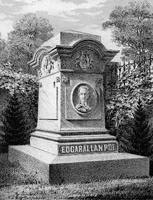
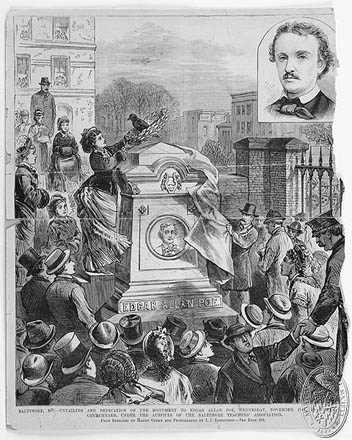
After over two decades buried in an unmarked corner of the cemetery at Baltimore's Westminster Church, Poe’s body was re-buried where people could see it from the street. A new memorial marker was dedicated on November 17, 1875.
 The monument was substantial. Money for it was raised by several parties, including a Baltimore schoolteacher named Sara Sigourney Rice. Rice kicked off a "pennies for Poe" campaign and even asked her students to perform public speeches to raise funds. The final $650 came from Philadelphian George William Childs. The design came from architect George A. Frederick, built by Colonel Hugh Sisson, with a stone medallion of Poe by artist Adalbert Volck (later replaced). The total cost of the new monument was equal today to over $28,000.
Despite all the hard work on the monument, Poe's birthday was incorrectly chiseled as January 20 instead of January 19. It has never been corrected. On his birthday ten years after his reburial, Poe's long-dead wife Virginia Poe was buried with him. Maria Clemm was buried there too, bringing the family trio together for their eternal rest.
The ceremony to dedicate the new monument included speeches from Neilson Poe, Poe's oft-maligned cousin. Several famous poets were invited to attend. The only one that made it was Walt Whitman, then age 56, who was still recovering from a stroke.
Letters, poems and remembrances were contributed his one-time fiancee Sarah Helen Whitman and his occasional enemy James Russell Lowell. Other acknowledgments came from John Greenleaf Whittier ("The extraordinary genius of Edgar Poe is now acknowledged the world over"), William Cullen Bryant (Poe is "distinguished alike for originality in the conception, skill in word-painting, and power over the mind of the reader") and even Henry Wadsworth Longfellow (who noted: "The fever called Living is conquered at last"). Some of the greatest lines in honor of Poe came from fellow 2009 bicentennial poets Alfred Lord Tennyson, who later said that "neglected spot" would be the first place he would visit on a trip to the United States, and Oliver Wendell Holmes. As Dr. Holmes wrote:
 The monument was substantial. Money for it was raised by several parties, including a Baltimore schoolteacher named Sara Sigourney Rice. Rice kicked off a "pennies for Poe" campaign and even asked her students to perform public speeches to raise funds. The final $650 came from Philadelphian George William Childs. The design came from architect George A. Frederick, built by Colonel Hugh Sisson, with a stone medallion of Poe by artist Adalbert Volck (later replaced). The total cost of the new monument was equal today to over $28,000.
Despite all the hard work on the monument, Poe's birthday was incorrectly chiseled as January 20 instead of January 19. It has never been corrected. On his birthday ten years after his reburial, Poe's long-dead wife Virginia Poe was buried with him. Maria Clemm was buried there too, bringing the family trio together for their eternal rest.
The ceremony to dedicate the new monument included speeches from Neilson Poe, Poe's oft-maligned cousin. Several famous poets were invited to attend. The only one that made it was Walt Whitman, then age 56, who was still recovering from a stroke.
Letters, poems and remembrances were contributed his one-time fiancee Sarah Helen Whitman and his occasional enemy James Russell Lowell. Other acknowledgments came from John Greenleaf Whittier ("The extraordinary genius of Edgar Poe is now acknowledged the world over"), William Cullen Bryant (Poe is "distinguished alike for originality in the conception, skill in word-painting, and power over the mind of the reader") and even Henry Wadsworth Longfellow (who noted: "The fever called Living is conquered at last"). Some of the greatest lines in honor of Poe came from fellow 2009 bicentennial poets Alfred Lord Tennyson, who later said that "neglected spot" would be the first place he would visit on a trip to the United States, and Oliver Wendell Holmes. As Dr. Holmes wrote:
His monument shall be his gentle verse,* People still leave "pennies for Poe" at this memorial today. This has become a tradition at the graves of famous figures, particularly writers. Poe did not originate the tradition, however.
Which eyes not yet created shall o'er read.
And tongues to be his being shall rehearse,
When all the breathers of this world are dead.
Sunday, November 1, 2009
The Boston Lyceum incident, cont'd
In October 1845, Poe made his triumphant return to Boston, the city of his birth, but that return was marred by what Poe termed a hoax. For his appearance at the Boston Lyceum, he was asked to present a new, original poem. Instead he presented "Al Aaaraf," one of his earliest poems, under the temporary title "The Messenger Star."
After the reading, Poe was invited to dinner with a gathering of Boston literati. "Over a bottle of champagne," he later wrote, he revealed to his fellow diners (including fellow speaker Caleb Cushing, critic Edwin Percy Whipple and publisher James T. Fields) that he had, in fact, read a "juvenile poem."
 Poe was immediately attacked for his strange choice in Boston, particularly by Miss Cornelia Wells Walter (pictured), editor of Boston's Evening Transcript. She wrote: "A poem delivered before a literary association of adults, as written by a boy! Only think of it! Poh! Poh!" This was only one of many accounts "Miss Walter" presented as she continuously attacked Poe, often with terrible puns. When Poe wrote in the Broadway Journal his account of the evening and his promise to return fire at the Boston press, she responded in the Evening Transcript: "The promise... is certainly very poe-tential. We thought the poet might possibly be poe-dagrical, but it seems he is intending to take time enough to become a poe-ser!"
One attendant of the Lyceum, Newburyport's William W. Caldwell, happily wrote to Poe about subscribing to his journal and praising "The Messenger Star" poem, despite "the silly abuse of the Boston Press."
Finally, on November 1, 1845, gives a substantial response to Miss Walter and others in Boston. "The adorable creature has been telling a parcel of fibs about us," he wrote, "by way of revenge for something that we did to Mr. Longfellow (who admires her very much) and for calling her 'a pretty little witch.'" He tells his version of the Lyceum incident, painting it as a success. According to Poe, he was "most cordially received" by his Boston audience and his reading was interrupted with several bursts of applause.
After the reading, Poe was invited to dinner with a gathering of Boston literati. "Over a bottle of champagne," he later wrote, he revealed to his fellow diners (including fellow speaker Caleb Cushing, critic Edwin Percy Whipple and publisher James T. Fields) that he had, in fact, read a "juvenile poem."
 Poe was immediately attacked for his strange choice in Boston, particularly by Miss Cornelia Wells Walter (pictured), editor of Boston's Evening Transcript. She wrote: "A poem delivered before a literary association of adults, as written by a boy! Only think of it! Poh! Poh!" This was only one of many accounts "Miss Walter" presented as she continuously attacked Poe, often with terrible puns. When Poe wrote in the Broadway Journal his account of the evening and his promise to return fire at the Boston press, she responded in the Evening Transcript: "The promise... is certainly very poe-tential. We thought the poet might possibly be poe-dagrical, but it seems he is intending to take time enough to become a poe-ser!"
One attendant of the Lyceum, Newburyport's William W. Caldwell, happily wrote to Poe about subscribing to his journal and praising "The Messenger Star" poem, despite "the silly abuse of the Boston Press."
Finally, on November 1, 1845, gives a substantial response to Miss Walter and others in Boston. "The adorable creature has been telling a parcel of fibs about us," he wrote, "by way of revenge for something that we did to Mr. Longfellow (who admires her very much) and for calling her 'a pretty little witch.'" He tells his version of the Lyceum incident, painting it as a success. According to Poe, he was "most cordially received" by his Boston audience and his reading was interrupted with several bursts of applause.
Thursday, October 29, 2009
Autographs, cont'd
Continued from a very, very early post in Poe Calendar Blog history.
The October 29, 1841 issue of the Philadelphia Inquirer reviewed Poe's recent chapter on "Autography" — an unusual work in which Poe analyzed the signatures of well-known literary figures and described the authors' personality based on them. The review called the chapter, "The most singular, and at the same time, the most interesting article" in Graham's Magazine that month. It also caused quite a stir, as some of the authors were not pleased by Poe's characterization.
Though Poe's attempts at "autography" date back to 1836, the review likely referred to a revival of the idea in the November 1841 issue of Graham's. If you're curious how they'd cause a stir, keep in mind that Poe is not a trained handwriting analyst. In fact, he's really just looking for an excuse to give his personal opinion on these people (and their writing, but not their handwriting). Here are a few entries from that issue:
*Actually, he was the Smith Professor of Modern Languages.
The October 29, 1841 issue of the Philadelphia Inquirer reviewed Poe's recent chapter on "Autography" — an unusual work in which Poe analyzed the signatures of well-known literary figures and described the authors' personality based on them. The review called the chapter, "The most singular, and at the same time, the most interesting article" in Graham's Magazine that month. It also caused quite a stir, as some of the authors were not pleased by Poe's characterization.
Though Poe's attempts at "autography" date back to 1836, the review likely referred to a revival of the idea in the November 1841 issue of Graham's. If you're curious how they'd cause a stir, keep in mind that Poe is not a trained handwriting analyst. In fact, he's really just looking for an excuse to give his personal opinion on these people (and their writing, but not their handwriting). Here are a few entries from that issue:
The MS. of Mr. IRVING has little about it indicative of his genius. Certainly, no one could suspect from it any nice finish in the writer's compositions; nor is this nice finish to be found. The letters now before us vary remarkably in appearance; and those of late date are not nearly so well written as the more antique. Mr. Irving has travelled much, has seen many vicissitudes, and has been so thoroughly satiated with fame as to grow slovenly in the performance of his literary tasks. This slovenliness has affected his hand-writing. But even from his earlier MSS. there is little to be gleaned, except the ideas of simplicity and precision. It must be admitted, however, that this fact, in itself, is characteristic of the literary manner, which, however excellent, has no prominent or very remarkable features.Poe was ultimately just taking part of the kind of literary gossip that was making the periodical industry thrive, be it in Philadelphia or New York, though the latter city really perfectly celebrity author gossip. For the rest of his "Chapters on Autography," visit the Poe Society of Baltimore.
Mr. BRYANT'S MS. puts us entirely at fault. It is one of the most common-place clerk's hands which we ever encountered, and has no character about it beyond that of the day-book and ledger. He writes, in short, what mercantile men and professional penmen call a fair hand, but what artists would term an abominable one. Among its regular up and down strokes, waving lines and hair-lines, systematic taperings and flourishes, we look in vain for the force, polish, and decision of the poet. The picturesque, to be sure, is equally deficient in his chirography and in his poetical productions.
Mr. HALLECK'S hand is strikingly indicative of his genius. We see in it some force, more grace, and little of the picturesque. There is a great deal of freedom about it, and his MSS. seem to be written currente calamo, but without hurry. His flourishes, which are not many, look as if thoughtfully planned, and deliberately, yet firmly executed. His paper is very good, and of a blueish tint — his seal of red wax.
Mr. WILLIS, when writing carefully, would write a hand nearly resembling that of Mr. Halleck ; although no similarity is perceptible in the signatures. His usual chirography is dashing, free, and not ungraceful, but is sadly deficient in force and picturesqueness.
It has been the fate of this gentleman to be alternately condemned ad infinitum, and lauded ad nauseam — a fact which speaks much in his praise. We know of no American writer who has evinced greater versatility of talent ; that is to say, of high talent, often amounting to genius ; and we know of none who has more narrowly missed placing himself at the head of our letters.
The paper of Mr. Willis's epistles is always fine and glossy. At present, he employs a somewhat large seal, with a dove, or carrier-pigeon, at the top, the word "Glenmary" at bottom, and the initials "N. P. W." in the middle.
H. W. LONGFELLOW, (Professor of Moral Philosophy* at Harvard,) is entitled to the first place among the poets of America — certainly to the first place among those who have put themselves prominently forth as poets. His good qualities are all of the highest order, while his sins are chiefly those of affectation and imitation — an imitation sometimes verging upon downright theft.
His MS. is remarkably good, and is fairly exemplified in the signature. We see here plain indications of the force, vigor, and glowing richness of his literary style; the deliberate and steady finish of his compositions. The man who writes thus may not accomplish much, but what he does, will always be thoroughly done. The main beauty, or at least one great beauty of his poetry, is that of proportion ; another, is a freedom from extraneous embellishment. He oftener runs into affectation through his endeavors at simplicity than through any other cause. Now this rigid simplicity, and proportion are easily perceptible in the MS., which, altogether, is a very excellent one.
Mrs. HALE is well known for her masculine style of thought. This is clearly expressed in her chirography, which is far larger, heavier, and altogether bolder than that of her sex generally. It resembles in a great degree that of Professor Lieber, and is not easily deciphered.
Mr. COOPER'S MS. is very bad — unformed, with little of distinctive character about it, and varying greatly in different epistles. In most of those before us a steel pen has been employed, the lines are crooked, and the whole chirography has a constrained and school-boyish air. The paper is fine, and of a bluish tint. A wafer is always used. Without appearing ill-natured, we could scarcely draw any inferences from such a MS. Mr. Cooper has seen many vicissitudes, and it is probable that he has not always written thus. Whatever are his faults, his genius cannot be doubted.
Mrs. E. F. ELLET has published one or two books, exclusively of a volume of poems, but is chiefly known to the literary world by her numerous contributions to the Magazines. As a translator from the Italian, she has acquired an enviable reputation. Her hand, of which the signature above scarcely conveys a full idea, is clear, neat, forcible and legible; just such a hand as one would desire for copying MSS. of importance. We have observed that the writers of such epistles as those before us, are often known as translators, but seldom evince high originality or very eminent talent of any kind.
*Actually, he was the Smith Professor of Modern Languages.
Friday, August 14, 2009
Poe's place in literary history
 Poe's place in literary history is occasionally questioned. Should he be considered a master of American literature? Does he deserve a place in the canon? Is he really important? I might be biased so take my opinion with a grain of salt (this post will shift away from my more academic tone and may, in fact, turn into starry-eyed gushing over my favorite author). Here's my argument: even if you remove the quality of Poe's work from the equation, Poe is one of the most important writers in American history.
The real evidence for this comes on August 14, 1835. It was on that date that the Trustees of the Richmond Academy began selecting their new English teacher. The fact that it was not Poe should solidify Poe's role in American literary history. Excluding his military stints, Poe only applied for two jobs outside of literature. The first was the job with the Richmond Academy teaching English. The second was a job with the Customs House in Philadelphia in 1841, hoping that a connection to Robert Tyler (brother of President John Tyler) would secure his employment. Neither role worked out. That means that Poe never had a job outside of literature; for his 40 short years, he would have no source of income besides his pen.
This is significant because no other major American writers in the first half of the United States were able to sustain themselves in such a manner. Washington Irving had a couple government jobs and was, for a time, part owner in a mercantile business. Henry Wadsworth Longfellow, James Russell Lowell, Oliver Wendell Holmes, and others held full-time teaching positions (at Harvard, in the case of all three). Nathaniel Hawthorne attempted to make a living as a farmer for a time before taking government jobs at two different Customs Houses (one in Boston, another in Salem, Massachusetts). Ralph Waldo Emerson had his ministry for a time and, later, a public lecturing career (he was also supported by an inheritance from the family of his first wife). Margaret Fuller struggled as a teacher in Providence before become a full-time journalist (and, then, nearly all of her writing was not literature but nonfiction).
Poe's financial failure is obvious. Nevertheless, his attempt is nothing less than historical, if not extraordinary. The fact that he stood the test of time is minor (so did the other writers I mentioned above) but, coupled with his lack of any other job outside of literature, Poe should be considered a trailblazer.
Odds were stacked against him, of course. The country was young, its literature younger, and the economy was not established for professional authors. Poe's critical work emphasized that the quality of American literature needed to improve and, as such, he fought against the puffing system which inhibited proper growth. He also railed against the lack of copyright (suggesting authors may as well slit their throats), the culture of republishing without authors' permission, and the tastes of American audiences which, he believed, did not recognize quality over popularity. All of these factors needed to change before an American could make money solely as an author. Poe missed out on those ideal conditions and did not survive into the American Renaissance of the 1850s. Even with all that, when he died at age 40, he showed no signs of turning away from his desired path.
For the sake of full disclosure, Poe was also hampered by bad decisions. He married before he had an established income and, in doing so, inherited not only a young wife but also a mother-in-law who needed his financial support (though, to Maria Clemm's credit, she occasionally provided minor assistance through odd jobs and, of course, begging). He also didn't stay in one place for too long, constantly moving when he needed to escape overdue rent payments or in an optimistic pursuit of greater opportunities — all the money he spent on rent and moving expenses could have been saved to buy a house. Other than that, he was thrifty, particularly in his clothing choices, but his challenges are already numerous.
Yes, Poe was a financial failure in his pursuit of the life of a professional author. But that failure was unprecedented — and it deserves our praise. Thanks to the Trustees of the Richmond Academy for (inadvertently) making it possible.
* Longfellow should be considered America's first successful professional poet as of 1854, when he retired from his professorship. However, Longfellow was gifted a mansion at age 35 thanks to his father-in-law and had saved up enough money from teaching for about 17 years before he had the solid footing to become a professional poet. Credit is deserved there as well, certainly, but he did not have the same challenges as Poe.
Wednesday, August 12, 2009
In memoriam: James Russell Lowell
 I have written about James Russell Lowell many times on this blog. He weaves in and out of the story of Poe so much, it's hard to separate the two. It's even harder, however, to distinctly categorize their relationship.
The December 1841 issue of Graham's Magazine printed Poe's first acknowledgment of Lowell, ten years his junior. In this edition of Poe's "Chapter on Autography," he wrote: "Mr. J. R. LOWELL, of Massachusetts, is entitled, in our opinion, to at least the second or third place among the poets of America. We say this on account of the vigor of his imagination — a faculty to be first considered in all criticism upon poetry." We know that Lowell was aware of the quick mention (though, for the series, Lowell's was a long entry) because he was given a heads-up by Charles J. Peterson in late October 1841.
When Poe read Lowell's "Rosaline" early the next year, Peterson reported that Poe was pleased and said "that no American poem equals it in the higher elements of song" and noted "Poe wishes to be remembered to you." In fact, it seems that it was through Peterson that Poe and Lowell first interacted — and for quite some time. In a letter dated February 17, 1842, Peterson notes "Poe laughed heartily when I told him you thought that he had a pique against Wakondah & its author" (e.g. Cornelius Mathews). And, in the same letter, "Poe sends his respects & says that he never allows personal love or hate to warp his criticisms." Why didn't the two just write directly to each other?
In fact, it seems the earliest extant direct correspondence is not until November 16, 1842, when Poe writes to Lowell offering to contribute to his new magazine, Pioneer ("The Tell-Tale Heart" will debut in its third issue). Poe praised the journal when it came out, noting it was edited "by a man whose genius and originality is at once the praise and wonder of his countrymen." Lowell later helped Poe correspond with Nathaniel Hawthorne, who Lowell convinced to be a contributor to the magazine Poe was founding, The Stylus.
Though they were cordial during this period and, in some cases, they praised one another, it's hard to call Poe and Lowell "friends." Certainly, by the mid 1840s, it would be even harder to do so. When Poe began his public attacks on Henry Wadsworth Longfellow, Lowell took the side of his friend and neighbor in Cambridge rather than Poe's. When Poe became one-third owner of the Broadway Journal and, later, sole owner, its founder Charles Frederick Briggs maligned Poe in private letters to his close friend James Russell Lowell — odd, considering Lowell helped secure Poe's partnership with his close friend Briggs (in fact, Lowell's A Fable for Critics was initially printed to raise money to help Briggs; in that poem, Lowell famously described Poe: "three fifths of him genius and two fifths sheer fudge"). Though Lowell had once referred to Poe's "genius," by 1845 he wrote to Briggs that "Poe, I am afraid, is wholly lacking in that element of manhood which, for want of a better name, we call character." Ouch.
Both sides are guilty for building enmity, and both were too proud and too stubborn to stop it from happening. I find it disappointing, as the two men could have been friends. Both were struggling writers interested in producing deep, important poetry. Both took serious care in writing their literary reviews (though each was also quite sensitive to being criticized). Each had a high appreciation of his own ability as a poet to the point of arrogance, mixed with an odd feeling of self-loathing when times got tough. Both had financial difficulties for much of their respective lives and ambitiously attempted to found a literary journal that would nudge American writing forward. Lowell's association with the abolitionists aside, this could have been a solid partnership.
Lowell died on August 12, 1891. Rest in peace, James Russell Lowell.
Thursday, August 6, 2009
Bicentennial of Tennyson
 Speaking of bicentennials, today marks the 200th birthday of Alfred, Lord Tennyson. Born August 6, 1809, Tennyson went on to become an important canonical poet not only in his native England, which granted him the title of Poet Laureate, but also worldwide. Among his most well-known works are "The Charge of the Light Brigade," "Ulysses," the lengthy In Memoriam A.H.H., and Idylls of the King.
Poe praised Tennyson's work profusely. His final assessment in 1845 was that Tennyson was "a poet, who (in our own humble, but sincere opinion,) is the greatest that ever lived." Years later, friend Lambert A. Wilmer recalled, "I never knew him to speak in warm terms of admiration of any poetical writer, except Alfred Tennyson." Poe even accused other poets of plagiarizing from Tennyson, including Henry Wadsworth Longfellow. Perhaps ironically, a London critic in 1844 suggested Poe was the one trying to be like Tennyson: "Poe is a capital artist after the manner of Tennyson; and approaches the spirit of his original more closely than any of them."
In 1886, speculating on a trip to the United States, Tennyson mentioned to an interviewer a certain spot that he wanted to see. He said, "There is one spot in your country which I should like to visit — a spot, which as your poet, Fitz-Greene Halleck, finely expressed it, is hallowed ground, a pilgrim shrine, a mecca of the mind." The interviewer assumed he meant Mount Vernon, the home of American icon George Washington. "No," Tennyson responded. "I mean a long-neglected spot in the provincial town of Baltimore, where the greatest American genius lies buried. I mean the grave of Edgar Allan Poe." Years earlier, in 1875, Tennyson provided a poem to be read at the dedication of Poe's memorial monument:
- Fate that once denied him,
- And envy that once decried him,
- And malice that belied him,
- Now cenotaph his fame.
Tuesday, July 21, 2009
The Martha arrives in the United States
After 36 days at sea, an 11-year old Edgar A. Poe returned to the United States on July 21, 1820. The ship, named Martha, left Liverpool on June 16; it docked in New York City just over a month later and, as the local newspaper reported, passengers included "J & F Allan, E A Poe," and others. "J & F Allan," of course, are John and Frances Allan — Poe's foster-parents.
John Allan brought the family to England to expand his mercantile business in 1815, shortly after trade was re-opened after the War of 1812. Poe spent five of his most important formative years abroad. He visited Scotland (where his foster-father was born) and was educated in several London schools, including a boarding school at Stoke Newington run by Rev. John Bransby (an experience later fictionalized in "William Wilson"; the character in that story also has a schoolmaster named Bransby).
For the Allan family, the five years in England were not successful. Frances Allan's health continued to deteriorate (in fact, in 1819, a year before their return trip, John Allan reported "Frances begins to think she will never be able to cross the Atlantic"; she dies ten years later) and the Liverpool branch was not prospering.
Nevertheless, the experience overseas must have been influential on the young Poe. Though several other American writers spent time in Europe (especially Washington Irving — who dined with John Allan while overseas — as well as Henry Wadsworth Longfellow, Nathaniel Hawthorne and James Russell Lowell), each of them visited in their adult years; only Poe spent a major portion of his childhood there. Though he would never return to Europe, his first-hand experience with long sea voyages likely inspired his later fictional sea tales, most notably The Narrative of Arthur Gordon Pym of Nantucket.
John Allan brought the family to England to expand his mercantile business in 1815, shortly after trade was re-opened after the War of 1812. Poe spent five of his most important formative years abroad. He visited Scotland (where his foster-father was born) and was educated in several London schools, including a boarding school at Stoke Newington run by Rev. John Bransby (an experience later fictionalized in "William Wilson"; the character in that story also has a schoolmaster named Bransby).
For the Allan family, the five years in England were not successful. Frances Allan's health continued to deteriorate (in fact, in 1819, a year before their return trip, John Allan reported "Frances begins to think she will never be able to cross the Atlantic"; she dies ten years later) and the Liverpool branch was not prospering.
Nevertheless, the experience overseas must have been influential on the young Poe. Though several other American writers spent time in Europe (especially Washington Irving — who dined with John Allan while overseas — as well as Henry Wadsworth Longfellow, Nathaniel Hawthorne and James Russell Lowell), each of them visited in their adult years; only Poe spent a major portion of his childhood there. Though he would never return to Europe, his first-hand experience with long sea voyages likely inspired his later fictional sea tales, most notably The Narrative of Arthur Gordon Pym of Nantucket.
Saturday, June 6, 2009
Poe's Penn Prospectus
On June 6, 1840, George Graham reported in the Saturday Evening Post that Edgar A. Poe had announced his plans to launch his own journal, the Penn Magazine. Graham, Poe's one-time boss at Graham's Magazine (Poe quit to pursue his own publishing venture; he would be replaced by Rufus Griswold) offered his best wishes: "The gentleman who issues the prospectus and proposes to be publisher and editor, is so well known in the literary world, that commendation would be useless... We wish him success in his new undertaking, and congratulate him."
The same week, the Pennsylvania Inquirer reported: "Edgar A. Poe, Esq. has just issued proposals for a monthly literary journal, to be called the 'Penn Magazine.'" Another notice was posted by the Philadelphia Gazette and several other newspapers. Support for the Penn was ample. Charles W. Alexander of the Daily Chronicle noted his pleasure at the idea that "Mr. Poe will again enter the field of literature." He noted that Poe "has a fund of talent" (a great phrase!) and offered his best wishes to Poe's success. "We ardently hope that he may succeed in his new enterprise," Alexander wrote. Critic Willis Gaylord Clark was inspired to write to, of all people, Henry Wadsworth Longfellow about his excitement over the idea:
If only Poe's dream came true! The closest he came was when he became, by default, the sole owner of the Broadway Journal. It ceased publication shortly after and Poe continued his quest to begin his magazine.
The same week, the Pennsylvania Inquirer reported: "Edgar A. Poe, Esq. has just issued proposals for a monthly literary journal, to be called the 'Penn Magazine.'" Another notice was posted by the Philadelphia Gazette and several other newspapers. Support for the Penn was ample. Charles W. Alexander of the Daily Chronicle noted his pleasure at the idea that "Mr. Poe will again enter the field of literature." He noted that Poe "has a fund of talent" (a great phrase!) and offered his best wishes to Poe's success. "We ardently hope that he may succeed in his new enterprise," Alexander wrote. Critic Willis Gaylord Clark was inspired to write to, of all people, Henry Wadsworth Longfellow about his excitement over the idea:
Mr. Edgar A. Poe will issue in this city on the first of January next, and continue thereafter in monthly numbers, 'The Penn Magazine.' Mr. Poe is a clear and vigorous writer; a discriminate and fearless critic, — and we shall be pleased to find him reigning in his own sphere, where his classic power and genuine good taste, untrammeled by base or palsying associations, shall have full scope and play. We do not doubt that the Penn Magazine will add to the reputation of its conductor, and do honor to its name.Many of these magazine printed the prospectus in question, usually as a paid advertisement. It read as follows:
Prospectus of the Penn magazine, a monthly literary journal, to be edited and published in the city of Philadelphia, by Edgar A. Poe. — To the Public... To those who remember the early years of the [Southern Literary] Messenger, it will be scarcely necessary to say that its main feature was [a] somewhat overdone causticity in its department of Critical Notices. The Penn Magazine will retain this trait of severity in so much only as the calmest and sternest sense of literary justice will permit. One or two years, since elapsed, may have mellowed down the petulance, without interfering with the rigor of the critic... It shall be the first and chief purpose of the Magazine now proposed, to become known as one where may be found, at all times, and upon all subjects, an honest and fearless opinion... The Penn Magazine will be published in Philadelphia, on the first of each month, and will form, half yearly, a volume of about 500 pages. The price will be $5 per annum, payable in advance, or upon the receipt of the first number...Though the Penn would never come to be, even in its later name The Stylus, it was a substantial dream for Poe to begin his new journal. What makes this potential business venture unique from other publications was the critic's fearless voice — a distinct response to the "puffing" which was rampant in American letters. This type of criticism was the selling point of Poe's journal — and was what Poe's supporters believed would lead to its success. Often, in modern times, we dismiss Poe's criticism as being too harsh — but it is this type of criticism which built Poe's reputation, gained the respect of fellow editors, and which would have launched his journal with tremendous support.
If only Poe's dream came true! The closest he came was when he became, by default, the sole owner of the Broadway Journal. It ceased publication shortly after and Poe continued his quest to begin his magazine.
Saturday, May 23, 2009
Margaret Fuller at 199
 On May 23, 1810, Timothy and Margaret (Crane) Fuller welcomed their first (of eight) children. They named her Sarah Margaret Fuller — it would not be long after that the precocious child demanded she be referred to only as "Margaret." In fact, in her professional career — which spanned education, journalism, criticism, poetry, etc. — she went by that name, rather than the more conventional etiquette which would have her named "Miss Fuller."
The relationship between Poe and Fuller was, like many of Poe's interactions, complicated. Despite some comments against Fuller (he once called her an "old maid" and a "busybody") and her involvement in a strange personal interaction (involving Frances Osgood; I'll tell that tale another time), I believe Poe sincerely admired her work.
The earliest interaction I found was, oddly, over James Russell Lowell, who later became a sort of literary rival for both Fuller and Poe. A critic for the Daily Tribune in New York (presumed to be Fuller) strongly disagreed with Poe's review of Lowell. Charles Frederick Briggs wrote to his friend Lowell on January 17, 1845, about the disagreement: "Poe's criticism about your Conversations [on Some of the Old Poets] was extremely laudatory and discriminating; it was the female ass of the Tribune [e.g. Fuller] that misunderstood him."
The same month, Fuller noted Lowell's critical/biographical sketch of Poe. She noted that the article ("frank" and "earnest") introduced her to some of Poe's poetry which she never read before. She liked "The Haunted Palace" and "To Helen" enough to reprint them in the Tribune. The latter, she writes, is "of such distinguished beauty in thought, feeling, and expression, that we might expect the life unfolded from such a bud to have the sweetness and soft lustre of a rose." She was always very honest in her opinions of Poe. Later in 1845, she reviewed The Raven and Other Poems and suggested they were "all fragments" — suggesting that he was capable of better poetry, "with the exception of The Raven, which seems intended chiefly to show the writer's artistic skill." Nevertheless, she notes that the poems "breathe a passionate sadness, relieved sometimes by touches very lovely and tender" and show "a sweep of images, thronging and distant like a procession of moonlight clouds on the horizon."
Poe, in turn, acknowledged Fuller's "high genius." In 1846, he commended her daring review of Henry Wadsworth Longfellow. As he wrote, "it is one of the very few reviews of Longfellow's poems, ever published in America, of which the critics have not had abundant reason to be ashamed." When Fuller published Woman in the Nineteenth Century, her definitive work (regarded as the first major feminist work in the United States), Poe praised her fortitude. He called it "a book which few women in the country could have written, and no woman in the country would have published, with the exception of Miss Fuller." He particularly praised her for not manufacturing a false public persona. Instead, he wrote, her "personal character and her printed book are merely one and the same thing."
Happy 199th birthday to Margaret Fuller — a woman well ahead of her time! All the best for her bicentennial next year, in 2010!
Sunday, May 17, 2009
"Insufferable trash... one of the most delightful books"
On May 17, 1845, The Town, a New York weekly, poked fun at Edgar A. Poe, who was in town working at the Broadway Journal. It featured a mock review, found "Astray from the office of the Broadway Journal" of the (fictitious) book The Adventures, Life and Opinions of John Smith. The Poe-like reviewer notes the work "a mass of insufferable trash, without one redeeming quality." Nevertheless, it is "one of the most delightful books... printed in a beautiful arabesque style by Wiley & Putnam."
The hilarious little stab at Poe was noting how his reviews always seem to fall in both positive and negative categories: even as he praises a writer, he still damns them. It is, of course, quite a true observation, and it's one of the many details I point out to folks who think Poe simply "hated" or "loved" certain other writers. The reality is, he always found ways to both praise and criticize nearly everyone. Such is the case with Rufus Griswold's The Poets and Poetry of America in 1842, which many categorize as a negative review outright — in fact, Poe loved the anthology and thought it a major turning point in American poetry, though he noted a few errors in judgment on the part of its editor. The same is also true for Poe's reviews of Henry Wadsworth Longfellow, which people seem to take for granted as "Poe hated Longfellow." Again, it's much more complicated.
But, before you think that Poe was being hypocritical or noncommittal, keep in mind the context here. The world of American literary criticism was slow to develop and, in a sense, Poe was moving against the grain. Writers like Margaret Fuller noted "the mutual admiration society" — a climate where reviewers praised to the point of absurdity, without any mark of sincerity. Such reviews, many felt, were detrimental to the advancement of American letters. At a time when Europeans were asking "Who reads an American book?", people like Poe (and Fuller) were trying to encourage writers to work harder and not just idly assume that their writing was good enough (clearly, it wasn't!).
I haven't found much information about The Town, but the Poe Log refers to it as a weekly magazine devoted to satirizing the New York literati. It's first mention of Poe seems to be in February 1845, when it notes Poe's plans to start a new magazine (presumably The Stylus, which was a dream never to come true). The writer noted Poe was "the most interesting and original of Magazine writers, and a fearless critic." When Poe became affiliated with the Evening Mirror that same month, The Town reported that they "rejoice at the fact" — especially because his style of criticism would relieve "much of the Miss Nancyism of [N. P.] Willis" and add "a more manly vigor" to the reviews. They nevertheless note their disagreement with Poe's review of Edward Bulwer-Lytton. Poe had denied the poet's genius, suggesting he was instead merely a clever fellow. The Town suggested Poe "ought to hurry express haste to Washington and get out a patent right for his Discovery." The point is: Poe's negativity looked strange to people who were used to "puffing" (Griswold, by the way, once noted to James Thomas Fields that he "puffed," or gave empty praise to, all the books Fields published, regardless of quality).
By the way, the satire of Poe's criticism happens to use the name "John Smith" in the title of their fictitious book. "John Smith" is also a character in Poe's 1849 comedy story "X-ing a Paragrab" who eventually takes revenge on his newfound rival publisher.
The hilarious little stab at Poe was noting how his reviews always seem to fall in both positive and negative categories: even as he praises a writer, he still damns them. It is, of course, quite a true observation, and it's one of the many details I point out to folks who think Poe simply "hated" or "loved" certain other writers. The reality is, he always found ways to both praise and criticize nearly everyone. Such is the case with Rufus Griswold's The Poets and Poetry of America in 1842, which many categorize as a negative review outright — in fact, Poe loved the anthology and thought it a major turning point in American poetry, though he noted a few errors in judgment on the part of its editor. The same is also true for Poe's reviews of Henry Wadsworth Longfellow, which people seem to take for granted as "Poe hated Longfellow." Again, it's much more complicated.
But, before you think that Poe was being hypocritical or noncommittal, keep in mind the context here. The world of American literary criticism was slow to develop and, in a sense, Poe was moving against the grain. Writers like Margaret Fuller noted "the mutual admiration society" — a climate where reviewers praised to the point of absurdity, without any mark of sincerity. Such reviews, many felt, were detrimental to the advancement of American letters. At a time when Europeans were asking "Who reads an American book?", people like Poe (and Fuller) were trying to encourage writers to work harder and not just idly assume that their writing was good enough (clearly, it wasn't!).
I haven't found much information about The Town, but the Poe Log refers to it as a weekly magazine devoted to satirizing the New York literati. It's first mention of Poe seems to be in February 1845, when it notes Poe's plans to start a new magazine (presumably The Stylus, which was a dream never to come true). The writer noted Poe was "the most interesting and original of Magazine writers, and a fearless critic." When Poe became affiliated with the Evening Mirror that same month, The Town reported that they "rejoice at the fact" — especially because his style of criticism would relieve "much of the Miss Nancyism of [N. P.] Willis" and add "a more manly vigor" to the reviews. They nevertheless note their disagreement with Poe's review of Edward Bulwer-Lytton. Poe had denied the poet's genius, suggesting he was instead merely a clever fellow. The Town suggested Poe "ought to hurry express haste to Washington and get out a patent right for his Discovery." The point is: Poe's negativity looked strange to people who were used to "puffing" (Griswold, by the way, once noted to James Thomas Fields that he "puffed," or gave empty praise to, all the books Fields published, regardless of quality).
By the way, the satire of Poe's criticism happens to use the name "John Smith" in the title of their fictitious book. "John Smith" is also a character in Poe's 1849 comedy story "X-ing a Paragrab" who eventually takes revenge on his newfound rival publisher.
Monday, April 27, 2009
Emerson, Transcendentalism, and Poe
 Ralph Waldo Emerson has become the figurehead of American Transcendentalism. Even in his lifetime, he was the face of the movement, even though several others were important participants; many of those names are not commonly known today (anyone remember Orestes Brownson, Christopher Pearse Cranch, Frederick Henry Hedge, Sylvester Judd, Jones Very...?). Emerson was considered to be one of the greatest minds of the 19th century. However, when he died on April 27, 1882, not much of that mind was left.
Emerson suffered from some form of dementia, speculated by some to be Alzheimer's. He certainly had aphasia — his memory could no longer find the words for simple objects and concepts. When he attended the funeral of his good friend Henry Wadsworth Longfellow only a month before his own death, Emerson reportedly said something to the effect of: "Today we bury a great man. I do not remember his name." Emerson was also forgetting his own name. When asked how he felt around this time, he once answered: ""Quite well; I have lost my mental faculties, but am perfectly well."
These final years of Emerson aren't often discussed.* Of course, Edgar A. Poe never knew Emerson at this late stage in his life. Poe knew of Emerson when he was in his prime. Poe, just like people today, saw Emerson as the icon of Transcendentalism - and that made him a target.
Poe's utter dislike of Transcendentalism was no secret (he once took a swipe at Nathaniel Hawthorne, who he otherwise respected, simply for living in Concord, Massachusetts — the seat of the movement), and his particular disgust with Emerson was equally well-known. Poe chided the Concord Sage for writing that was purposely difficult to understand — "mysticism for mysticism's sake," as Poe referred to it. Poe also identified (and he was a bit right) that Emerson was "little more than a respectful imitation of [Thomas] Carlyle."
Overall, Transcendentalism and its avowed idealism didn't make sense to Poe (nor does it make sense to most high schoolers introduced to it). As he wrote, "They could not define their own position & cannot be expected that I can define them exactly." However, he noted that their philosophy wasn't inherently bad. "You mistake me in supposing I dislike the transcendentalists," he wrote to friend Thomas Holley Chivers. "It is only the pretenders and sophists among them." When the Transcendental community at Brook Farm began publishing their journal, The Harbinger, to promote their worldview, Poe wrote it was "conducted by an assemblage of well-read persons who mean no harm—and who, perhaps, can do no less." True enough.

Eventually, Poe looped all of the Boston area with Transcendentalism (and a general Longfellow-like lack of originality). So, feel free to blame Emerson for at least part of Poe's distaste for Boston in his adult years. Next month (May 25), I'll follow up with a battle of poetry, Emerson vs. Poe.
Perhaps ironically, today, the City of Boston dedicates "Edgar Allan Poe Square" at the intersection of Charles St. and Boylston St. near his original birthplace, directly across from the Boston Common. I'm sure the ceremony was scheduled on the anniversary of Emerson's death by mere coincidence.
*I am of the opinion that Emersonians have, for years, been cleaning up his image. Hiding his struggle with dimentia - or the fact that he was not perfect - does not help him. It would be better to humanize him, rather than try to deify him.
Sunday, April 19, 2009
Griswold and Graham's
It's hard to tell for certain when the first edition of The Poets and Poetry of America hit book stores. It wasn't until April 18, 1842, however that the anthology's editor, Rufus Wilmot Griswold, was informed by publishers that it was finally published. As Carey & Hart (Philadelphia) wrote to Griswold (in New York): "We have at last published the 'Poets & Poetry of America' & a handsome Book it is."
The publisher must have rushed copies to important or influential literary figures on that first day. George Rex Graham in Philadelphia, the proprietor of the very popular Graham's Magazine, almost immediately jumped to take advantage of the rising star of Griswold. He wrote only a day later, April 19, 1842:
"Have you fully determined on assuming the Chaplaincy* and to abandon the editorial chair? Or could you find it in your heart to locate in Philadelphia? Let me hear from you, as I have a proposal to make. I like your book very much. We received it from Carey & Hart on yesterday, and although it will give offense to a few, it must be popular, and it will please every man of taste."
Graham had recently parted ways with his famous editor, Edgar Poe, who had miraculously increased circulation to 40,000, but resigned in late March. What really drove sales up was Poe's infamous critical review style, which was somewhat controversial. The Arcturus (edited by Cornelius Mathews and Evert Augustus Duyckinck) noted Poe's reviews as "elaborate" and "richly deserving of attention," though he was "somewhat over literal and minute, looking oftener to the letter than the spirit."Joseph Evans Snodgrass in the Saturday Visiter in Baltimore wrote that Poe was "an excellent reviewer" even though he was "at times, provokingly hypercritical." James Russell Lowell was a little less euphemistic and wrote that Poe occasionally mistook "his phial of prussic acid for his inkstand."

The "proposal" Graham wanted to offer Griswold was Poe's former role. Griswold seems to have accepted without hesitation and moved to Philadelphia to take the job with Graham's (leaving his family behind in New York). The transition was so quick, a rumor persisted (and still does in some circles) that Poe came to clean out his desk and saw Griswold already sitting there. The rumor is quite untrue. Nevertheless, Griswold was paid $1000 — $200 more per year than Poe — likely building up some of the animosity between the two.
Griswold's run on Graham's was significantly less successful than Poe's. Though he was able to bring in substantial writers (including James Fenimore Cooper and Henry Wadsworth Longfellow), he never earned much respect there. In fact, a year after he took over, George Lippard wrote, "It was Mr. Poe that made Graham's Magazine what it was a year ago; it was his intellect that gave this now weak and flimsy periodical a tone of refinement and mental vigor."
*Griswold had recently earned the title of "Reverend," though he never had a regular congregation.
The publisher must have rushed copies to important or influential literary figures on that first day. George Rex Graham in Philadelphia, the proprietor of the very popular Graham's Magazine, almost immediately jumped to take advantage of the rising star of Griswold. He wrote only a day later, April 19, 1842:
"Have you fully determined on assuming the Chaplaincy* and to abandon the editorial chair? Or could you find it in your heart to locate in Philadelphia? Let me hear from you, as I have a proposal to make. I like your book very much. We received it from Carey & Hart on yesterday, and although it will give offense to a few, it must be popular, and it will please every man of taste."
Graham had recently parted ways with his famous editor, Edgar Poe, who had miraculously increased circulation to 40,000, but resigned in late March. What really drove sales up was Poe's infamous critical review style, which was somewhat controversial. The Arcturus (edited by Cornelius Mathews and Evert Augustus Duyckinck) noted Poe's reviews as "elaborate" and "richly deserving of attention," though he was "somewhat over literal and minute, looking oftener to the letter than the spirit."Joseph Evans Snodgrass in the Saturday Visiter in Baltimore wrote that Poe was "an excellent reviewer" even though he was "at times, provokingly hypercritical." James Russell Lowell was a little less euphemistic and wrote that Poe occasionally mistook "his phial of prussic acid for his inkstand."

The "proposal" Graham wanted to offer Griswold was Poe's former role. Griswold seems to have accepted without hesitation and moved to Philadelphia to take the job with Graham's (leaving his family behind in New York). The transition was so quick, a rumor persisted (and still does in some circles) that Poe came to clean out his desk and saw Griswold already sitting there. The rumor is quite untrue. Nevertheless, Griswold was paid $1000 — $200 more per year than Poe — likely building up some of the animosity between the two.
Griswold's run on Graham's was significantly less successful than Poe's. Though he was able to bring in substantial writers (including James Fenimore Cooper and Henry Wadsworth Longfellow), he never earned much respect there. In fact, a year after he took over, George Lippard wrote, "It was Mr. Poe that made Graham's Magazine what it was a year ago; it was his intellect that gave this now weak and flimsy periodical a tone of refinement and mental vigor."
*Griswold had recently earned the title of "Reverend," though he never had a regular congregation.
Thursday, March 19, 2009
Poe reviews Longfellow
For my 50th post, I'd like to give you Poe's own words. For those who don't know what to make of third-hand accounts of Poe's criticism of Henry Longfellow: here it is, straight from the horse's mouth, so to speak. The following is Poe's actual review from my personal copy of Graham's Magazine, March 1842, of Ballads and Other Poems. By Henry Wadsworth Longfellow, Author of "Voices of the Night," "Hyperion," etc. This has been edited somewhat for length but I have not altered the spirit of the review (including, in typical Poe fashion, the philosophical argument he uses for introduction and his "show off" discussion of language):
One would be safe in wagering that any given public idea is erroneous, for it has been yielded to the clamor of the majority; —and this strictly philosophical, although somewhat French assertion has especial bearing upon the whole race of what are termed maxims and popular proverbs; nine-tenths of which are the quintessence of folly. One of the most deplorably false of them is the antique adage, De gustibus non est disputandum — there should be no disputing about taste. Here the idea designed to be conveyed is that any one person has as just right to consider his own taste the true, as has any one other — that taste itself, in short, is an arbitrary something, amenable to no law, and measurable by no definite rules. It must be confessed, however, that the exceedingly vague and impotent treatises which are alone extand have much to answer for as regards confirming the general error. Not the least important service which, hereafter, makind will owe to Phrenology, may perhaps, be recognized in an analysis of the real principles, and a digest of the resulting laws of taste.
...
[Extracts from "The Skeleton in Armor," "Endymion," and possibly others I don't recognize.]
And there you have it — Poe's awful, terrible, mean-spirited, jealous rage in which he damns Longfellow... by calling him a genius to whom he offers earnest love and admiration. Yes, there are a few left-handed compliments in there, but he is noting that Longfellow is, after all, a good poet — who happens to be stuck in the rut of didacticism, something which Poe hates. Again, I emphasize that Poe's concern with Longfellow is based on poetic theory. What's important here, of course, is that Poe is emphasizing that all of this is just his personal opinion, which he has every right to offer, even if it is opposite popular opinion (hence the long introduction). I also love the comparison to James Russell Lowell, who may have (in part) spurred the later Longfellow War by instigating Poe.
My paper on the Poe-Longfellow War, in which I will return to contemporary responses (Lowell, Margaret Fuller, Charles Frederick Briggs, Rufus Griswold, and others) has just been accepted by the Poe Studies Association. This means I will have the honor of presenting at the Poe Bicentennial Conference in Philadelphia this fall.
Happy 50th blog post, fellow Poeists!
One would be safe in wagering that any given public idea is erroneous, for it has been yielded to the clamor of the majority; —and this strictly philosophical, although somewhat French assertion has especial bearing upon the whole race of what are termed maxims and popular proverbs; nine-tenths of which are the quintessence of folly. One of the most deplorably false of them is the antique adage, De gustibus non est disputandum — there should be no disputing about taste. Here the idea designed to be conveyed is that any one person has as just right to consider his own taste the true, as has any one other — that taste itself, in short, is an arbitrary something, amenable to no law, and measurable by no definite rules. It must be confessed, however, that the exceedingly vague and impotent treatises which are alone extand have much to answer for as regards confirming the general error. Not the least important service which, hereafter, makind will owe to Phrenology, may perhaps, be recognized in an analysis of the real principles, and a digest of the resulting laws of taste.
...
In the present number of our Magazine we have left ourselves barely room to say a few random words of welcome to these "Ballads," by Longfellow, and to tender him, and all such as he, the homage of our most earnest love and admiration.
The volume before us (in whose outward appearance lies the keen "taste" of genius is evinced with nearly as much precision as in its internal soul) includes, with several brief original pieces, a translation from the Swedish of Tegner. In attempting (what never should be attempted) a literal version of both the words and the metre of this poem, Professor Longfellow has failed to do justice either to his author or himself. He has striven to do what no man ever did well and what, from the nature of language itself, never can be well done. Unless, for example, we shall come to have an influx of spondees in our English tongue, it will always be impossible to construct an English hexameter. Our spondees, or, we should say, our spondaic words, are rare. In the Swedish they are nearly as abundant as in the Latin and Greek...
But within the narrow compass now left us we must not indulge in anything like critical comment. Our readers will be satisfied perhaps with a few brief extracts from the original poems of the volume — which we give for their rare excellence, without pausing now to say in what particulars this excellence exists.
[Extracts from "The Skeleton in Armor," "Endymion," and possibly others I don't recognize.]
Some of these passages cannot be fully appreciated apart from the context — but we address these who have read the book. Of the translations we have not spoken. It is but right to say, however, that "The Luck of Edenhall" is a far finer poem, in every respect, than any of the original pieces. Nor would we have our previous observations misunderstood. Much as we admire the genius of Mr. Longfellow, we are fully sensible of his many errors of affectation and imitation. His artistical skill is great, and his ideality high. But his conception of the aims of poesy is all wrong; and this we shall prove at some future day — to our own satisfaction, at least. His didactics are all out of place. He has written brilliant poems — by accident; that is to say when permitting his genius to get the better of his conventional habit of thinking — a habit deduced from German study. We do not mean to say that a didactic moral may not be well made the under-current of a poetical thesis; but that it can never be well put so obtrusively forth, as in the majority of his compositions. There is a young American who, with ideality not richer than that of Longfellow, and with less artistical knowledge, has yet composed far truer poems, merely through the greater propriety of his themes. We allude to James Russell Lowell; and in the number of this Magazine for last month, will be found a ballad entitled "Rosaline," affording an excellent exemplification of our meaning. This composition has unquestionably its defects, and the very defects which are never perceptible in Mr. Longfellow — but we sincerely think that no American poems equals it in the higher elements of song.----
And there you have it — Poe's awful, terrible, mean-spirited, jealous rage in which he damns Longfellow... by calling him a genius to whom he offers earnest love and admiration. Yes, there are a few left-handed compliments in there, but he is noting that Longfellow is, after all, a good poet — who happens to be stuck in the rut of didacticism, something which Poe hates. Again, I emphasize that Poe's concern with Longfellow is based on poetic theory. What's important here, of course, is that Poe is emphasizing that all of this is just his personal opinion, which he has every right to offer, even if it is opposite popular opinion (hence the long introduction). I also love the comparison to James Russell Lowell, who may have (in part) spurred the later Longfellow War by instigating Poe.
My paper on the Poe-Longfellow War, in which I will return to contemporary responses (Lowell, Margaret Fuller, Charles Frederick Briggs, Rufus Griswold, and others) has just been accepted by the Poe Studies Association. This means I will have the honor of presenting at the Poe Bicentennial Conference in Philadelphia this fall.
Happy 50th blog post, fellow Poeists!
Friday, February 27, 2009
Longfellow damns censorious Poe
 America's most beloved poet for the majority of the 19th century was Henry Wadsworth Longfellow, who was born this day, February 27, back in 1807. The relationship between Longfellow and Poe — if it can be called that — has become somewhat infamous. Poe made many strong statements against Longfellow (to put it lightly), and people today consider his "war" on Longfellow an example of Poe's declining mental health, a sign of his raging jealousy of successful poets, or of his endless enmity towards all things Boston.
Those superficial interpretations are great examples of how we oversimplify parts of Poe's life.
Poe and Longfellow never met face-to-face, though they certainly corresponded. As an editor, Poe contacted him to urge him to submit to Graham's Magazine (he did, but moreso under Poe's successor Rufus Griswold). Longfellow was one of the most popular poets of the day and, shortly after Poe's death, did what Poe was never able to do: sustain himself financially solely as a poet — no small feat!
Poe's criticism began as early as 1840, after Longfellow had published his collection Voices of the Night (unlike many poets of his generation, Longfellow generally released books of brand new poetry, rather than releasing piecemeal in magazines then collecting the so-called "fugitive" poems later; he had this option because he had a full-time job as a Harvard professor and didn't need constant money from his writing like Poe did). Poe noted that one particular poem in the collection was very similar to one by Lord Tennyson. He wrote (anonymously) of it as the "most barbarous class of literary robbery; that class in which, while the words of the wronged author are avoided, his most intangible, and therefore least defensible and least reclaimable property is purloined." The so-called "Longfellow War" continued with several accusations of plagiarism throughout the 1840s, especially in the Broadway Journal while Poe was its editor. It became such a heated feud that others, including James Russell Lowell and Margaret Fuller, jumped in and took sides (the former took Longfellow's, the latter took Poe's). The oddest to join in was the pseudonymous "Outis" (translates to "nobody") — which generally is agreed to be Poe himself as an attempt at keeping the spotlight a bit longer. But, even the friendly, non-confrontational Nathaniel Parker Willis noted that Longfellow was too free from criticism and that the controversy would "do him good to rouse him."
Critics or readers who think the Longfellow War is about plagiarism are overstating things. When Poe used the term "plagiarism," it didn't mean what it does today. In fact, it was the opposite of "originality." Like that quote above makes clear, it's not a word-for-word theft, but a theft of poetic ideas.
Poe was strung up as a bad guy in all of this, and critics and scholars today refer to it as Poe's attempt to destroy his own reputation — his "imp of the perverse," if you will. Others say it shows Poe was merely jealous of success, or he was inspired by his hatred of New England and the Boston elite literary circle. Even in Poe circles, there is no consensus and it still brings up debate. Longfellow, on the other hand, universally comes out squeaky clean, and didn't actually engage in the feud personally. After Poe's death, Longfellow noted that all was forgiven and called him "richly endowed with genius." He added, famously: "The harshness of his criticisms, I have never attributed to anything but the irritation of a sensitive nature, chafed by some indefinite sense of wrong."
Longfellow never publicly responded, but he did make an obscure response, which I have yet to see noted by Poe scholars. In his journal in 1845, Longfellow wrote a line in verse: "In Hexameter sings serenely a Harvard professor / In Pentameter him damns censorious Poe." Amidst these accusations of imitation, Longfellow carefully noted that this impromptu couplet was an imitation of another poem, thereby admitting his guilt as a plagiarist.
And it's quite true: Longfellow often lifted ideas from other poems. He was incredibly well-read and often paid homage to his influences. He wasn't ground-breaking as a poet; he did not significantly experiment with poetic structure or invent anything new. Instead, he went back to classic poems — especially European poems — and copied their meter. Remember, of course, that this was a time (the 1840s in particular) where we as Americans were really trying to define and create an American literature — Emerson asked for it, as did Lowell and Fuller. But, instead of trying to be distinctly American, Longfellow said he was trying to be "universal" (read: "European"). Poe, on the other hand, was part of this newly-developing world of American literature that, as Emerson said, aimed to be "free" from the "courtly muses of Europe."
So, was Poe right?
If anyone is interested, I will be speaking much more in-depth on "A War of the Words: Poe's Battle With Longfellow" on Thursday, April 9 at the Cambridge Center for Adult Education, Brattle Street in Cambridge, Massachusetts (the former home of Margaret Fuller!). The lecture is free and open to the public. Later, in October, I'll be making a similar presentation at the Poe Bicentennial Conference in Philadelphia.
In the meantime, I cheerily wish Henry Wadsworth Longfellow a happy 202nd birthday.
Sunday, February 22, 2009
A Fable for James Russell Lowell
 It was on this day in 1819 that James Russell Lowell was born. Over the next 72 years, he would lead a diverse life — as a professor, a poet, an editor, a critic, an ambassador, and as an ardent abolitionist. His most famous connection to Poe comes from his book-length satirical poem A Fable for Critics,* in which he writes:
There comes Poe with his Raven, like Barnaby Rudge,
Three fifths of him genius and two fifths sheer fudge,
Who talks like a book of iambs and pentameters,
In a way to make people of common sense damn metres,
Who has written some things quite the best of their kind,
But the heart somehow seems all squeezed out by the mind,
Who — But hey-day! What's this? Messieurs [Cornelius] Mathews and Poe,
You mustn't fling mud-balls at Longfellow so (But, more on him in a few days)...
Poe did not leave this mention unanswered. He reviewed A Fable for Critics (rather late) in March 1849 for the Southern Literary Messenger. Unfortunately, Poe proves Lowell's characterization to be accurate by spending far too much time writing about the Fable's structure and poetic meter: "Mr. L. should not have meddled with the anapaestic [sic] rhythm; it is exceedingly awkward in the hands of one who knows nothing about it and who will persist in fancying that he can write it by ear." He also spends too much time judging Lowell's abolitionism rather than looking at the poem independently. Reading the review, I keep thinking, "Lighten up, Poe! It's a joke!" Having read A Fable for Critics, I have to say, I always laugh like crazy, regardless of what meter he used — though I'd agree with Poe that Lowell's attempt at a "plot" is weak.
It's easy to assume from this information that Lowell hated Poe and Poe hated Lowell. But, as is often the case, things are quite a bit more complicated than that.
Poe actually liked Lowell's poetry. For one example, well before Lowell's potshot against him, Poe wrote that he was surprised Rufus Griswold didn't dedicate more space to Lowell in the ground-breaking anthology The Poets and Poetry of America in 1842 (Griswold actually gave Lowell less space by the 1851 edition). A bit earlier, in the December 1841 issue of Graham's Magazine, Poe ranked Lowell to "at least the second or third place among the poets of America. We say this on account of the vigor of his imagination — a faculty to be first considered in all criticism upon poetry" (though, even here, he notes that Lowell doesn't quite have an ear for meter).
I believe Poe appreciated Lowell because of similar aesthetic theories (very disparate from Lowell's close friend Longfellow's theories, but more on that in an upcoming entry). Besides the spirits and sadness in some of Lowell's works which Poe undoubtedly appreciated, Lowell placed the aesthetic beauty of a poem as its foremost quality. He also believed that the poet held a special role because he had an insight that the general population lacked. Poe must have agreed; he once wrote, a writer must "explain the unexplainable."
 Lowell and Poe had a falling out for a couple of reasons. For one, Lowell was a New Englander (Elmwood, at right, is where he lived the majority of his life, from birth to death, in Cambridge, MA) and, like many New Englanders, was an abolitionist — a quick turn-off to Southerners like Poe ("Out from the land of bondage 'tis decreed our slaves shall go," Lowell wrote in the poem "On the Capture of Fugitive Slaves Near Washington" in 1845). Additionally, Lowell was sucked into that dreaded idea that poetry should teach lessons (like Longfellow believed) or that poetry could be used for social reform (like Emerson and the Transcendentalists believed). Poe hated both didacticism and Transcendentalism, and the snot-nosed Boston literary culture that embraced Emerson, Longfellow, and Lowell.
This dislike of New England came to a head in the mid-1840s, when Poe paid special critical attention to Lowell's good friend and neighbor Henry Wadsworth Longfellow. Too endeared by Longfellow to look at Poe's criticism objectively, he took his neighbor's side in the conflict. And that endearment is what led to the quote from A Fable for Critics above.
Even amidst the beginnings of the "Longfellow War," however, in 1843 Lowell was the first to publish Poe's now-famous story "The Tell-Tale Heart" in his short-lived journal Pioneer. The journal only lasted three issues and, upon its cancellation, Poe lamented it as "a most severe blow to the cause—the cause of a Pure Taste." In fact, the prospectus for the Pioneer sounds strikingly like the prospectus for Poe's dream-project The Stylus. Around this time, Lowell also referred to Poe as having "that indescribable something which men have agreed to call genius.” Lowell later helped Poe find his way to a role at the Broadway Journal because of his connection to a very good friend named Charles Frederick Briggs (to whom A Fable for Critics was dedicated). Shortly after, Lowell helped set-up a prestigious speaking engagement for Poe in Boston in late 1845. Of course, Poe's "Messenger Star" poem turned out to be... well, that will be a post for another day, perhaps.
In the meantime — if I haven't bored you too much already — here's a great example of Lowell's more typical poetry, an excerpt from "To the Dandelion":
Dear common flower, that grow'st beside the way,
Fringing the dusty road with harmless gold,
First pledge of blithesome May,
Which children pluck, and, full of pride, uphold,
High-hearted buccaneers, o'erjoyed that they
An Eldorado in the grass have found.
Or, perhaps, an excerpt from "The Syrens":
The sea is lonely, the sea is dreary,
The sea is restless and uneasy;
Thou seekest quiet, thou art weary,
Wandering thou knowest not whither;—
Our little isle is green and breezy,
Come and rest thee! O come hither!
Come to this peaceful home of ours
Where evermore
The low west-wind creeps panting up the shore
To be at rest among the flowers;
Full of rest, the green moss lifts,
As the dark waves of the sea
Draw in and out of rocky rifts,
Calling solemnly to thee
With voice deep and hollow,—
"To the shore
Follow! O follow!
To be at rest forevermore!
For evermore!"
Happy birthday, James Russell Lowell.*
 Above: Your fearless blogger paying his respects at the grave of James Russell Lowell, Mount Auburn Cemetery
* I had difficulty finding a full version of the Fable online so I started transposing it from an 1888 edition I own (you're welcome).
**My apologies for the extra-long entry. Poe and Lowell intertwine so much and, from there, branch out into so many other stories; the number of tags on this post has to be a record-breaker. And, of course, I am a big fan of Lowell (not just Poe)!
Wednesday, February 18, 2009
Upcoming lectures
Looking for some of Rob's famous Poe-expertise outside the electronic/digital realm? Here are some "real world" appearances and lectures coming up:
"Poe and the Maritime Literary Tradition"
Wednesday, March 4 at 7:00 p.m.
160 Derby Street, Salem, Massachusetts
Part of a maritime lecture series by the schooner Fame and Salem Maritime National Park
Join Rob Velella, creator of the Edgar Allan Poe Bicentennial Desk Calendar, to discuss why sea adventures were popular, how Poe was inspired to write several of his own, Poe's personal experience of the sea, and how one particularly famous sailor who has a link to Salem's Friendship may have a connection to Poe`s mysterious (and as yet unsolved) death in 1849.
"A War of the Words: Poe's Battle With Longfellow"
Thursday, April 9 at 7:00 p.m. (I'll confirm the time later)
Cambridge Center for Adult Education, Brattle Street in Cambridge, Massachusetts
In the 1840s, at the height of his literary fame, Edgar Allan Poe publicly accused Henry Wadsworth Longfellow of being a weak poetic imitator. Poe's infamous conflict with the Brattle Street poet drew the attention of other writers with deep connections to Cambridge. Was Poe right or was he just jealous? This discussion will reexamine the various theories behind Poe's accusations and determine his true motivation.
"Edgar A. Poe's Friends and Enemies: A Walk Among the Dead"
Sunday, April 19 at 2:00 p.m.
Mount Auburn Cemetery, Cambridge, Massachusetts
Nothing goes together better than cemeteries and Edgar Allan Poe. Meet many of his interred literary contemporaries at Mount Auburn. As a critic, Poe had much to say about many of these figures, both well-known and lesser-known. Some were friends, and some were enemies.
"Poe and Publishing"
Tuesday, May 12 at 6:00 p.m. (I'll confirm the time later)
Boston Public Library (room TBD)
Sponsored by the Ticknor Society
In addition to his poetry and fiction, Poe was also an editor and magazine proprietor at a time when the publishing industry was changing and technology was rapidly improving. This lecture will discuss Poe's knowledge of the industry, his role in it, and how it changed around him - though, ultimately, he was never able to profit significantly from it.
More to come, I hope!
"Poe and the Maritime Literary Tradition"
Wednesday, March 4 at 7:00 p.m.
160 Derby Street, Salem, Massachusetts
Part of a maritime lecture series by the schooner Fame and Salem Maritime National Park
Join Rob Velella, creator of the Edgar Allan Poe Bicentennial Desk Calendar, to discuss why sea adventures were popular, how Poe was inspired to write several of his own, Poe's personal experience of the sea, and how one particularly famous sailor who has a link to Salem's Friendship may have a connection to Poe`s mysterious (and as yet unsolved) death in 1849.
"A War of the Words: Poe's Battle With Longfellow"
Thursday, April 9 at 7:00 p.m. (I'll confirm the time later)
Cambridge Center for Adult Education, Brattle Street in Cambridge, Massachusetts
In the 1840s, at the height of his literary fame, Edgar Allan Poe publicly accused Henry Wadsworth Longfellow of being a weak poetic imitator. Poe's infamous conflict with the Brattle Street poet drew the attention of other writers with deep connections to Cambridge. Was Poe right or was he just jealous? This discussion will reexamine the various theories behind Poe's accusations and determine his true motivation.
"Edgar A. Poe's Friends and Enemies: A Walk Among the Dead"
Sunday, April 19 at 2:00 p.m.
Mount Auburn Cemetery, Cambridge, Massachusetts
Nothing goes together better than cemeteries and Edgar Allan Poe. Meet many of his interred literary contemporaries at Mount Auburn. As a critic, Poe had much to say about many of these figures, both well-known and lesser-known. Some were friends, and some were enemies.
"Poe and Publishing"
Tuesday, May 12 at 6:00 p.m. (I'll confirm the time later)
Boston Public Library (room TBD)
Sponsored by the Ticknor Society
In addition to his poetry and fiction, Poe was also an editor and magazine proprietor at a time when the publishing industry was changing and technology was rapidly improving. This lecture will discuss Poe's knowledge of the industry, his role in it, and how it changed around him - though, ultimately, he was never able to profit significantly from it.
More to come, I hope!
Monday, February 16, 2009
Maria Poe Clemm (1790-1871)
Maria Poe was the sister of David Poe, Jr., father of Edgar Poe, making her, by blood, his aunt. When Poe married Maria's daughter Virginia Clemm, she became his mother-in-law by marriage — she also became his "mother" by choice. Poe, Virginia, and Maria were a very close and very loving three-part family from then on. She served, at times, as Poe's adviser, as a financial aid and, occasional, as a literary agent — all in small ways, of course. There is some debate out there that she was a worse influence on Poe than a help, but I'll leave that aside to tell her tragic story today.
Maria outlived two husbands, three children, and one son-in-law before her death on February 16, 1871. When Poe died in 1849, she didn't hear about it right away, and missed his funeral. She left the Fordham Cottage shortly after. She may have given (not sold) the rights to all of her son-in-law's works to a man named Rufus Griswold — a controversial move for many reasons. Besides rumors that Griswold tricked her into this, Griswold was a hated enemy of Poe's and, technically, Maria didn't have the right to sell anything because Poe's closest next of kin was his sister Rosalie Poe in Richmond. Nevertheless, Griswold promised Maria that she would benefit from the multi-volume editions of Poe's works he edited. Or, so he said.
In the 22 years after Poe's death, she struggled to survive. Her only income would have come from doing odd jobs like sewing, selling off autographs of her son-in-law — and, of course, sales from Griswold's collected works of Poe. She was promised that, after the publisher had enough profit to cover initial printing costs, all profit would go to Maria. Desperate, she turned to several people for monetary hand-outs, including Senator Charles Sumner, Harvard President Jared Sparks, poet James Russell Lowell, and, quite famously, Henry Wadsworth Longfellow.
Maria's fourteen surviving letters to Longfellow are a chronicle of her struggles after Poe's death. In March 1850, She offered him a few volumes of Poe's collected works that the publisher had given her (at $2 apiece) and he willingly bought several, thinking she would get the money. She didn't. She was living in Lowell, Massachusetts at the time (the home of Nancy "Annie" Richmond, one of Poe's infatuations at the end of his life) and she requested Longfellow kindly to give her a few of his autographs for "friends" (she likely sold them).
By December 1852, Maria was living in Milford, Connecticut, having left Lowell due to poor health. She planned on heading further South, to family in Louisiana. By February 1857, she was in Brooklyn instead. Later that year, she reported she suffered from "inflammation of the lungs."
By October 1858, she was living with the Johnston family in Alexandria, Virginia. She noted that she was still waiting for the publishers to finish bringing in enough profit from their initial publication of Poe's collected works by Griswold. Eight years after its printing, the publisher most certainly had covered their costs; Maria would never see profit from Griswold's edition.
Maria Clemm never made it further South than Virginia and Maryland. Her plans to Louisiana came up just as the country was on the eve of Civil War, not making travel for an old lady advisable. For a time, she instead found herself in Muskingham, Ohio. She finally was put up in the Church Home in Baltimore by about 1863, if not earlier. It was essentially a nursing home but, years before, it had been a hospital — the same hospital were Edgar Poe died on October 7, 1849. Maria died, perhaps unknowingly, in the same building where her beloved son-in-law had died 22 years earlier. She was 81 years old, and penniless.
Till the end of her life, she defended Poe as best she could. To James Russell Lowell in 1850, she wrote: "He was noble, generous, affectionate, and most amiable (Dr. Griswold's assertion notwithstanding). Poor poor Eddie, it matters little to him now, but it almost breaks my heart to hear him spoken of so unkindly and untrue." We could ask today, did Griswold cause more harm to Poe, or to Mrs. Clemm?
Maria outlived two husbands, three children, and one son-in-law before her death on February 16, 1871. When Poe died in 1849, she didn't hear about it right away, and missed his funeral. She left the Fordham Cottage shortly after. She may have given (not sold) the rights to all of her son-in-law's works to a man named Rufus Griswold — a controversial move for many reasons. Besides rumors that Griswold tricked her into this, Griswold was a hated enemy of Poe's and, technically, Maria didn't have the right to sell anything because Poe's closest next of kin was his sister Rosalie Poe in Richmond. Nevertheless, Griswold promised Maria that she would benefit from the multi-volume editions of Poe's works he edited. Or, so he said.
In the 22 years after Poe's death, she struggled to survive. Her only income would have come from doing odd jobs like sewing, selling off autographs of her son-in-law — and, of course, sales from Griswold's collected works of Poe. She was promised that, after the publisher had enough profit to cover initial printing costs, all profit would go to Maria. Desperate, she turned to several people for monetary hand-outs, including Senator Charles Sumner, Harvard President Jared Sparks, poet James Russell Lowell, and, quite famously, Henry Wadsworth Longfellow.
Maria's fourteen surviving letters to Longfellow are a chronicle of her struggles after Poe's death. In March 1850, She offered him a few volumes of Poe's collected works that the publisher had given her (at $2 apiece) and he willingly bought several, thinking she would get the money. She didn't. She was living in Lowell, Massachusetts at the time (the home of Nancy "Annie" Richmond, one of Poe's infatuations at the end of his life) and she requested Longfellow kindly to give her a few of his autographs for "friends" (she likely sold them).
By December 1852, Maria was living in Milford, Connecticut, having left Lowell due to poor health. She planned on heading further South, to family in Louisiana. By February 1857, she was in Brooklyn instead. Later that year, she reported she suffered from "inflammation of the lungs."
By October 1858, she was living with the Johnston family in Alexandria, Virginia. She noted that she was still waiting for the publishers to finish bringing in enough profit from their initial publication of Poe's collected works by Griswold. Eight years after its printing, the publisher most certainly had covered their costs; Maria would never see profit from Griswold's edition.
Maria Clemm never made it further South than Virginia and Maryland. Her plans to Louisiana came up just as the country was on the eve of Civil War, not making travel for an old lady advisable. For a time, she instead found herself in Muskingham, Ohio. She finally was put up in the Church Home in Baltimore by about 1863, if not earlier. It was essentially a nursing home but, years before, it had been a hospital — the same hospital were Edgar Poe died on October 7, 1849. Maria died, perhaps unknowingly, in the same building where her beloved son-in-law had died 22 years earlier. She was 81 years old, and penniless.
Till the end of her life, she defended Poe as best she could. To James Russell Lowell in 1850, she wrote: "He was noble, generous, affectionate, and most amiable (Dr. Griswold's assertion notwithstanding). Poor poor Eddie, it matters little to him now, but it almost breaks my heart to hear him spoken of so unkindly and untrue." We could ask today, did Griswold cause more harm to Poe, or to Mrs. Clemm?
Friday, February 13, 2009
A day that will live in infamy
 It was February 13, 1815, that one of the most despised figures in the story of Poe was born.
The man's name is Rufus Wilmot Griswold, and he was born humbly to a farming family in Vermont, thirty-five years before he destroyed the reputation of Edgar Poe (and stuck the name "Edgar Allan Poe" firmly in the mouths of his readers). Young Griswold was the twelfth of fourteen children but he didn't last long in this family and broke ties at age 15 to become a wanderer. He called himself a "solitary soul, wandering through the world, a homeless, joyless outcast." Throughout his life, he would live throughout Vermont, New York, Philadelphia, and even South Carolina intermittently.
At some point, Griswold decided he wanted to become the world's leading expert on the history of American literature. He claimed to have read every American book worth reading - amassing a library of hundreds and thousands of books over time. His anthology in 1842, The Poets and Poetry of America, was written intentionally as a chronicle of American poetry's development. His introduction alone was successful in this attempt (and worthwhile reading), as he traced the origins of poetry in the New World from colonization to Independence to his contemporary time. More than anything, he tried to show that we still needed to continue growing and improving.
But, far from being solely a scholarly work, Griswold directly appealed to the masses of mainstream poetry readers. Poetry was a huge entertainment in these days (we can't even begin to imagine the "family fun" of reading together by the fireplace), and Griswold took advantage even before his book's title page. Not leaving book sales to chance, he included an illustration that has been called "The Copperplate Five": images of the five top-selling poets of the day all in one image. The big five were: William Cullen Bryant, Fitz-Greene Halleck, Charles Sprague, Henry Wadsworth Longfellow, all topped by the idol-like image of Richard Henry Dana (did you guess wrong?).
The work instantly cemented Griswold as an important literary historian and an arbiter of taste in American poetry. The book sold immensely well and inspired many, many future editions (including posthumous ones) throughout the 19th century - I happen to own a third edition, in fact. Its success also spurned "sequels" of sorts, with titles like Gems from American Poets, The Prose Writers of America, and The Female Poets of America (which, he believed, required a separate book because men and women writers could not be judged equally).
The Poets and Poetry of America also connected Griswold to a man named Edgar Poe for the first time. Three of Poe's poems were included in the first edition, and Griswold asked Poe (being such an influential critic) to write a review... But, that is a story for another day.
Today, we remember Griswold, the man, whose birth this day 194 years ago today showed signs of promise. As he aged and his career progressed, he became an important figure in the story of American writing. What he would do with his fame and influence, of course, would be completely up to him, be it for good... or evil?
Subscribe to:
Posts (Atom)