Showing posts with label Women writers. Show all posts

Sunday, December 13, 2009

Osgood's happy refinement

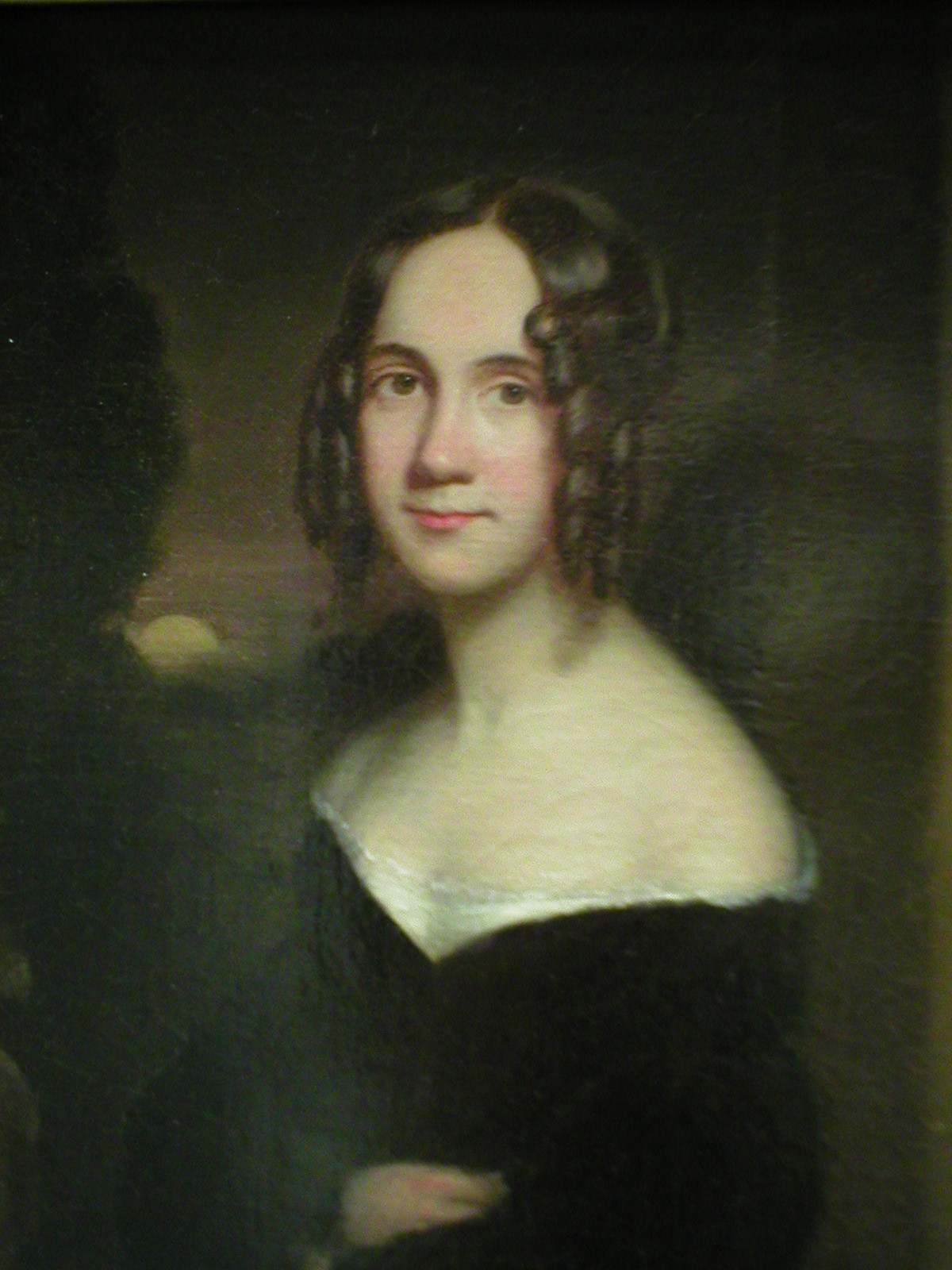
On December 13, 1845, the Broadway Journal printed a review of Poems, a collection of poetry by Frances Sargent Osgood. Poe praises her work for its "happy refinement" and noted that its author "gives a charm inexpressible to everything which flows from her pen." Poe's opinion of Osgood, however, may be partially tainted by their personal relationship. Earlier that year, the two had engaged in a heavy (and public) literary flirtation while Poe's wife Virginia was sick. They exchanged poems addressed to one another in Poe's own magazine, the Broadway Journal.

Interpretations of the relationship between Poe and Fanny Osgood are wide-ranging. Both were married at the time, though rumors suggest that Osgood was "estranged" from her husband, the artist Samuel Stillman Osgood. One person, noted for being a bit of a trouble maker, suggested that Osgood's third daughter, Fanny Fay, was actually the bastard child from the affair with Poe. Little Fanny Fay did not survive long and, though no evidence supports Elizabeth Ellet's claim, some modern scholars suggest that Poe's poem "Ulalume" is about his lost child.

Rufus Griswold almost certainly developed a crush on Osgood too. It seems to me that Osgood was a bit too flirtatious for her own good and some weak-willed men, like Griswold, read too much into it. Nevertheless, rivalry for the attention of Osgood may have led Griswold to build up further spite against Poe.

Ultimately, there is very little about Osgood's poetry that is memorable. A stereotypical woman poet of her era, much of her work has a damsel in distress vibe to it. Breathy, overloaded with dashes and exclamation points, most of her poems use some version of the word "sigh" at least once. One is about a faithful dog that does not leave his master's side, even as he is dying. Not very profound stuff.

The reality seems to be that the poetry exchanged by Osgood and Poe was platonic, not hot and heavy as some suggest (apparently without reading the interchanges). One, for example, was published in the same issue as Poe's review of Osgood's poetry. It is addressed to Poe and poetically notes how she takes a risk in writing her poetry, launches it like a ship, and tries to find a sympathetic "friend." Poe, the "you" of the poem, should be the pilot of the ship, she says. So, Poe is steering her poetry (like the editor he was), as she tries to find a friend. Not much scandal there, really.

Nevertheless, some even go so far as to say that the strange romance (which it was not) led to the creation of one of the greatest American masterpieces ever written. If you'll excuse me, there is no evidence whatsoever to support this conclusion. None. And the base generalizations in the article, the assumptions one must make for this theory to be plausible, have no basis either (Fanny Osgood as one of the most written about poets? Give me an example. Then explain to me how the infamously-reclusive, anti-women-writers Hawthorne even knew Osgood, let alone was interested in her enough to turn her into Hester Prynne).

Thursday, November 26, 2009

Thank your editor today

Being from Massachusetts, I'm aware of some of the controversies surrounding the myths of the Pilgrims and Thanksgiving. For one, I know how much of a disappointment it is to actually see Plymouth Rock and realize it is, after all, just a rock... and one which likely has no connection to that fateful day in the year 1620. It's also broken in half. Oops. I also know that the Pilgrims didn't even land in Plymouth first, but first set foot on New World soil in what is now Provincetown, Massachusetts (a town which now has a Pilgrim monument which is much better than a broken rock). I also know that 1620 is a stupid date to celebrate, considering America wasn't "found" that year; it was already settled by millions of natives (who quickly started dying out when paranoid white men deemed them "savage" and also introduced exotic diseases, not to mention slavery, to their land).

But, here's the good news: today's Thanksgiving has less to do with the Pilgrims and 1620 and much more to do with poetry.

Edgar Poe would have to appreciate the influence that a poet/magazine editor would have, considering how much he wore those hats himself. But I would argue that no magazinist ever had as much influence as Sarah Josepha Hale, the woman who steered the most popular magazine in the United States for half a century.

Godey's Lady's Book was a powerhouse. Its circulation was incomparable, partly because it was so inoffensive (Hale herself is now mostly forgotten, but her poem about "Mary's Lamb" survives as a nursery rhyme; I consider it the most famous poem in the English language). No doubt, the hand-colored fashion-plates made a difference too; they can still be found in spades at online auction sites and at antique shops, sometimes even framed.

Before Sarah Hale got involved, Thanksgiving was a minor holiday, celebrated by a few states in the Union on no particular date, at that state's discretion. In the midst of the Civil War, Hale campaigned for a national Thanksgiving. She approached no less a figure than President Abraham Lincoln. In her letter to him, she reminded him of the holiday's distinctly American origin, its sentiment, and how the disintegrating country could use some sort of unifying holiday. Lincoln agreed, and Thanksgiving became a national holiday.

Of course, this was after Poe's lifetime and, one could argue, during his life Poe had little for which to be thankful. I disagree.

I think Poe would have embodied the spirit of Thanksgiving fairly well. Though he struggled, he had a loving wife, good friends, and was writing amazing works of literature. For some of those works, he could even thank the "editress" (as she called herself) Sarah Josepha Hale. For Godey's Lady's Book, she published Poe's "A Tale of the Ragged Mountains" (1844), "The Oblong Box" (1844), "Thou Art the Man" (1844), "The Thousand-and-Second Tale of Scheherazade" (1845) and, of course, the now iconic tale "The Cask of Amontillado" (1846).

Wednesday, November 25, 2009

Like a procession of moonlight clouds

By the time The Raven and Other Poems had been published in 1845, Poe was a well-known figure in American writing. Though his earliest fame (infamy?) was more for his criticism, publishing a certain poem about a black bird with limited vocabulary established him as one of the most talked about poets in the United States. It was because of that instant fame that The Raven and Other Poems was published — and some big-name critics sunk their teeth into it.

One such critique was published in the Daily Tribune in New York on November 26, 1845. The critic, Margaret Fuller, commented on Poe's introduction (in which he called his poems "trifles"). She agreed. "The productions in this volume indicate a power to do something far better. With the exception of The Raven, which seems intended chiefly to show the writer's artistic skill, and is in the way a rare and finished specimen, they are fragments... almost all of which leave us something to desire or demand."

Among the "fragments" in the book were "To One in Paradise" (which she said "breathe[s] a passionate sadness") and "The Haunted Palace" (she referred to its "dignity"). The review printed in full the poem "Israfel," presumably as a specimen which she particularly liked.

Overall, Margaret Fuller deemed Poe's poems as:
a sweep of images, thronging and distant like a procession of moonlight clouds on the horizon, but like them characteristic and harmonious one with another, according to their office. The descriptive power is greatest when it takes a shape not unlike an incantation, as in the first part of "The Sleeper."
Fuller's overall positive review is somewhat surprising, considering the personal quarrel with Poe she got herself involved with. By the way, she was only about one year younger than Poe — which means next year, 2010, is her bicentennial. For information on celebrations in honor of her 200th, visit www.margaretfuller.org.

Thursday, November 19, 2009

Not a purpose, but a passion

The popularity of "The Raven" led to the publication of a collection of poetry titled The Raven and Other Poems, released on November 19, 1845. Wiley & Putnam issued the small volume of 100 pages with a cover price of 31 cents. In his introduction, Poe referred to the poems within as "trifles." He adds: "It is incumbent upon me to say, that I think nothing in this volume of much value to the public, or very creditable to myself."

These "trifles" included not only the title poem but also "The Valley of Unrest," "Bridal Ballad," "The Sleeper," "The Coliseum," "Lenore," "The City in the Sea," "To One in Paradise," "Eulalie," "The Haunted Palace," and "The Conqueror Worm" (my personal favorite), among others.

I tend to agree with George Pope Morris, who wrote in his review: "In spite of Mr. Poe's majestic disclaimer of any great interest in this book, we must venture to think it contains a good deal of that which we call poetry — an element too rare in these days of frigid verse-making to be treated with disregard."

Poe also notes that "with me poetry has been not a purpose, but a passion." He could never dedicate his life to writing poetry because he knew he would never make substantial money from it. So, rather than it being a "purpose," it was a "passion" for him.

Poe dedicated the collection to the popular English poet Elizabeth Barrett. Poe had reviewed her work (specifically The Drama of Exile and Other Poems) earlier that year and Barrett (later Browning) responded positively to "The Raven." Poe's dedication was as follows:
To the Noblest of her Sex—
To the author of
The Drama of Exile—
To Miss Elizabeth Barrett Barrett,
Of England
I Dedicate This Volume
With the most Enthusiasm Admiration
And with the most Sincere Esteem.

Wednesday, June 3, 2009

The scandalous Elizabeth F. Ellet

Elizabeth F. Ellet is the female equivalent of Rufus W. Griswold: jealous, petty, cruel, and an instigator who lashed out against others without reason. For example, she threw herself into the strange "affair" between Frances Sargent Osgood and Poe, for whom she had a romantic interest. After tricking Mrs. Virginia Poe into showing her some of Mrs. Osgood's letters, she suggested to Mrs. Osgood that their contents would lead to shameful scandal. Though today, most accounts suggest that the flirtation between Osgood and Poe was purely innocent, she was convinced to have Poe destroy the letters. A minor controversy ensued which involved Margaret Fuller, Anne Lynch, and Ellet's pistol-wielding brother (which eventually also pulled in Thomas Dunn English — but that story will be told here later this summer). Mr. Samuel Osgood accused Ellet of scandal-mongering, but she placed the blame squarely on Mr. and Mrs. Poe. Virginia died in 1847 and at least one friend suggested Ellet's forced scandal exacerbated her illness such that it could be claimed "Mrs. E. had been her murderer." Griswold, of course, was involved as well — he also had a crush on Osgood; she even dedicated a book to him.

But, if you think that controversy was confusing, nothing compares to what Ellet did to Rufus Griswold.

Griswold was not a nice man, certainly, but there are a few incidents that beg sympathy. In 1852, he broke off a loveless marriage with his second wife, Charlotte Myers (their relationship is still confusing) so that he could marry a woman named Harriet McCrillis. Ellet stepped in and urged Myers (a complete stranger) not to grant the divorce and for McCrillis (a complete stranger) not to marry Griswold. Nevertheless, the divorce was made official and Griswold married McCrillis. Ellet did not quit.

She continued writing to Myers, urging her to seek a repeal of the divorce. Myers gave in and the matter was to be brought before the Philadelphia Court of Common Pleas. While awaiting the court date, Griswold's house caught fire, leaving him brutally disfigured; he lost his eyebrows, eyelashes, and seven of his fingernails to the fire. In 1856, the Court date arrived and neither Myers nor Griswold bothered to show up — but Mrs. Ellet did, serving as a character witness against Griswold. The divorce was not repealed, but Griswold's third wife Harriet McCrillis left him amidst the public scandal over the possible bigamy — she never saw her husband again before his death from tuberculosis in 1857. Shortly before his death, Griswold published a pamphlet to publicly address the scandal, Statement of the Relations of Rufus W. Griswold with Charlotte Myers (called Charlotte Griswold) [and] Elizabeth F. Ellet... With Particular Reference to Their Late Unsuccessful Attempt to Have Set Aside the Decree Granted in the Case of Griswold vs. Griswold. One friend suggested that Ellet had "goaded Griswold to his death."

Frankly, there was no apparent reason why Ellet got involved in Griswold's romantic life. She did not seem to exhibit any romantic feelings towards him (her messages to Poe were more than clear, if not sultry). Griswold had always treated her well in his criticism and even helped her publish her popular book The Women of the American Revolution (1845). Ellet deserves no more complicated a description than "a bad person."

Nevertheless, rest in peace, Elizabeth. She died this day, June 3, in 1877. Today she is buried in Green-Wood Cemetery in Brooklyn — the same cemetery where lies Rufus Griswold.

Saturday, May 30, 2009

Poe and Sarah Hale

On May 30, 1844, the influential "editress" (as she called herself) Sarah Josepha Hale wrote to Edgar A. Poe. Poe had submitted a tale to Nathaniel Parker Willis in the hopes of it getting published in The New Mirror. Instead, Willis thought it better placed in an annual called The Opal; though he had edited its first issue (perhaps ironically, this annual gift-book was originally founded by none other than Rufus Wilmot Griswold), he no longer held that role. The new editor was Sarah Josepha Hale, better known as the long-time editor of Godey's Lady's Book for forty years, but best known (unfortunately) as the author of "Mary Had a Little Lamb."

Willis had accepted Poe's submission before turning it over to Hale. Poe was now unsure if his tale would be published at all and wrote directly to Hale to secure its appearance in The Opal. As he wrote, Poe wanted Hale "be so kind as to take it, unseen, upon Mr. Willis' testimony in its favor." Hale's response is apparently lost, but likely written on May 30, 1844. Poe refers to this now-missing letter as a "kind and very satisfactory one." He agrees to the pathetic payment of 50 cents per page (compare to Graham's Magazine's $4 or $5 per page).

It was not published in The Opal, as Willis anticipated. Instead, "The Oblong Box" was published in the September issue of Godey's. The story is an odd mesh of horror, mystery, and sea adventure, unlike any other Poe tale. Highly recommended!

More important here is the interaction between Poe and Hale, a woman who some (including me!) consider among the most powerful and influential women of her generation. Her first awareness of Poe was through her son, David Emerson Hale, who was a classmate of Poe's at West Point. When David mentioned to his mother that there was a poet among them, Mrs. Hale inquired about him. Under Hale, Poe published one poem and six stories (including "The Cask of Amontillado") in Godey's Lady's Book — something which Poe could not have been too happy with. Though it was the highest-circulating magazine of its day, it was trashy and sentimental, with more colored fashion-plates than worthwhile content.

Saturday, May 23, 2009

Margaret Fuller at 199

On May 23, 1810, Timothy and Margaret (Crane) Fuller welcomed their first (of eight) children. They named her Sarah Margaret Fuller — it would not be long after that the precocious child demanded she be referred to only as "Margaret." In fact, in her professional career — which spanned education, journalism, criticism, poetry, etc. — she went by that name, rather than the more conventional etiquette which would have her named "Miss Fuller."

The relationship between Poe and Fuller was, like many of Poe's interactions, complicated. Despite some comments against Fuller (he once called her an "old maid" and a "busybody") and her involvement in a strange personal interaction (involving Frances Osgood; I'll tell that tale another time), I believe Poe sincerely admired her work.

The earliest interaction I found was, oddly, over James Russell Lowell, who later became a sort of literary rival for both Fuller and Poe. A critic for the Daily Tribune in New York (presumed to be Fuller) strongly disagreed with Poe's review of Lowell. Charles Frederick Briggs wrote to his friend Lowell on January 17, 1845, about the disagreement: "Poe's criticism about your Conversations [on Some of the Old Poets] was extremely laudatory and discriminating; it was the female ass of the Tribune [e.g. Fuller] that misunderstood him."

The same month, Fuller noted Lowell's critical/biographical sketch of Poe. She noted that the article ("frank" and "earnest") introduced her to some of Poe's poetry which she never read before. She liked "The Haunted Palace" and "To Helen" enough to reprint them in the Tribune. The latter, she writes, is "of such distinguished beauty in thought, feeling, and expression, that we might expect the life unfolded from such a bud to have the sweetness and soft lustre of a rose." She was always very honest in her opinions of Poe. Later in 1845, she reviewed The Raven and Other Poems and suggested they were "all fragments" — suggesting that he was capable of better poetry, "with the exception of The Raven, which seems intended chiefly to show the writer's artistic skill." Nevertheless, she notes that the poems "breathe a passionate sadness, relieved sometimes by touches very lovely and tender" and show "a sweep of images, thronging and distant like a procession of moonlight clouds on the horizon."

Poe, in turn, acknowledged Fuller's "high genius." In 1846, he commended her daring review of Henry Wadsworth Longfellow. As he wrote, "it is one of the very few reviews of Longfellow's poems, ever published in America, of which the critics have not had abundant reason to be ashamed." When Fuller published Woman in the Nineteenth Century, her definitive work (regarded as the first major feminist work in the United States), Poe praised her fortitude. He called it "a book which few women in the country could have written, and no woman in the country would have published, with the exception of Miss Fuller." He particularly praised her for not manufacturing a false public persona. Instead, he wrote, her "personal character and her printed book are merely one and the same thing."

Happy 199th birthday to Margaret Fuller — a woman well ahead of her time! All the best for her bicentennial next year, in 2010!

Friday, March 6, 2009

To the Noblest of Her Sex

On March 6, 1806, Elizabeth Barrett Moulton-Barrett — better known today as the English poet Elizabeth Barrett Browning — was born.* As with many other well-known writers of the time period, she has a connection to Edgar A. Poe.

The easy connection is in Poe's famous poem "The Raven." In writing that poem, he chose to emulate the complex poetic format and rhyming scheme of Barrett's "Lady Geraldine's Courtship." Both "The Raven" and "Lady Geraldine's Courtship" use a poetic form called "trochaic octameter" — that is, lines are made up of eight metrical feet utilizing trochees (a stressed syllable followed by an unstressed one). This is a very wide meter — it's so long, in fact, that Poe requested his publishers not print it in the typical two-column style magazines used in those days but to instead allow only a single column, so that the entire line could run across the page.

Poe noted one line of Barrett's in particular as a source of inspiration: "With a rushing stir, uncertain, in the air, the purple curtain" which sounds very similar to Poe's "And the silken, sad, uncertain rustling of each purple curtain..."

But, enough with the poetry lesson. Let's talk about the correspondence between Barrett and Poe.

Poe's earliest known review of Barrett was published in the Janaury 4, 1845, issue of the Broadway Journal — shortly after he had sold "The Raven." He reviewed her book The Drama of Exile, and Other Poems. The review (which later had a part two) was, I think, rather on the neutral side (though other Poe scholars refer to it as "gushing" and "enthusiastic"), especially because he condemns her "continuous mystical strain of ill-fitting and exaggerated allegory." What he does offer, however, is praise of Barrett's technical ability at crafting poems. He also notes that her "sense of art is pure in itself" (any time Poe uses "pure," he's giving the equivalent of a 5-star rating). A copy of the review is sent to Barrett through an acquaintance (and fellow poet) named Richard Henry Horne on January 25, along with a copy of "The Raven." While awaiting a reply, Poe criticized another journal for its negative comments about Barrett, referring to her as "the queen of all female poets." Okay, now we're getting gushy.

Barrett, after some delay, writes to Horne on May 12 that "The Raven" has power, though it suggests its author is not sane. As she writes, "it does not appear to me the natural expression of a sane intellect in whatever mood." She praises Poe's rhythm (ironically?) and the repeated "nevermore." Overall, she says, "there is an uncommon force and effect in the poem."

Barrett, within moments of this letter, writes another to Horne, telling him not to share her words with Poe. She downplays her interest in "The Raven" and instead focuses on the review, making sure to sound grateful for his praise. She refers to him as "a wonder among critics."

The success of "The Raven" prompted Poe to publish a full collection of poems (something he hadn't done in 14 years!). The Raven and Other Poems included the dedication: "To the noblest of her sex — to the author of 'The Drama of Exile' — to Miss Elizabeth Barrett Barrett, of England, I dedicate this volume, with the most enthusiastic admiration and with the most sincere esteem."

The dedication was a bit odd. The two had not corresponded directly, only through Horne as an intermediary. She was a bit surprised. As she wrote to Robert Browning on November 28, 1845, acknowledging the dedication: "And think of Mr. Poe... He wrote a review of me... the two extremes of laudation & reprehension, folded in on one another—You would have thought that it had been written by a friend & foe, each stark mad with love & hate, & writing the alternate paragraphs."

Poe finally sent her a personal, autographed copy of his collected poems and tales (presumably a London-printed version) in February 1846. A month later, she wrote to a friend: "Mr. Poe sent me a volume containing his poems and tales collected, so now I must write and thank him for his dedication. What is to be said, I wonder, when a man calls you the 'noblest of your sex'? 'Sir, you are the most discerning of yours.'" The letter she writes to Poe, some time in April 1846, says: "It is too great a distinction, conferred by a hand of too liberal generosity. I wish for my own sake I were worthy of it." She also, quite famously, refers to the English response to "The Raven," saying it has "produced a sensation, a 'fit horror'... Some of my friends are taken by the fear of it and some by the music. I hear of persons haunted by the 'Nevermore,' and one acquaintance of mine who has the misfortune of possessing a 'bust of Pallas' never can bear to look at it in the twilight." She also notes her fascination with Poe's tale "The Facts in the Case of M. Valdemar" (one of my favorites too!). Poe was proud of her response and is reported to have read it aloud to guests at his Fordham cottage some time that summer.

* I will refer to her as "Barrett" throughout. At the time this correspondence take place, she was not yet married to Robert Browning.

Thursday, February 5, 2009

Sarah Helen Whitman responds to Poe's critics

On February 5, 1860, poetess Sarah Helen Whitman (1803-1878) published Edgar Poe and His Critics, a book which directly responded to various accusations hurled against Poe in the ten+ years since his death.

A Providence native, Whitman specifically responded to accusations from Rufus W. Griswold and others. One specific charge made by Griswold was responded fairly cheekily — Griswold said Poe had no friends. Whitman introduced her book, "by a friend."

It's sort of a shame now that today Whitman is only recognized for her connection with Poe — she was amongst the most famous women poets of her day and, to be honest, much of her work deserves reclaiming. At least one scholar, Brett Rutherford, agrees with me, though he still frames his book on Whitman around her relationship with Poe.

Let me sum up her relationship with Poe: She was almost his second wife. I'll give the details of their relationship closer to their wedding date in December.

After her book was published, Whitman maintained a heavy correspondence with John Henry Ingram, an independent biographer (and postal worker!) considered one of the first to punch a significant hole in Griswold's lies. And, really, it was Whitman that made Ingram's Poe biography so rich and so vital, even today.

Her relationship with Poe, her book response to Griswold, and her correspondence with Ingram make up all that she is remembered for today (quite unfortunately). A friend of mine performs as Sarah Helen Whitman on occasion, and nearly brings me to tears every time I see her.

In 1848, Whitman wrote this poem to Edgar Poe:
If thy sad heart, pining for human love,
In its earth solitude grew dark with fear,
Lest the high Sun of Heaven itself should prove
Powerless to save from that phantasmal sphere
Wherein thy spirit wandered,—if the flowers
That pressed around thy feet, seemed but to bloom
In lone Gethsemanes, through starless hours,
When all who loved had left thee to thy doom,—
Oh, yet believe that in that hollow vale
Where thy soul lingers, waiting to attain
So much of Heaven's sweet grace as shall avail
To lift its burden of remorseful pain,
My soul shall meet thee, and its Heaven forego
Till God's great love, on both, one hope, one Heaven bestow.

Tuesday, January 13, 2009

Poe the Critic

We can only speculate on how Poe wanted to be remembered. Considering his massive literary output, he could have hoped for any number of legacies. During most of his career, however, he was first and foremost a critic, and it was in his criticism that he first built a national reputation. Known especially for his particularly harsh reviews and even harsher dissection of bad sentences, James Russell Lowell once remarked that Poe occasionally mistook his vial of prussic acid for ink.

Today, few readers are familiar with Poe's criticism beyond the generalizations I've just made. To fill in that gap, I'm copying in full one of Poe's criticisms, originally printed 167 years ago in the January issue of Graham's Magazine in 1842. Poe provides his usual ambiguous commentary, his specific indictment of poor word usage (phonetics, in this case), hypocrisy (see if you can spot it), and a brief mention of his favorite topic: imitation.

Pocahontas, and Other Poems. By Mrs. L. H. Sigourney. Harper and Brothers: New York.
Some years ago we had occasion to speak of "Zinzendorf, and Other Poems," by Mrs. Sigourney, and at that period we found, or fancied that we found many points, in her general manner, which called for critical animadversion. At no period, however, have we been so rash as to dispute her claim to high rank among the poets of the land. In the volume now published by the Messieurs Harper, we are proud to discover not one of those more important blemishes which were a stain upon her earlier style. We had accused her of imitation of Mrs. Hemans - but this imitation is no longer apparent.

The author of "Pocahontas" (an unusually fine poem of which we may take occasion to speak full hereafter) has also abandoned a very foolish mannerism with which she was erewhile infected - the mannerism of heading her pieces with paragraphs, or quotations, by way of text, from which the poem itself ensued as a sermon. This was an exceedingly inartistical practice, and one now well discarded.

The lesser pieces in the volume before us have, for the most part, already met our eye as fugitive effusions. In general, they deserve all commendation.

"Pocahontas" is a far finer poem than a late one on the same subject by Mrs. Sheba Smith. Mrs. Sigourney, however, has the wrong accentuation of Powhatan. In the second stanza of the poem, too, "harassed" is in false quantity. We speak of these trifles merely en passant.

Hereafter we may speak in full.