Charles Frederick Briggs and John Bisco signed a contract on December 23, 1844 to begin a new publication in New York. Only a couple weeks earlier, Briggs was struggling over what to name the new periodical. He settled on "The Broadway Journal."
Bisco was the brains that handled the business operations while Briggs utilized his established literary reputation to attract both contributors and readers. Briggs, however, was no fool and wanted an even bigger name to attract attention. He asked his close friend James Russell Lowell how to get in touch with Edgar Allan Poe.
The Broadway Journal rose and fell very quickly. Briggs and Bisco partnered with Poe because of his reputation — a reputation earned partly from "The Raven" but also from his harsh, relentless literary criticism. When Poe did the same sort of criticism for the Journal, Briggs was offended (particularly when Poe attacked Henry Wadsworth Longfellow, angering mutual friend J. R. Lowell).
The three business partners never quite came together. Briggs, who was also dealing with personal financial difficulties, attempted to buy out Bisco to take in more profit for himself. Instead, he abandoned the journal he helped start only about six months into the project. Poe considered selling his share of the company to another editor, a lion of New York periodicals named Evert Augustus Duyckinck, or the main proponent of copyright law Cornelius Mathews. Instead, he borrowed money from Horace Greeley and bought out John Bisco. As of October 1845, Poe was the sole owner of The Broadway Journal. Despite Poe's high hopes, the publication shut down with its January 3, 1846 issue (after which Poe vowed to start the Stylus, which never came to be).
Briggs continued to work in the publishing industry, editing several other magazines, journals, newspapers, and annuals. He had a somewhat long run on Putnam's Magazine, where he worked with notables like Parke Godwin (son-in-law of William Cullen Bryant) and George William Curtis. Little seems to be known about John Bisco outside his connection to Briggs and Poe.
Showing posts with label 1844. Show all posts
Showing posts with label 1844. Show all posts
Wednesday, December 23, 2009


Monday, December 7, 2009
Or Broadway Something...
 Charles Frederick Briggs was mostly known as a writer of satiric novels, particularly the then-famous The Adventures of Harry Franco. To his dismay, his title character also became his nickname (much like Poe was later referred to as "The Raven"). Wanting to do more, Briggs intended to start his own journal. He was struggling, however, with choosing a name.
On December 7, 1844, Briggs wrote his friend,* the literary critic James Russell Lowell: "I shall issue a prospectus in a day or two; the name will be, for the sake of individuality... the Broadway Journal, or Review, or Chronicle, or Broadway Something..."
Briggs wanted to emphasize the distinct New York flavor to his journal. Most periodicals were regional, after all (even Poe original aimed for Pennsylvanian readers when planning The Penn; he later renamed it The Stylus to appeal to a broader audience). The one which Briggs was planning would become The Broadway Journal with the help of his business-minded partner John Bisco.
In the same letter to Lowell, he asks about getting in touch with Poe. Poe came in as a co-editor and business partner. The venture, however, never turned a substantial profit and Bisco eventually bailed out. Oddly enough, Briggs had difficulty working with Poe, in part due to the vitriolic style of criticism which first drew him towards hiring Poe. He soon sold his portion of the business to Poe to break the partnership. By the fall of 1845, The Broadway Journal was solely under the control and ownership of Edgar Poe — it was the only journal and the only business Poe ever owned.
During his tenure there, Poe tweaked and republished a substantial portion of his major works; many of the versions featured in The Broadway Journal became the standard editions. He continued reviewing other writers, noticed newly-published works, updated his readers on local politics, and gave his theories on good literature.
Despite his best intentions (and even a vow to his friend Thomas Holley Chivers to "make a fortune of it yet"), Poe did not succeed in bringing the struggling journal to success. Its final issue was in January 1846. Nevertheless, the experience pushed him closer to producing The Stylus. Despite working in earnest, his plans never came to fruition.
*More work could be done considering their friendship. Lowell turned over all profits from his famous A Fable for Critics directly to Briggs. Certainly, some of the animosity Lowell will begin to feel towards Poe during the "Longfellow War" comes from Briggs's trash-talking, so to speak.
Thursday, December 3, 2009
The fatal resemblance
On December 3, 1844, the Paris, France-based newspaper La Quotidienne began publishing installments of "James Dixon, ou la funeste resemblance" (which translates to "James Dixon, or the fatal resemblance"). Though it included a byline of Gustave Brunet, the story was, in fact, an adaptation of Poe's doppelganger story "William Wilson." This was two years before Charles Beaudelaire began his translations of Poe. The same Paris newspaper would soon publish a controversial translation of "The Murders in the Rue Morgue."
As I've noted elsewhere, French readers have long been devoted followers of Poe. I would say that their appreciation for Poe could never be overstated. An entire book has been written about it, so I could never do it justice here. But, to get an idea, besides the admiration of Charles Baudelaire, Poe is credited as the main inspiration for the Symbolist poetry movement that took hold in France, particularly the work of Stephane Mallarmé. This "James Dixon" is the first known translation of Poe's work into French so, in a sense, this one started it all.
More than that, however, the publication of "James Dixon, ou la funeste resemblance" is the first known version of the work of Poe in any language other than English. Even during his lifetime, Poe was becoming a figure of world literature. Some foreigners find it ironic (or, in the case of Baudelaire, unconscionable) that Poe earned greater respect outside of his native country. I would argue that he has come to be much better appreciated here in the United States since then, but that most Americans make their assessment of him based on a very narrow selection of his works. Many readers in countries like France, Spain, England, the Czech Republic, Russia, and scores of others in Europe and South America in particular do not consider Poe a horror writer. They embrace the full span of his various works, including science fiction, comedy, and romantic poetry. I've been particularly surprised to see how much non-American readers have come to love strange works like Eureka and The Narrative of Arthur Gordon Pym of Nantucket.
I have two questions: If you are an American, when do you think we will come to know Poe beyond his horror works? If you are from elsewhere, what has been your experience with Poe?
As I've noted elsewhere, French readers have long been devoted followers of Poe. I would say that their appreciation for Poe could never be overstated. An entire book has been written about it, so I could never do it justice here. But, to get an idea, besides the admiration of Charles Baudelaire, Poe is credited as the main inspiration for the Symbolist poetry movement that took hold in France, particularly the work of Stephane Mallarmé. This "James Dixon" is the first known translation of Poe's work into French so, in a sense, this one started it all.
More than that, however, the publication of "James Dixon, ou la funeste resemblance" is the first known version of the work of Poe in any language other than English. Even during his lifetime, Poe was becoming a figure of world literature. Some foreigners find it ironic (or, in the case of Baudelaire, unconscionable) that Poe earned greater respect outside of his native country. I would argue that he has come to be much better appreciated here in the United States since then, but that most Americans make their assessment of him based on a very narrow selection of his works. Many readers in countries like France, Spain, England, the Czech Republic, Russia, and scores of others in Europe and South America in particular do not consider Poe a horror writer. They embrace the full span of his various works, including science fiction, comedy, and romantic poetry. I've been particularly surprised to see how much non-American readers have come to love strange works like Eureka and The Narrative of Arthur Gordon Pym of Nantucket.
I have two questions: If you are an American, when do you think we will come to know Poe beyond his horror works? If you are from elsewhere, what has been your experience with Poe?
Sunday, September 20, 2009
This shape was peculiar
Continuing the series of Poe works published in September issues, I realized I almost neglected one of the most interesting and spirited of Poe's tales. "The Oblong Box" was first published in the September 1844 issue of Godey's Lady's Book (and, part of a trend of concurrent publications, similar to "The Raven," it was also published in the August 28, 1844 issue of the Philadelphia Dollar Newspaper).
"The Oblong Box" is a mixture of some of Poe's greatest story-telling elements. Set as a variation of the sea adventure tale, the story follows an unnamed narrator traveling by boat (the Independence) from Charleston, South Carolina to New York. On board, he bumps into his old friend Cornelius Wyatt, who is traveling with his wife and two sisters. The narrator is suspicious that his friend has rented three state-rooms, not to mention the cargo he brought aboard: an oblong box, ("this shape was peculiar," we are told) and a fairly large one at that — "about six feet in length by two and half in breadth." The box is made of pine and emits a slight odor. As a reader, you might already know what's in the box, but the narrator sure didn't.
Instead, he assumes (oddly) that the box housed a copy of The Last Supper that Wyatt recently acquired. He grows more suspicious, however, when he realizes how those three state-rooms are being used. One is for the two sisters, the other seems to be empty, and the third is for Wyatt, his wife, and the mysterious box. At night, however, Wyatt's wife leaves the room and spends the rest of the night in the empty room. After she leaves, the narrator hears the box being opened, followed by his friend's audible sobs. When the Independence is caught in a hurricane and breaks apart, Wyatt refuses to get in a lifeboat and leave the box behind. Instead, he goes down with the ship.
Some time later, the narrator meets the captain of the ship, who reveals what was in that box, why Wyatt refused to part with it, and why his "wife" left the state-room every night.
In addition to elements of the sea tale, the ending proves "The Oblong Box" is a horror story. The mystery behind the box, however, also implies it is a part of Poe's developing "ratiocination" method of tale-telling. More than all this, however, is the amazing symbolism in the story. Wyatt refuses to part with his precious cargo while aboard a ship named Independence, of all things. The voyage from South Carolina also echoes Poe's own trip from there via steamboat.
Oddly, Arthur Hobson Quinn notes that Poe offered the tale to Nathaniel Parker Willis, who suggested it be included in a new annual gift-book founded by Rufus Griswold. The Opal, which was edited first by Willis and later by Sarah Josepha Hale, was subtitled "A Pure Gift for the Holidays." Packed with religious or moral tales and poems for Christmas, "The Oblong Box" would have been an odd fit.
"The Oblong Box" is a mixture of some of Poe's greatest story-telling elements. Set as a variation of the sea adventure tale, the story follows an unnamed narrator traveling by boat (the Independence) from Charleston, South Carolina to New York. On board, he bumps into his old friend Cornelius Wyatt, who is traveling with his wife and two sisters. The narrator is suspicious that his friend has rented three state-rooms, not to mention the cargo he brought aboard: an oblong box, ("this shape was peculiar," we are told) and a fairly large one at that — "about six feet in length by two and half in breadth." The box is made of pine and emits a slight odor. As a reader, you might already know what's in the box, but the narrator sure didn't.
Instead, he assumes (oddly) that the box housed a copy of The Last Supper that Wyatt recently acquired. He grows more suspicious, however, when he realizes how those three state-rooms are being used. One is for the two sisters, the other seems to be empty, and the third is for Wyatt, his wife, and the mysterious box. At night, however, Wyatt's wife leaves the room and spends the rest of the night in the empty room. After she leaves, the narrator hears the box being opened, followed by his friend's audible sobs. When the Independence is caught in a hurricane and breaks apart, Wyatt refuses to get in a lifeboat and leave the box behind. Instead, he goes down with the ship.
Some time later, the narrator meets the captain of the ship, who reveals what was in that box, why Wyatt refused to part with it, and why his "wife" left the state-room every night.
In addition to elements of the sea tale, the ending proves "The Oblong Box" is a horror story. The mystery behind the box, however, also implies it is a part of Poe's developing "ratiocination" method of tale-telling. More than all this, however, is the amazing symbolism in the story. Wyatt refuses to part with his precious cargo while aboard a ship named Independence, of all things. The voyage from South Carolina also echoes Poe's own trip from there via steamboat.
Oddly, Arthur Hobson Quinn notes that Poe offered the tale to Nathaniel Parker Willis, who suggested it be included in a new annual gift-book founded by Rufus Griswold. The Opal, which was edited first by Willis and later by Sarah Josepha Hale, was subtitled "A Pure Gift for the Holidays." Packed with religious or moral tales and poems for Christmas, "The Oblong Box" would have been an odd fit.
Monday, August 3, 2009
A mesmeric republication
Poe often revised and reprinted his works to purposefully improve them and expand his audience. Other times, his works were reprinted without his permission, thanks to the piracy-laden culture of reprinting in American publishing (in some cases, publishers would sell the works to other publishers, without checking with the writer). One example of this is the August 3, 1844 issue of the New World in New York, which reprinted the tale "Mesmeric Revelation," likely without Poe's authorization.
But, what prompted them to republish the work was not so much getting attention thanks to Poe's name, but the inherent interest of the story. The editor wrote: "Mr. Poe cannot, on so serious a subject, trifle with his readers: yet more extraordinary statements can hardly be conceived... we recommend it [e.g. the tale] to the perusal of our readers and invite them to draw their own conclusions."
Poe's story was being republished because it was believed to be a true account.
"Mesmeric Revelation" features a a mesmerist ("animal magnetism," as developed by Franz Mesmer, believed that the fluids in the body could be manipulated with magnets, allowing for a trance-like state similar to hypnotism) who wants to determine if the soul can survive after death. The mesmerist, coyly named "Mr. P.," puts Mr. Vankirk into a "mesmeric sleep." While in this trance, Vankirk and the mesmerist engage in a metaphysical discussion touching upon topics like the true nature of God ("What then is God?" Vankirk's answer is, "I cannot tell."). Vankirk dies while in this trance (much like Poe's similar, more horrific story, "The Facts in the Case of M. Valdemar") and, though Mr. P. tries to bring him back, Vankirk refuses because of his experience and "keenly redefined perception" from transitioning to what is, in essence, the afterlife.
The German-born Franz Mesmer introduced his process in the 1770s, making public spectacles of his discoveries, sometimes accompanied by a glass armonica, a musical instrument developed by Benjamin Franklin. Mesmer died in 1815, but his animal magnetism (he apparently never used the term "mesmerism") lived on, particularly through a traveling practitioner named Charles Lafontaine. In the 1840s, Scottish physician James Braid saw Lafontaine and developed a similar process which earned the name "hypnosis."
"Mesmeric Revelation" was republished several more times in the next few months. One reader responded that the story was likely true, but the "revelations" of Mr. Vankirk were hallucinations. One notable reprint was in the American Phrenological Journal in 1845. That journal, purportedly a one of science rather than literature, noted their belief in the story, though they were not attempting to convince readers. As they introduced: "We simply lay it before our readers, soliciting that they do by it as we have done, think it over fully, and form their own conclusions... Read and re-read." The editors later published a retraction.
Certainly, Poe's story made a stir (to his amusement). We can only speculate if Poe truly believed in mesmerism. The first lines of the "Mesmeric Revelation" are curious: "Whatever doubt may still envelop the rationale of mesmerism, its startling facts are now almost universally admitted." I would argue that Poe was, as he often did, appealing to the interests of his reading audience, rather than showing his personal interests. His italics on the term "facts" in that quote may be the hint...
But, what prompted them to republish the work was not so much getting attention thanks to Poe's name, but the inherent interest of the story. The editor wrote: "Mr. Poe cannot, on so serious a subject, trifle with his readers: yet more extraordinary statements can hardly be conceived... we recommend it [e.g. the tale] to the perusal of our readers and invite them to draw their own conclusions."
Poe's story was being republished because it was believed to be a true account.
"Mesmeric Revelation" features a a mesmerist ("animal magnetism," as developed by Franz Mesmer, believed that the fluids in the body could be manipulated with magnets, allowing for a trance-like state similar to hypnotism) who wants to determine if the soul can survive after death. The mesmerist, coyly named "Mr. P.," puts Mr. Vankirk into a "mesmeric sleep." While in this trance, Vankirk and the mesmerist engage in a metaphysical discussion touching upon topics like the true nature of God ("What then is God?" Vankirk's answer is, "I cannot tell."). Vankirk dies while in this trance (much like Poe's similar, more horrific story, "The Facts in the Case of M. Valdemar") and, though Mr. P. tries to bring him back, Vankirk refuses because of his experience and "keenly redefined perception" from transitioning to what is, in essence, the afterlife.
The German-born Franz Mesmer introduced his process in the 1770s, making public spectacles of his discoveries, sometimes accompanied by a glass armonica, a musical instrument developed by Benjamin Franklin. Mesmer died in 1815, but his animal magnetism (he apparently never used the term "mesmerism") lived on, particularly through a traveling practitioner named Charles Lafontaine. In the 1840s, Scottish physician James Braid saw Lafontaine and developed a similar process which earned the name "hypnosis."
"Mesmeric Revelation" was republished several more times in the next few months. One reader responded that the story was likely true, but the "revelations" of Mr. Vankirk were hallucinations. One notable reprint was in the American Phrenological Journal in 1845. That journal, purportedly a one of science rather than literature, noted their belief in the story, though they were not attempting to convince readers. As they introduced: "We simply lay it before our readers, soliciting that they do by it as we have done, think it over fully, and form their own conclusions... Read and re-read." The editors later published a retraction.
Certainly, Poe's story made a stir (to his amusement). We can only speculate if Poe truly believed in mesmerism. The first lines of the "Mesmeric Revelation" are curious: "Whatever doubt may still envelop the rationale of mesmerism, its startling facts are now almost universally admitted." I would argue that Poe was, as he often did, appealing to the interests of his reading audience, rather than showing his personal interests. His italics on the term "facts" in that quote may be the hint...
Friday, July 31, 2009
Silence like a sea that overwhelms
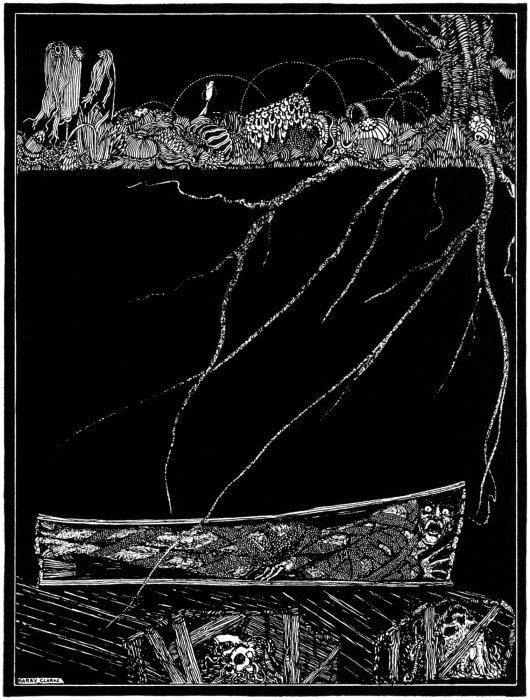 Perhaps the quintessential Poe short story that few have read, "The Premature Burial" was published for the first time in the July 31, 1844 issue of Philadelphia's Dollar Newspaper. Only a few of Poe's works feature the concept of being buried alive, yet, for some reason, I often read that Poe was obsessed that he would be buried prematurely. It's hard to say if this is true but I have yet to find any evidence at all that Poe was personally concerned with being buried alive.
Instead, Poe was responding to the popular concern about premature burial among his readers. Poe was, after all, a pop culture writer trying to appeal to a mass audience (the most obvious piece of evidence is that "The Premature Burial" was published in a cheap newspaper, not a high-end book). Even Poe's only novel was a direct response to the common interest of the masses.
I could argue that the reason American readers were suddenly interested in stories about premature burial is based on a general interest in death at the time. Concepts of death shifted from a Puritan "dirty death" point of view to a more romantic Victorian idealism. Medical science, however, was beginning to help define the moments where life and death meet at the same time that Spiritualism, galvanism, and similar movements were becoming popular. All of this created, I think, a sort of anxiety over death. Coffins in Poe's time could be affixed with bells and other emergency devices in case the "deceased" suddenly awoke after burial, organizations like the "Society for the Prevention of People Being Buried Alive" were formed, and it was reported that hundreds of people were mistakenly pronounced dead while, in fact, still living.
Can you blame Poe for writing a story like "The Premature Burial"? As Poe writes in this tale,
It may be asserted, without hesitation, that no event is so terribly well adapted to inspire the supremeness of bodily and of mental distress, as is burial before death. The unendurable oppression of the lungs — the stifling fumes from the damp earth — the clinging to the death garments — the rigid embrace of the narrow house — the blackness of the absolute Night — the silence like a sea that overwhelms — the unseen but palpable presence of the Conqueror Worm — these things, with thoughts of the air and grass above, with memory of dear friends who would fly to save us if but informed of our fate, and with consciousness that of this fate they can never be informed... We know of nothing so agonizing upon Earth — we can dream of nothing half so hideous in the realms of the nethermost Hell.In addition to being written specifically to appeal to popular tastes, what makes the story so quintessentially Poe? Well, its vaguely frightening storyline is not based on blood, guts, violence, or the supernatural. Instead, it's a psychological story that creeps you out more than scares you. And, also very Poe-like, the story turns out to be a comedy at the end. Who knew??
By the way, Poe's other stories which feature premature burial are "Berenice," "The Cask of Amontillado" and, most notably, "The Fall of the House of Usher."
*Above, "The Premature Burial," as illustrated by Harry Clarke, 1919.
Sunday, July 12, 2009
Mrs. Shelton is widowed
Alexander Barrett Shelton died of pneumonia at the age of 37 on July 12, 1844 in Richmond, Virginia. He left behind his widow, Sarah Elmira Shelton, and two children — as well as an estate valued at $100,000 (in 1844 dollars, equal to about $2.2 million today). He made his fortune in the transportation industry as the co-owner of a substantial boat route along the James River.
 Poe met the widow when she was still Sarah Elmira Royster. At age 15/16, Poe and Elmira (as he called her) spent much of their free time together in Richmond, becoming childhood sweethearts. In 1825, the couple seems to have gotten secretly engaged right before Poe entered the University of Virginia. While at school, Poe sent several letters to his beloved and got more and more anxious when she never responded to any of them. In reality, her father had intercepted the letters and destroyed them before they could be read. Elmira thought Poe had forgotten her and, in 1827, she married Alexander Shelton instead.
The loss of Poe's first relationship inspired several fictionalizations. Baltimore author Lamber A. Wilmer wrote a dramatic poem called Merlin on the relationship. Poe's older brother William Henry Leonard Poe (who seems to have made off with all the middle names while his two younger siblings received none) also fictionalized the romance in a short story called "The Pirate." Poe himself seems to express his emotions in his poems "The Happiest Day" and "Song." The latter seems to make a direct reference to Elmira's marriage to Alexander Shelton; the poem begins: "I saw thee on thy bridal day."
Years later, in 1848, Poe and Elmira met in Richmond again. By then, both were widows (Poe lost his wife Virginia three years after the death of Mr. Shelton). They seem to have almost instantly rekindled their relationship and Poe proposed marriage (again). Elmira carefully considered this; according to Shelton's will, re-marrying would strip her of one-third of her $100,000 inheritance. Her children also clearly did not approve, just as her father had not approved decades earlier. Yet, she clearly was drawn to Poe...
What happens next is a bit unclear. But, that is a discussion for a later date, perhaps a day in September?
 Poe met the widow when she was still Sarah Elmira Royster. At age 15/16, Poe and Elmira (as he called her) spent much of their free time together in Richmond, becoming childhood sweethearts. In 1825, the couple seems to have gotten secretly engaged right before Poe entered the University of Virginia. While at school, Poe sent several letters to his beloved and got more and more anxious when she never responded to any of them. In reality, her father had intercepted the letters and destroyed them before they could be read. Elmira thought Poe had forgotten her and, in 1827, she married Alexander Shelton instead.
The loss of Poe's first relationship inspired several fictionalizations. Baltimore author Lamber A. Wilmer wrote a dramatic poem called Merlin on the relationship. Poe's older brother William Henry Leonard Poe (who seems to have made off with all the middle names while his two younger siblings received none) also fictionalized the romance in a short story called "The Pirate." Poe himself seems to express his emotions in his poems "The Happiest Day" and "Song." The latter seems to make a direct reference to Elmira's marriage to Alexander Shelton; the poem begins: "I saw thee on thy bridal day."
Years later, in 1848, Poe and Elmira met in Richmond again. By then, both were widows (Poe lost his wife Virginia three years after the death of Mr. Shelton). They seem to have almost instantly rekindled their relationship and Poe proposed marriage (again). Elmira carefully considered this; according to Shelton's will, re-marrying would strip her of one-third of her $100,000 inheritance. Her children also clearly did not approve, just as her father had not approved decades earlier. Yet, she clearly was drawn to Poe...
What happens next is a bit unclear. But, that is a discussion for a later date, perhaps a day in September?
Friday, July 10, 2009
6000 years ago
In a letter dated July 10, 1844, to friend and fellow poet Thomas Holley Chivers, Poe gave one of his most often quoted, profound-sounding-yet-elusive comments. He wrote: "Man is now only more active — not more happy — nor more wise, than he was 6000 years ago."
Some, who put little effort into it, read this as Poe's admission that he's not happy and is, perhaps, depressed. Such a juvenile interpretation strips the quote of its depth. The "active" nature of humanity Poe refers to refers to the changing cultural climate: the boom in industry, the sudden influx of writers and magazines, the movement from agrarian communities to urban centers, the growth of crime, etc. Does any of that stuff make mankind any happier or wiser?
Is it still true today? Our "activity" is now internet-driven. We make "friends" through Facebook, have "conversations" through e-mail, "meet" people through webcast conferences, and believe that any knowledge worth knowing is available for free on any given web page. Are we happier or wiser today?
Feel free to interpret in the comments.
Some, who put little effort into it, read this as Poe's admission that he's not happy and is, perhaps, depressed. Such a juvenile interpretation strips the quote of its depth. The "active" nature of humanity Poe refers to refers to the changing cultural climate: the boom in industry, the sudden influx of writers and magazines, the movement from agrarian communities to urban centers, the growth of crime, etc. Does any of that stuff make mankind any happier or wiser?
Is it still true today? Our "activity" is now internet-driven. We make "friends" through Facebook, have "conversations" through e-mail, "meet" people through webcast conferences, and believe that any knowledge worth knowing is available for free on any given web page. Are we happier or wiser today?
Feel free to interpret in the comments.
Monday, June 8, 2009
Poe, Pym, and Reynolds
On June 8, 1844, the Spy — a periodical based in Columbia, Pennsylvania — printed the fourth in a series of "dispatches" by Edgar A. Poe. Written from New York, the series of weekly articles gossiped about his experiences wandering Manhattan, the public's reaction to "The Balloon-Hoax," and occasional notices about recent New York publications. The June 8 issue, however, included a discussion of an explorer named Jeremiah N. Reynolds.
 Years earlier, Reynolds had sailed to the Antarctic: a treacherous yet exciting voyage which Reynolds wrote about in a pamphlet entitled Address on the Subject of a Surveying and Exploring Expedition to the Pacific Ocean and the South Seas. Poe reviewed the work in January 1837 and praised Reynolds's words, which had originally been presented to Congress, and he supported efforts to fund future expeditions in the Pacific Ocean and South Seas. Of Reynolds himself, Poe notes he is "the originator, the persevering and indomitable advocate, the soul of the design." Science would benefit from further exploration, he writes, and "the people demand it, and thus there is a multiplicity of reasons why it should immediately be set to foot." Poe admits he wants to inspire his audience to read the original pamphlet — it's that good.
Reynolds and his voyage were the biggest inspirations to Poe's own major sea voyage — the fictitious one in The Narrative of Arthur Gordon Pym of Nantucket. The first installment of the serialized novel was published in the same issue as Poe's review of Reynolds. In fact, Poe borrowed verbatim about 700 words of Reynolds's address in Chapter XVI, amounting to nearly half the content of that chapter. The novel, one of Poe's most bizarre and confusing works, is based on the public's interest in sea voyages and expeditions to the Antarctic in particular. Like Reynolds, the title character of Pym heads as far south as he can go, and Pym eventually reaches the Polar regions. What he finds there is the single strangest ending to any of Poe's works — and amongst the most debated to this day.
Poe's notice about Reynolds in the Spy was published six years after the novel was published in two volumes. It's an indication that Poe was such a strong supporter of Reynolds and Polar exploration that he thought about it throughout his life. This life-long interest has also led to speculation on Poe's death. In the couple days before his death at a Baltimore hospital in 1849, Poe was delirious and incoherent. The doctor noted he screamed out in the night, repeatedly calling out the name "Reynolds!" There is, of course, as much speculation on Poe's death as there is on Pym's final chapter
 Years earlier, Reynolds had sailed to the Antarctic: a treacherous yet exciting voyage which Reynolds wrote about in a pamphlet entitled Address on the Subject of a Surveying and Exploring Expedition to the Pacific Ocean and the South Seas. Poe reviewed the work in January 1837 and praised Reynolds's words, which had originally been presented to Congress, and he supported efforts to fund future expeditions in the Pacific Ocean and South Seas. Of Reynolds himself, Poe notes he is "the originator, the persevering and indomitable advocate, the soul of the design." Science would benefit from further exploration, he writes, and "the people demand it, and thus there is a multiplicity of reasons why it should immediately be set to foot." Poe admits he wants to inspire his audience to read the original pamphlet — it's that good.
Reynolds and his voyage were the biggest inspirations to Poe's own major sea voyage — the fictitious one in The Narrative of Arthur Gordon Pym of Nantucket. The first installment of the serialized novel was published in the same issue as Poe's review of Reynolds. In fact, Poe borrowed verbatim about 700 words of Reynolds's address in Chapter XVI, amounting to nearly half the content of that chapter. The novel, one of Poe's most bizarre and confusing works, is based on the public's interest in sea voyages and expeditions to the Antarctic in particular. Like Reynolds, the title character of Pym heads as far south as he can go, and Pym eventually reaches the Polar regions. What he finds there is the single strangest ending to any of Poe's works — and amongst the most debated to this day.
Poe's notice about Reynolds in the Spy was published six years after the novel was published in two volumes. It's an indication that Poe was such a strong supporter of Reynolds and Polar exploration that he thought about it throughout his life. This life-long interest has also led to speculation on Poe's death. In the couple days before his death at a Baltimore hospital in 1849, Poe was delirious and incoherent. The doctor noted he screamed out in the night, repeatedly calling out the name "Reynolds!" There is, of course, as much speculation on Poe's death as there is on Pym's final chapter
Saturday, May 30, 2009
Poe and Sarah Hale
 On May 30, 1844, the influential "editress" (as she called herself) Sarah Josepha Hale wrote to Edgar A. Poe. Poe had submitted a tale to Nathaniel Parker Willis in the hopes of it getting published in The New Mirror. Instead, Willis thought it better placed in an annual called The Opal; though he had edited its first issue (perhaps ironically, this annual gift-book was originally founded by none other than Rufus Wilmot Griswold), he no longer held that role. The new editor was Sarah Josepha Hale, better known as the long-time editor of Godey's Lady's Book for forty years, but best known (unfortunately) as the author of "Mary Had a Little Lamb."
Willis had accepted Poe's submission before turning it over to Hale. Poe was now unsure if his tale would be published at all and wrote directly to Hale to secure its appearance in The Opal. As he wrote, Poe wanted Hale "be so kind as to take it, unseen, upon Mr. Willis' testimony in its favor." Hale's response is apparently lost, but likely written on May 30, 1844. Poe refers to this now-missing letter as a "kind and very satisfactory one." He agrees to the pathetic payment of 50 cents per page (compare to Graham's Magazine's $4 or $5 per page).
It was not published in The Opal, as Willis anticipated. Instead, "The Oblong Box" was published in the September issue of Godey's. The story is an odd mesh of horror, mystery, and sea adventure, unlike any other Poe tale. Highly recommended!
More important here is the interaction between Poe and Hale, a woman who some (including me!) consider among the most powerful and influential women of her generation. Her first awareness of Poe was through her son, David Emerson Hale, who was a classmate of Poe's at West Point. When David mentioned to his mother that there was a poet among them, Mrs. Hale inquired about him. Under Hale, Poe published one poem and six stories (including "The Cask of Amontillado") in Godey's Lady's Book — something which Poe could not have been too happy with. Though it was the highest-circulating magazine of its day, it was trashy and sentimental, with more colored fashion-plates than worthwhile content.
Monday, April 13, 2009
Astounding news!
ASTOUNDING NEWS!
BY EXPRESS VIA NORFOLK:
THE ATLANTIC CROSSED
IN THREE DAYS!
SIGNAL TRIUMPH OF
MR. MONCK MASON'S
FLYING MACHINE!!!
THE ATLANTIC CROSSED
IN THREE DAYS!
SIGNAL TRIUMPH OF
MR. MONCK MASON'S
FLYING MACHINE!!!
This was the headline on the front page of the New York Sun on April 13, 1844. The article below it described, in great detail, an amazing variation on a hot-air balloon invented by the well-known balloonist Monck Mason. Using a propeller, Mason was able to lead his balloon, full of riders, across the Atlantic Ocean in an impressively-fast 75 hours. This discovery would have marked an epic moment in trans-Atlantic flight, which suddenly made the world seem a little smaller and a little more accessible... as the article states: "The air, as well as the earth and the ocean, has been subdued by science." The article sums up:
This is unquestionably the most stupendous, the most interesting, and the most important undertaking, ever accomplished or even attempted by man. What magnificent events may ensue, it would be useless now to think of determining.
...If only the story were true.
 Known today as "The Balloon-Hoax," Edgar A. Poe made quite a sensation with his "news" story, only a few months after his relocation to New York. Excited readers in the city demanded to know more, and copies of the newspaper quickly sold out. In fact, those who didn't get a copy "besieged" the newspaper offices and demanded more be printed. "I never witnessed more intense excitement to get possession of a newspaper," Poe wrote. His hoax had certainly made a hit.
That's not to say everyone was taken in by the hoax. It was spoofed only a day later in the Mercury, under the headline "Astounding Intelligence from the Man on the Moon." Some critics pointed out how suspicious it was to already have an image of the balloon in New York — that's some quick turn-over time in making an engraving, if the balloon had only landed in Charleston, South Carolina, just four days before publication. Poe was sure to let readers know it was all a fake within a couple of days. But Poe proved something important: he was capable of writing impossible ideas with perfect plausibility. Scholars and critics today think "The Balloon-Hoax" falls under the category of "tales of ratiocination," the early form of detective fiction which Poe invented. More importantly, however, the story is an early form of what would become known as "modern science fiction."
Early forms of sci-fi prior to Poe were not interested in presenting plausible stories. Read Frankenstein (1818), for example, and you are not given a recipe for creating a living creature out of dead people — quite the opposite, in fact. In Poe's story, however, he gives you all the details: he gave the names of everyone involved (some were real people, including novelist William Harrison Ainsworth), the balloon's exact size (13' 6" x 6' 8", filled with 320 cubic feet of gas), the materials which were used to build it, and even included snippets of the journal which Mason kept during the travel.
What denotes Poe's science fiction, then, is its emphasis on science rather than fiction. Other sci-fi works by Poe (which you've probably never read!) include "The Unparalleled Adventure of One Hans Pfaall" (1835), "Mellonta Tauta" (1840), "Mesmeric Revelation" (1844), and "The Facts in the Case of M. Valdemar" (1845). Arguments have been made for several others, including "A Descent into the Maelstrom" (1841) and, of course, Eureka: A Prose Poem (1848). Another example that Poe is much more than a writer of scary stories!
Tuesday, April 7, 2009
The Poe family leaves Philadelphia
 Though Poe had his work published throughout the United States, the Edgar Allan Poe National Historic Site specifically commemorates his time in Philadelphia — considered to be his most prolific, most lucrative, and happiest period. Here, he published "The Gold-Bug," "The Murders in the Rue Morgue," "The Black Cat," and "The Tell-Tale Heart" (to name a few). He lived in several homes throughout the city, the last of which was the one here on Spring Garden St. It is also the only of his Philadelphia homes still standing.
This post, however, is about the end of that several-year period in 1844. Poe and his wife Virginia left their Spring Garden home early on April 6, traveling via train to Perth Amboy, New Jersey and from there taking a steamer to New York. Virginia, who Poe called "Sissy," was already sick with tuberculosis and would die within three years. Nevertheless, they were optimistic and hoped that a relocation to New York would solve their problems.
The next day, April 7, Poe wrote to his mother-in-law Maria Clemm, still in Philadelphia. "We started in good spirits, but did not get here until nearly 3 o'clock... Sissy coughed none at all." The day was a rainy one and Poe left Virginia behind on the boat while he tried to find a place to board. He found a boarding-house at 130 Greenwich Street in lower Manhattan and went back for Virginia. They celebrated their arrival in style:
Last night, for supper, we had the nicest tea you ever drank, strong & hot — wheat bread & rye bread — cheese — tea-cakes (elegant) a great dish (2 dishes) of elegant ham, and 2 of cold veal, piled up like a mountain and large slices — 3 dishes of the cakes, and every thing in the greatest profusion. No fear of starving here... I feel in excellent spirits & have'nt drank a drop.Poe concludes the letter by noting that Sissy cried later that night because she missed her mother — and the family cat, Catterina.
The letter has been analyzed by several Poe scholars, who question the veracity of their big meal, how they could have afforded it, why Poe was sure to note he wasn't drinking, why Virginia was crying, and how juvenile she must be for missing the cat (she was 21 years old at this point).
Either way, Poe's time in New York will be a struggle, financially and emotionally. Yet, here he will also meet one of his greatest successes with the publication of "The Raven." And don't think that New York has forgotten their adopted son. Walking tours of Greenwich focusing on Poe are offered, and the last home in which Poe lived — the Poe Cottage in Fordham — is open to the public.
Subscribe to:
Posts (Atom)


