Showing posts with label Walt Whitman. Show all posts

Tuesday, November 17, 2009

Fate that once denied him

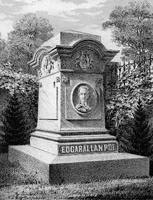
After over two decades buried in an unmarked corner of the cemetery at Baltimore's Westminster Church, Poe’s body was re-buried where people could see it from the street. A new memorial marker was dedicated on November 17, 1875.

The monument was substantial. Money for it was raised by several parties, including a Baltimore schoolteacher named Sara Sigourney Rice. Rice kicked off a "pennies for Poe" campaign and even asked her students to perform public speeches to raise funds. The final $650 came from Philadelphian George William Childs. The design came from architect George A. Frederick, built by Colonel Hugh Sisson, with a stone medallion of Poe by artist Adalbert Volck (later replaced). The total cost of the new monument was equal today to over $28,000.

Despite all the hard work on the monument, Poe's birthday was incorrectly chiseled as January 20 instead of January 19. It has never been corrected. On his birthday ten years after his reburial, Poe's long-dead wife Virginia Poe was buried with him. Maria Clemm was buried there too, bringing the family trio together for their eternal rest.

The ceremony to dedicate the new monument included speeches from Neilson Poe, Poe's oft-maligned cousin. Several famous poets were invited to attend. The only one that made it was Walt Whitman, then age 56, who was still recovering from a stroke.

Letters, poems and remembrances were contributed his one-time fiancee Sarah Helen Whitman and his occasional enemy James Russell Lowell. Other acknowledgments came from John Greenleaf Whittier ("The extraordinary genius of Edgar Poe is now acknowledged the world over"), William Cullen Bryant (Poe is "distinguished alike for originality in the conception, skill in word-painting, and power over the mind of the reader") and even Henry Wadsworth Longfellow (who noted: "The fever called Living is conquered at last"). Some of the greatest lines in honor of Poe came from fellow 2009 bicentennial poets Alfred Lord Tennyson, who later said that "neglected spot" would be the first place he would visit on a trip to the United States, and Oliver Wendell Holmes. As Dr. Holmes wrote:
His monument shall be his gentle verse,
Which eyes not yet created shall o'er read.
And tongues to be his being shall rehearse,
When all the breathers of this world are dead.
* People still leave "pennies for Poe" at this memorial today. This has become a tradition at the graves of famous figures, particularly writers. Poe did not originate the tradition, however.

Monday, November 9, 2009

Ultima Thule


On November 9, 1848, Sarah Helen Whitman convinced Edgar Poe to have his daguerreotype taken in Providence, Rhode Island. It was a few days after Poe's alleged suicide attempt. Whether a true attempt at killing himself or not, Poe was quite ill that day. This image, which has become one of the most iconic images of any American writer (though at least one of Walt Whitman could compete for it) has been many things to many people. It has been used as evidence of Poe's depression, his poverty, his physical idiosyncrasy, or even proof of what killed him (i.e. carbon monoxide).

To Whitman, it was a "sombre & tragic portrait.” She nicknamed it the "Ultima Thule" portrait, in a letter to John Ingram almost exactly 26 years later (the letter was dated November 13, 1874). This image of Poe, at the furthest habitable region of the world, now only exists in copies; the original has disappeared. He died 11 months after he sat for it.

I leave no further commentary; the image is simply too important.

Tuesday, May 5, 2009

"Txld yxu sx, yxu knxw!"

One of the many pieces published in the Flag of Our Union toward the end of Poe's life was the comedy "X-ing a Paragrab" — released on May 5, 1849, though the issue carried the cover date of May 12. "X-ing a Paragrab" is, quite simply, one of Poe's funniest works, and its humor easily stands the test of time after a century and a half.

The story follows a "wise man" from the east named Mr. Touch-and-go Bullet-head, whose intellect is easily proven by his being an editor. He also had a bit of a problem with stubbornness, which he considered his greatest strength. After moving to Alexander-the-Great-o-nopolis ("or some place of similar title") in the West, he established a newspaper called The Tea-Pot, assuming no other newspaper existed. He was wrong; the Alexander-the-Great-o-nopolis Gazette had been quite successful for years. Nevertheless, Bullet-head establishes his Tea-Pot offices right next door to the Gazette. As you can imagine, rivalry ensues. No matter how often I read it, Bullet-head's final editorial in The Tea-Pot always has me laughing out loud. Try it yourself. Seriously, read it!!

Poe was openly mocking a couple of things that make the humor even deeper. For one, he was clearly making fun of the "irascibility," "firmness" or, really, obstinacy of editors like Bullet-head. He also mocked the sort of rivalries which became common in the press during this period. Newspapers were battle-grounds; for example, many staunchly supported one political party over another, resulting in back-and-forth arguments printed between opposing party papers. Poe was stretching to ask what would happen if these rivals took their wars beyond the printed page (though, ultimately, the war stays within those printed pages anyway).

Poe's humor has had many, many critics, who suggest that Poe knew nothing about comedy and was only able to present dark, death-obsessed comedy. "X-ing a Paragrab" is either the exception or the proof that this generalization is untrue. There is no blood or gore in this story, even for humorous effect. This is, to put it simply, a cute comedy — and it really is funny.

I also use the story as an example to note Poe's understanding of the printing technology of the day. The humor relies on movable type. There is evidence that Poe was directly responsible for typesetting here and there throughout his career as a writer. As an aside, Walt Whitman knew about movable type as well and personally oversaw the type-setting for the first edition of Leaves of Grass, resulting in the poem's odd yet artistic spacing.

I will be speaking more in-depth on Poe's understanding of his contemporary publishing world, including its technology, a week from today at the Boston Public Library. The lecture, sponsored by the bibliophiles in The Ticknor Society, is called "Poe and Publishing." All are invited: May 12 at 6:00 p.m. in the orientation room of the McKim Building.

Monday, February 2, 2009

Virginia's funeral

Virginia Clemm Poe died on January 30. Her obituary in the New York Daily Tribune her death "of plumonary consumption, in the 25th year of her age, VIRGINIA ELIZA, wife of EDGAR A. Poe". A young Walt Whitman also made a notice of her death in the Brooklyn Eagle. On February 2, 1847, her funeral was held and she was buried (for the first time).

Not having a lot of money at this point, Poe turned to his landlord, John Valentine, in Fordham, New York. The Valentine family had taken an interest in the Poes and were willing to have Virginia buried in their family plot in a Dutch Reformed Church near the cottage they rented to the Poes (seen in the image at right, the Fordham Cottage is open to the public!). Funeral attendees included Nathaniel Parker Willis, Mary Valentine, Sarah Anna Lewis (presumably), Poe's cousin Elizabeth Rebecca Herring, and possibly Evert Augustus Duyckinck, Cornelius Mathews, and other (then) important literary figures. It was a cold afternoon and Poe wore the great grey coat he was issued at West Point — which had previously been used as a blanket by Virginia on her deathbed.

It is speculated that it was only a few hours after Virginia's that Poe, realizing he had no image of his wife, commissioned a water color portrait (possibly painted by Mary Louise Shew). For a time, it was believed this, a portrait of her corpse, was the only image of Virginia in existence. Some time ago, however, a more flattering oil portrait was found in the possession of the Herring family.

Mary Louise Shew, a friend who had served as an amateur nurse in Virginia's final days, helped arrange for the funeral. After Virginia's death, she tried to take care of Poe, who was suddenly ill. She also helped make the controversial diagnosis that Poe had a brain lesion or brain congestion — leading to more modern speculation about his death two years and eight months later.

Shortly after Virginia's funeral, possibly a day or two, Poe scribbled out a couplet — the beginning of a poem he never finished:

Deep in earth my love is lying
And I must weep alone