Showing posts with label Philadelphia. Show all posts

Saturday, November 21, 2009

In not the most gentle manner

Poe began a lecture tour on November 21, 1843 in Philadelphia. The broad topic was "The Poetry of America." This was an era of oratory and many writers knew that lectures and public readings would greatly boost their income. Other writers turned lecturers included James Russell Lowell, Oliver Wendell Holmes, and, of course, Ralph Waldo Emerson, who was so successful as a lecturer it qualifies as his full-time job.

The purpose of this particular lecture was for Poe to discuss the state of American poetry and his literary theories. However, he couldn't resist wielding his tomahawk as a critic. He focused on the poor taste of his critical rival Rufus Wilmot Griswold, whose book The Poets and Poetry of America was published a year earlier and was clearly referenced in the lecture title. One periodical later noted "this book and its author were handled by the critical Lecturer in not the most gentle manner" (what a great euphemism!).

This could be yet another minor reason why the two men would build a major rivalry/enmity for one another. It was shortly after this, in January 1844, that Griswold wrote to Poe about "some cause of personal quarrel with you, which you will easily remember."

One review later remarked that the lecture "placed all the pseudo-critics, the Rev. Mr. Rufus Griswold, Esq. among others, to the blush."

Poe's lecture in Philadelphia was very successful. The Saturday Museum noted it had "quite a large, and certainly highly intelligent audience." According to the United States Gazette, "hundreds" were turned away, "unable to gain admission." The Saturday Courier noted that "it was a very learned critique, marked by the severity of illustration for which the author is so ably known."

Over about four months, Poe also lectured on the same topic in Reading, Pennsylvania and Baltimore, as well as Wilmington and Newark, Delaware. He begins another lecture tour on a similar topic in 1845, culminating in his strange appearance at the Boston Lyceum.

Tuesday, November 10, 2009

Poe preserved by the National Park Service

Though Poe lived in many parts of the United States (born in Boston; raised in Richmond, schooled in England and Charlottesville, VA; stationed in South Carolina; lived and worked in Baltimore, New York City, Philadelphia, The Bronx, etc.) there is only one federally-recognized, federally-funded site dedicated to his memory, and it is in Philadelphia.

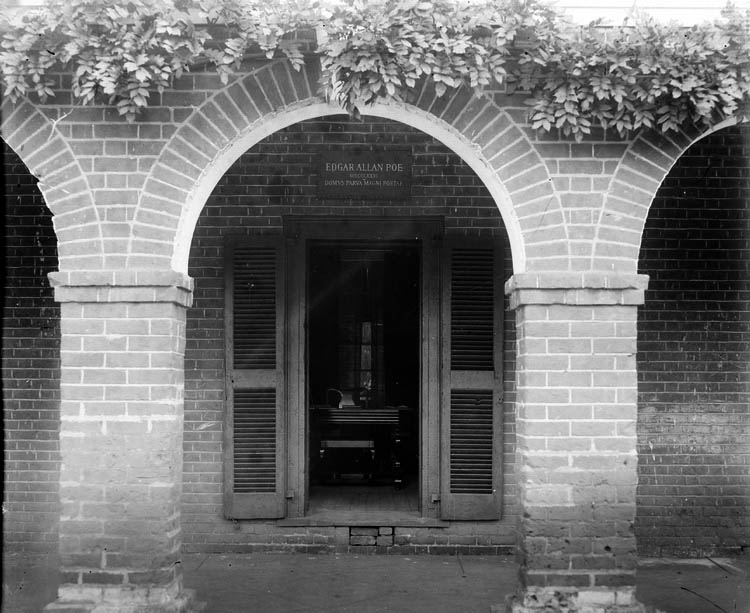
The Edgar Allan Poe National Historic Site was dedicated as part of the National Park Service on November 10, 1978. It remains one of only five literary landmarks funded by the federal government and overseen by the National Park Service.*

Poe's most productive (and, likely, most sober) years were spent in Philadelphia. He lived at this house near the corner of 7th and Spring Garden Streets for less than a year; none of his other Philadelphia homes (and there were many) are still standing. Nevertheless, in this city, Poe published iconic works like "The Tell-Tale Heart," "The Black Cat," "The Balloon-Hoax," and the world-changing "The Murders in the Rue Morgue." It was also during his time in Philadelphia that Poe met Charles Dickens and reviewed his work.

The home's extant status is thanks to Richard Gimbel, who became a collector of Poe. He purchased Poe's former home in 1933, making it the centerpiece of his collection. He claimed that Poe began writing "The Raven" here, though it's not likely. Upon Gimbel's death, the home was donated and became the "official" shrine to Poe. However, none of Poe's furniture survived and, lacking clear information on how the interior of the home looked in Poe's time, the house remains empty under the NPS. They refused to "fake it" and install representative period furniture. The result is a creepy, unfurnished, empty house — complete with decaying walls and decrepit fireplaces.

The home remains open to the public after a renovation to its visitor center (completed just in time for the bicentennial) and is open year-round — and admission is always free.

Other sites related to Poe include the Baltimore Poe House and Museum, the Poe Cottage in the Bronx, Poe's preserved dorm-room at the University of Virginia, and the Richmond Poe Museum.

Happy anniversary to the Poe National Historic Site.

*The other four are: The Wayside in Concord, MA; Longfellow National Historic Site in Cambridge, MA; Carl Sandburg National Historic Site in North Carolina; Eugene O'Neill National Historic Site in California.

Friday, October 23, 2009

Hirst and Poe: Rollicking companions

After Poe's death, Maria Clemm believed much of the negative things written about Poe by Rufus Wilmot Griswold, partly because Griswold had evidence to prove it. It turns out, however, that Griswold forged many of the documents that served as back-up for his concerted character assassination on Poe. Reading Griswold's lies, Maria Clemm lamented: "To think of that villain Griswold dragging before the public all my poor Eddie's faults and not to have the generosity of speaking one word of his good qualities."

That's why Maria Clemm was particularly grateful to the people who came forward in defense of Poe. One such defender was Henry B. Hirst, a friend from Philadelphia. Clemm wrote to him (using black-bordered "mourning" stationary) on October 23, 1849, thanking him for his kind words. As she wrote, "God bless you for doing justice to the memory of my own dear Eddie."

Henry Hirst is a strange character in the study of Poe. The two were introduced in Philadelphia some time in the summer of 1839 (by, of all people, Thomas Dunn English). The two became friends during Poe's tenure in Philadelphia. Though a minor poet at best, Hirst did his best to make money from writing. He even wrote a biography of Poe, published in 1843, in the Philadelphia Saturday Museum. He also reviewed (rather caustically) Griswold's The Poets of Poetry of America in that same newspaper. Poe's own published reviews of Hirst's poetry isn't particularly flattering, though he also accused T. D. English of plagiarizing from Hirst. Poe also though Hirst was stealing his own poetry, but those accusations weren't published in Poe's lifetime ("I do not object to him stealing my verses," Poe wrote; "but I do object to his stealing them in bad grammar. My quarrel with him is not, in short, that he did this thing, but that he has went and done did it."). In fact, Hirst at one point suggested that he was the true author of "The Raven" (who wasn't trying to steal Poe's thunder?), the only evidence being that he owned a pet raven for a time (well, so did Dickens).

Later, after Poe's death, Hirst became a heavy drinker, and it was well-known that he was addicted to absinthe, and soon went insane. The association between Poe and Hirst, especially his defense of Poe and reference to "rollicking" companionship made by John Sartain, led to the rumor that Poe was a heavy absinthe drinker himself (something I still hear about on occasion; a quick Google for "Poe and absinthe" proves there are still people out there perpetuating the rumor). However, as the Edgar Allan Poe Society (Jeff Savoye?) has proven, Poe was almost certainly never an absinthe drinker.

Thursday, September 17, 2009

Poe and politics

Frederick William Thomas came to visit Poe at his house (then on Coates Street in Philadelphia) on September 17, 1842. Years later, he described Poe's home life in the so-called Quaker City:
He lived in a rural home on the outskirts of the city. His house was small, but comfortable inside for one of the kind. The rooms looked neat and orderly, but everything about the place wore an air of pecuniary want. Although I arrived late in the morning Mrs. Clemm, Poe's mother-in-law, was busy preparing for his breakfast. My presence possibly caused some confusion, but I noticed that there was delay and evident difficulty in procuring the meal. His wife entertained me. Her manners were agreeable and graceful... She and her mother showed much concern about Eddie, as they called Poe, and were anxious to have him secure work.
Thomas was a writer himself and, throughout his 60 years, lived in Providence, Charleston, Baltimore, Cincinnati — though it was in Philadelphia that he met Edgar Poe. Thomas maintained a long, frequent correspondence with Poe, three years his junior; letters between the two are very frank, honest, and interesting. Thomas also got his hands dirty in politics and campaigned on behalf of William Henry Harrison, who died shortly after his presidential inauguration. Harrison's successor, the "accidental president" John Tyler, compensated Thomas for his support by granting him a clerkship at the Treasury Department in Washington, D.C.

Thomas hoped his connection with the new president would lead to a job for his friend Poe. Their September 1842 meeting was to discuss this possibility. Robert Tyler, son of the new president, was in town and would likely show his support for granting Poe a government job, Thomas believed. But, Poe knew his preferred path: even as Thomas chatted with Poe about obtaining a government post, Poe chatted about creating his own literary journal. Nevertheless, the struggling writer/critic was somewhat intrigued by government work, which he had heard was easy money. Thomas implied the job was all but his already; Robert Tyler was "remarkably fond of poetry." He agreed to meet Thomas the next morning.

Thomas likely didn't hear from Poe for several days. A letter from Poe dated September 21, 1842 excuses his absence:
I am afraid you will think that I keep my promises but indifferently well, since I failed to make my appearance at Congress Hall on Sunday, and I now, therefore, write to apologize... Upon reaching home Saturday night, I was taken with a severe chill and fever — the latter keeping me company the next day. I found myself too ill to venture out, but, nevertheless, would have done so had I been able to obtain the consent of all parties.
Poe blamed both illness and his wife for not allowing him to meet with Tyler, the president's son. Was he really sick? Was his wife concerned about his health? Or, as biographer Kenneth Silverman concludes, was he just nursing a hangover after a night's drinking? When Poe realized he had missed a good opportunity (apparently, the job promised an annual salary of $1,500 — nearly double what he was making at Graham's Magazine), he wrote he still wanted to pursue the job, "if he [Tyler] can look over matters & get me the Inspectorship I will join the Washingtonians" — a temperance group (years later, Poe did, in fact, join a temperance organization).

Thursday, August 27, 2009

Poe stays sober

Perhaps the biggest event in Poe's life which inspired this blog, what occurred on August 27, 1849 continues to surprise casual readers of Poe who thought they already knew all about the man...

On August 27, 1849, Edgar A. Poe pledged to abstain from alcohol and stay sober indefinitely. It was a Monday evening when he was initiated into the Shockoe Hill Division (no. 54) of the Sons of Temperance, sworn in by William J. Glenn. Speculation has raged as far as how serious Poe was about this pledge. He had to have been somewhat committed to the idea, if only because membership required a fee. He may have done it to impress a potential second wife he was courting in Richmond (more on her another time) or, as biographer Kenneth Silverman speculates, "the effects of his drinking... had frightened him." A few days earlier, after one of his (rare but excessive) binges, a doctor suggested that drinking would kill him.

The reality is that throughout his life, Poe was aware of the problems that alcohol caused him, and he often made an effort to avoid drinking. Extant letters show updates Poe gave to friends and family about his efforts. But, even if we can't trust Poe's first-hand claims, other accounts do exist. For example, one friend reported that Poe went a full eighteen months* without a single drop of alcohol while living and working in Philadelphia. This undisputed account lends serious evidence against the prevalent image of Poe as a perpetual drunk. His joining the Sons of Temperance in 1849 may have been a final declaration that he would win his battle against alcoholism.

What really would have helped Poe stick to being sober this time? I'd speculate that Poe hoped the special nature of his pledge would make a difference: His membership was very public and, within three weeks, several newspapers were reporting about it in Richmond, Raleigh, Philadelphia, and Boston. Temperance advocates considered Poe's membership a great victory and a boon to their cause as they hoped he would lend his pen to the movement. One wrote, "We trust his pen will sometimes be employed in its behalf. A vast amount of good might be accomplished by so pungent and forcible a writer." Poe, in fact, had already written two temperance tales, of a sort: "The Black Cat" and the humorous "The Angel of the Odd." Writing was important to the group as a form of propoganda to get the word out about their movement; the Sons of Temperance would soon even create their own literary journal (edited by T. S. Arthur, author of Ten Nights in a Bar-Room).

The fact that Poe vowed to stay sober has led to further confusion over his final days right before his mysterious death — which will occur less than two months after taking his temperance pledge.

Perhaps ironically, August 27 is also the anniversary of the death of one of the many responsible for exaggerating Poe's drinking habits. Rufus Wilmot Griswold died this day in 1857 at the age of 42.

* There does not seem to be any question over the veracity of this statement. Give Poe credit for what he was doing: Poe kept his alcoholism in check before it was considered a disease, before self-help books, before AA meetings, etc. By the way, the image above is from a great online exhibit by the Library Company of Philadelphia called "Ardent Spirits."

Saturday, August 8, 2009

Bitten by "The Gold-Bug," cont'd

It's hard for some to believe that the single most successful of Poe's prose works during his lifetime was not a horror story. In fact, the most-read story and the one which earned him the most money was an adventure tale called "The Gold-Bug." In the story, which is set in South Carolina, a seemingly mad loner named Legrand discovers a gold scarab which he believes is the key to buried treasure. Legrand breaks a secret cryptogram to discover gold coins and jewelry left years behind by the pirate Captain Kidd (upon seeing the treasure chest open, the narrator remarks: "As the rays of the lanterns fell within the pit, there flashed upwards a glow and a glare, from a confused heap of gold and of jewels that absolutely dazzled our eyes." A couple paragraphs later is an extensive description of all that they found.).

Audiences ate up "The Gold-Bug" when it was first published in 1843, bringing Poe's name into the homes of many more Americans than ever before. In fact, the story proved so popular that a stage production was adapted shortly after publication. This dramatic presentation of the story opened on August 8, 1843, at the Walnut Street Theatre in Philadelphia; this performance is the earliest adaptation of Poe's works into another medium. As one newspaper noted, the play was part of a "Farewell Benefit" for playwright Silas S. Steele, who was about to depart for England. The benefit started with a performance of Steele's drama Clandare and it would "conclude with an entire new piece, entitled THE GOLD BUG, Or, The Pirate's Treasure." The African servant Jupiter was performed by "Coal White" (a stage name, possibly a white man in black face).

The play, however, did not fare as well as the original story. John Du Solle of the Spirit of the Times noted: "Mr. Steele had a good house at his benefit on Tuesday night, and the performances were generally good. The Gold Bug, however, dragged, and was rather tedious. The frame work was well enough, but wanted filling up."

I can't imagine "The Gold-Bug" would easily translate into a stage play. One of the aspects of the story which makes it so novel is the secret message which Legrand decodes. A reader can play along and try to decipher the message himself; a 19th-century theatre isn't likely to replicate that experience. I haven't read any speculation as far as Poe's financial benefit from the play. I would speculate he earned nothing at all from it, other than some recognition. The original publication of "The Gold-Bug," however, earned him a hefty $100.

Friday, July 31, 2009

Silence like a sea that overwhelms

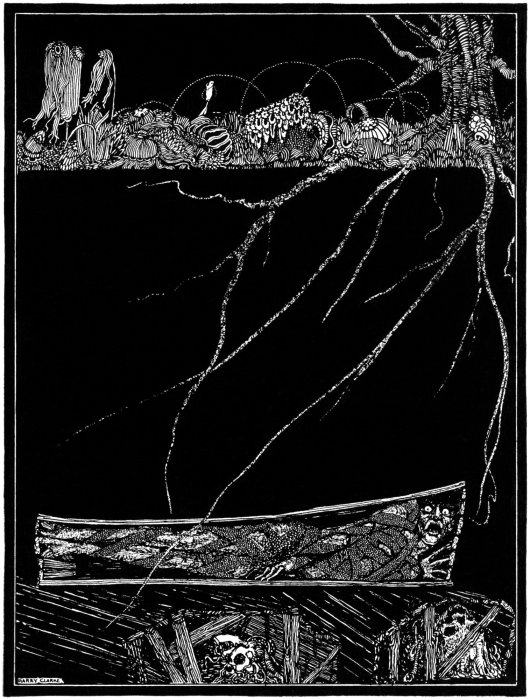
Perhaps the quintessential Poe short story that few have read, "The Premature Burial" was published for the first time in the July 31, 1844 issue of Philadelphia's Dollar Newspaper. Only a few of Poe's works feature the concept of being buried alive, yet, for some reason, I often read that Poe was obsessed that he would be buried prematurely. It's hard to say if this is true but I have yet to find any evidence at all that Poe was personally concerned with being buried alive.

Instead, Poe was responding to the popular concern about premature burial among his readers. Poe was, after all, a pop culture writer trying to appeal to a mass audience (the most obvious piece of evidence is that "The Premature Burial" was published in a cheap newspaper, not a high-end book). Even Poe's only novel was a direct response to the common interest of the masses.

I could argue that the reason American readers were suddenly interested in stories about premature burial is based on a general interest in death at the time. Concepts of death shifted from a Puritan "dirty death" point of view to a more romantic Victorian idealism. Medical science, however, was beginning to help define the moments where life and death meet at the same time that Spiritualism, galvanism, and similar movements were becoming popular. All of this created, I think, a sort of anxiety over death. Coffins in Poe's time could be affixed with bells and other emergency devices in case the "deceased" suddenly awoke after burial, organizations like the "Society for the Prevention of People Being Buried Alive" were formed, and it was reported that hundreds of people were mistakenly pronounced dead while, in fact, still living.

Can you blame Poe for writing a story like "The Premature Burial"? As Poe writes in this tale,
It may be asserted, without hesitation, that no event is so terribly well adapted to inspire the supremeness of bodily and of mental distress, as is burial before death. The unendurable oppression of the lungs — the stifling fumes from the damp earth — the clinging to the death garments — the rigid embrace of the narrow house — the blackness of the absolute Night — the silence like a sea that overwhelms — the unseen but palpable presence of the Conqueror Worm — these things, with thoughts of the air and grass above, with memory of dear friends who would fly to save us if but informed of our fate, and with consciousness that of this fate they can never be informed... We know of nothing so agonizing upon Earth — we can dream of nothing half so hideous in the realms of the nethermost Hell.
In addition to being written specifically to appeal to popular tastes, what makes the story so quintessentially Poe? Well, its vaguely frightening storyline is not based on blood, guts, violence, or the supernatural. Instead, it's a psychological story that creeps you out more than scares you. And, also very Poe-like, the story turns out to be a comedy at the end. Who knew??

By the way, Poe's other stories which feature premature burial are "Berenice," "The Cask of Amontillado" and, most notably, "The Fall of the House of Usher."

*Above, "The Premature Burial," as illustrated by Harry Clarke, 1919.

Monday, July 13, 2009

A wedding and a death

At a ceremony held at St. John's Protestant Episcopal Church in Baltimore, presided over by "Rev. Mr. Wyatt," William Clemm Jr. married Maria Poe on July 13, 1817.

Maria Poe was the younger sister of David Poe, Jr. — other siblings were John Hancock Poe, William Poe, George Washington Poe, Samuel Poe, and Elizabeth Poe. She was William Clemm's second wife and their marriage would produce three children: Henry Clemm, Virginia Marie Clemm, and Virginia Eliza Clemm (the first Virginia died as an infant; her younger sister was born the same year and given her name as an honor). That second Virginia Clemm would later marry Edgar A. Poe.

Very little is known about the marriage of William Clemm and Maria Poe Clemm. He already had five children from his first marriage and very little property or money when he had his second marriage. His first wife, in fact, was Maria's first cousin Harriet Poe. He died in 1826 and left what little he had to the five children from his first marriage. It's likely he never met Edgar Poe, who was living overseas with the Allans at the time of this marriage.

A relative of Clemm, presumably a nephew, became minister of the Methodist Episcopal Church in Baltimore — and presided over the three-minute burial service held after Poe's death in 1849.

Today also marks the death of George Rex Graham in 1894. Over his 81-year life, he experienced a series of ups and downs. Between 1839 and 1840, he acquired the Saturday Evening Post and then merged two Philadelphia journals to create Graham's Magazine. Shortly after, he hired Poe as his book review editor at the salary of $800 a year. Though Poe questioned the "namby-pamby" magazine on occasion, he helped lead it to become one of the most prominent publications in the country. Graham was concerned about his writers: his magazine was one of the first in the U. S. to copyright each issue and some writers (if they were paid at all) were granted an average five times more than other magazines. After Poe left, Graham hired Rufus Wilmot Griswold to replace him.

Nevertheless, Graham was pushed into bankruptcy in 1848 and lost controlling interest of both the Saturday Evening Post and Graham's Magazine. The latter magazine ceased publication in 1858. At the age of 70, Graham lost his eyesight and relied on the financial assistance of publisher George William Childs. The one-time powerhouse of American publishing, Graham died in obscurity in Orange, New Jersey on July 13, 1894 and was buried in Philadelphia's Laurel Hill Cemetery — apparently unmarked (I could not find it after three or four attempts).

Thursday, July 2, 2009

Poe, Prison, Pursuers, and a Shaved Moustache

One of the oddest moments in the last few months of Poe's life is so confusing, even the date is unclear. Rumors abound on what Poe was doing in the first few days in July 1849. July 1, it is claimed Poe was jailed in Philadelphia "for getting drunk" — according to Poe himself, who also denies the charges. Poe's friend, the mezzotint engraver John Sartain, later claimed Poe's detainment in Moyamensing, the Philadelphia County Prison (no longer standing), lasted "for a few hours only." The mayor of Philadelphia soon recognized Poe and had him released "without the customary fine."

Ah, John Sartain.

Sartain was a frequent collaborator with Graham's Magazine. In fact, at one point, George Rex Graham says that the engravers like Sartain were followed just as much as the famous writers in the magazine. Sartain apparently believed it, and tried to take credit for the magazine's success. Eventually, he was so confident in his appeal that he split from Graham's to found Sartain's Union Magazine in 1849. In November, shortly after Poe's death, his was the first to publish Poe's poem "The Bells."

Possibly July 2, 1849, Sartain was visited by Poe at his Philadelphia home on Sansom Street. Poe was "pale and haggard, with a wild and frightened expression in his eyes," Sartain later recalled. Poe was looking for "refuge and protection" because he was being followed by men trying to kill him — he had overheard their murderous plan while on the train. Sartain asked why anyone would want to kill him, Poe answered it was "woman trouble." To conceal his identity, Poe asked for a razor so that he could shave off his mustache. Sartain suggested he do it himself using a pair of scissors. Poe agreed and, as Sartain wrote, "Accordingly, I took him to the bathroom and performed the operation successfully."

After a walk for fresh air, Sartain took him back to his house and helped him to bed (the sofa in the dining room, actually). Sartain himself lined up three chairs for a bed of his own and slept next to his friend, "without undressing." It seems Poe stayed with Sartain until July 4; that day, Poe claims his pursuit was just paranoia or hallucinations "created by his own excited imagination."

This strange episode with Sartain (and the disappearing mustache) has often confused Poe scholars. Did the event really happen? Was Poe really being pursued by murderers? Was he hallucinating? What could have caused Poe's hallucinations?

The episode has been used as evidence for some of the many theories on Poe's mysterious death, which occurred just over four months later. Some scholars suggest Sartain's memory was off and the date is inaccurate and might refer to a different year.

*Pictured above is an engraving of Poe by John Sartain, based on a portrait by Samuel Stillman Osgood. The lack of mustache in the image has nothing to do with the July 1849 incident; Poe did not grow the moustache until some time in 1846 or 1847. Prior to that, he kept long mutton-chops, as seen in this image.

Saturday, June 6, 2009

Poe's Penn Prospectus

On June 6, 1840, George Graham reported in the Saturday Evening Post that Edgar A. Poe had announced his plans to launch his own journal, the Penn Magazine. Graham, Poe's one-time boss at Graham's Magazine (Poe quit to pursue his own publishing venture; he would be replaced by Rufus Griswold) offered his best wishes: "The gentleman who issues the prospectus and proposes to be publisher and editor, is so well known in the literary world, that commendation would be useless... We wish him success in his new undertaking, and congratulate him."

The same week, the Pennsylvania Inquirer reported: "Edgar A. Poe, Esq. has just issued proposals for a monthly literary journal, to be called the 'Penn Magazine.'" Another notice was posted by the Philadelphia Gazette and several other newspapers. Support for the Penn was ample. Charles W. Alexander of the Daily Chronicle noted his pleasure at the idea that "Mr. Poe will again enter the field of literature." He noted that Poe "has a fund of talent" (a great phrase!) and offered his best wishes to Poe's success. "We ardently hope that he may succeed in his new enterprise," Alexander wrote. Critic Willis Gaylord Clark was inspired to write to, of all people, Henry Wadsworth Longfellow about his excitement over the idea:
Mr. Edgar A. Poe will issue in this city on the first of January next, and continue thereafter in monthly numbers, 'The Penn Magazine.' Mr. Poe is a clear and vigorous writer; a discriminate and fearless critic, — and we shall be pleased to find him reigning in his own sphere, where his classic power and genuine good taste, untrammeled by base or palsying associations, shall have full scope and play. We do not doubt that the Penn Magazine will add to the reputation of its conductor, and do honor to its name.
Many of these magazine printed the prospectus in question, usually as a paid advertisement. It read as follows:
Prospectus of the Penn magazine, a monthly literary journal, to be edited and published in the city of Philadelphia, by Edgar A. Poe. — To the Public... To those who remember the early years of the [Southern Literary] Messenger, it will be scarcely necessary to say that its main feature was [a] somewhat overdone causticity in its department of Critical Notices. The Penn Magazine will retain this trait of severity in so much only as the calmest and sternest sense of literary justice will permit. One or two years, since elapsed, may have mellowed down the petulance, without interfering with the rigor of the critic... It shall be the first and chief purpose of the Magazine now proposed, to become known as one where may be found, at all times, and upon all subjects, an honest and fearless opinion... The Penn Magazine will be published in Philadelphia, on the first of each month, and will form, half yearly, a volume of about 500 pages. The price will be $5 per annum, payable in advance, or upon the receipt of the first number...
Though the Penn would never come to be, even in its later name The Stylus, it was a substantial dream for Poe to begin his new journal. What makes this potential business venture unique from other publications was the critic's fearless voice — a distinct response to the "puffing" which was rampant in American letters. This type of criticism was the selling point of Poe's journal — and was what Poe's supporters believed would lead to its success. Often, in modern times, we dismiss Poe's criticism as being too harsh — but it is this type of criticism which built Poe's reputation, gained the respect of fellow editors, and which would have launched his journal with tremendous support.

If only Poe's dream came true! The closest he came was when he became, by default, the sole owner of the Broadway Journal. It ceased publication shortly after and Poe continued his quest to begin his magazine.

Sunday, May 10, 2009

The mystific panic of 1837

On May 10, 1837, the New York City banks suspended payments in specie (gold and silver). The date is now agreed to be the start of one of the worst depressions in American history: the Bank Panic of 1837.

The Second Bank of the United States had been chartered by Alexander Hamilton. Andrew Jackson chose not to renew their charter, forcing them to close under the presidency of Martin Van Buren. The value of paper money fell to nothing, credit was refused, and payment in gold or silver was demanded. Banks, like those in New York which suspended specie payments on May 10, had more paper money circulating than the gold and silver they had to back it up. One group called for paper money under $100 to be banned completely so that only gold and silver be used permanently. The resulting "panic" was immediate. City Hall in New York was mobbed with people demanding prices on goods be forced down. A flour warehouse in that same city was robbed and the excitement had to be quelled by state militia. Mills and factories closed, banks went out of business, and even state governments were denied loans.

New York City, the center of national publishing in the United States, was hit especially hard (note that other publishing centers — including Baltimore, Hartford, and Boston — generally printed only regionally; New York was the first to print for a nation-wide audience). In addition to the panic, a severe fire in the publishing district destroyed many warehouses, printing machinery, and entire companies.

Edgar A. Poe had moved to New York in February 1837, hoping to make it big as a writer. The Panic, as you can imagine, stymied his literary output. His only major work that year was an obscure comedic short story, "Von Jung, the Mystific" — now known as "Mystification." Poe had hoped that publishing a novel would get his name out there but the panic also caused delays and other troubles for his novel The Narrative of Arthur Gordon Pym of Nantucket (which was eventually released in two volumes in 1838). He soon gave up on New York and moved to Philadelphia — his several years in that city became his most prolific writing period.

Panics happened with some regularity in the 19th century in the United States. 1818 and 1857, for example, saw difficult panics. Another popped up in 1873, ten years after a National Banking Act was passed.

This economic climate and its effect on the publishing industry are one part of my upcoming lecture, "Poe and Publishing." Sponsored by the bibliophiles of the Ticknor Society, this talk will take place on May 12 at 6:00 p.m. in the Orientation Room of the Boston Public Library. If you drop by, introduce yourself!

Sunday, April 19, 2009

Griswold and Graham's

It's hard to tell for certain when the first edition of The Poets and Poetry of America hit book stores. It wasn't until April 18, 1842, however that the anthology's editor, Rufus Wilmot Griswold, was informed by publishers that it was finally published. As Carey & Hart (Philadelphia) wrote to Griswold (in New York): "We have at last published the 'Poets & Poetry of America' & a handsome Book it is."

The publisher must have rushed copies to important or influential literary figures on that first day. George Rex Graham in Philadelphia, the proprietor of the very popular Graham's Magazine, almost immediately jumped to take advantage of the rising star of Griswold. He wrote only a day later, April 19, 1842:

"Have you fully determined on assuming the Chaplaincy* and to abandon the editorial chair? Or could you find it in your heart to locate in Philadelphia? Let me hear from you, as I have a proposal to make. I like your book very much. We received it from Carey & Hart on yesterday, and although it will give offense to a few, it must be popular, and it will please every man of taste."

Graham had recently parted ways with his famous editor, Edgar Poe, who had miraculously increased circulation to 40,000, but resigned in late March. What really drove sales up was Poe's infamous critical review style, which was somewhat controversial. The Arcturus (edited by Cornelius Mathews and Evert Augustus Duyckinck) noted Poe's reviews as "elaborate" and "richly deserving of attention," though he was "somewhat over literal and minute, looking oftener to the letter than the spirit."Joseph Evans Snodgrass in the Saturday Visiter in Baltimore wrote that Poe was "an excellent reviewer" even though he was "at times, provokingly hypercritical." James Russell Lowell was a little less euphemistic and wrote that Poe occasionally mistook "his phial of prussic acid for his inkstand."

The "proposal" Graham wanted to offer Griswold was Poe's former role. Griswold seems to have accepted without hesitation and moved to Philadelphia to take the job with Graham's (leaving his family behind in New York). The transition was so quick, a rumor persisted (and still does in some circles) that Poe came to clean out his desk and saw Griswold already sitting there. The rumor is quite untrue. Nevertheless, Griswold was paid $1000 — $200 more per year than Poe — likely building up some of the animosity between the two.

Griswold's run on Graham's was significantly less successful than Poe's. Though he was able to bring in substantial writers (including James Fenimore Cooper and Henry Wadsworth Longfellow), he never earned much respect there. In fact, a year after he took over, George Lippard wrote, "It was Mr. Poe that made Graham's Magazine what it was a year ago; it was his intellect that gave this now weak and flimsy periodical a tone of refinement and mental vigor."

*Griswold had recently earned the title of "Reverend," though he never had a regular congregation.

Tuesday, April 7, 2009

The Poe family leaves Philadelphia

Though Poe had his work published throughout the United States, the Edgar Allan Poe National Historic Site specifically commemorates his time in Philadelphia — considered to be his most prolific, most lucrative, and happiest period. Here, he published "The Gold-Bug," "The Murders in the Rue Morgue," "The Black Cat," and "The Tell-Tale Heart" (to name a few). He lived in several homes throughout the city, the last of which was the one here on Spring Garden St. It is also the only of his Philadelphia homes still standing.

This post, however, is about the end of that several-year period in 1844. Poe and his wife Virginia left their Spring Garden home early on April 6, traveling via train to Perth Amboy, New Jersey and from there taking a steamer to New York. Virginia, who Poe called "Sissy," was already sick with tuberculosis and would die within three years. Nevertheless, they were optimistic and hoped that a relocation to New York would solve their problems.

The next day, April 7, Poe wrote to his mother-in-law Maria Clemm, still in Philadelphia. "We started in good spirits, but did not get here until nearly 3 o'clock... Sissy coughed none at all." The day was a rainy one and Poe left Virginia behind on the boat while he tried to find a place to board. He found a boarding-house at 130 Greenwich Street in lower Manhattan and went back for Virginia. They celebrated their arrival in style:
Last night, for supper, we had the nicest tea you ever drank, strong & hot — wheat bread & rye bread — cheese — tea-cakes (elegant) a great dish (2 dishes) of elegant ham, and 2 of cold veal, piled up like a mountain and large slices — 3 dishes of the cakes, and every thing in the greatest profusion. No fear of starving here... I feel in excellent spirits & have'nt drank a drop.
Poe concludes the letter by noting that Sissy cried later that night because she missed her mother — and the family cat, Catterina.

The letter has been analyzed by several Poe scholars, who question the veracity of their big meal, how they could have afforded it, why Poe was sure to note he wasn't drinking, why Virginia was crying, and how juvenile she must be for missing the cat (she was 21 years old at this point).

Either way, Poe's time in New York will be a struggle, financially and emotionally. Yet, here he will also meet one of his greatest successes with the publication of "The Raven." And don't think that New York has forgotten their adopted son. Walking tours of Greenwich focusing on Poe are offered, and the last home in which Poe lived — the Poe Cottage in Fordham — is open to the public.

Saturday, March 7, 2009

Dickens and Poe in Philadelphia

The date is uncertain, but Charles Dickens and Edgar A. Poe met some time in March 1842, likely March 7.

As part of his tour of the United States, Dickens arrived in Philadelphia on March 5 and lodged at the United States Hotel on Chestnut Street above Fourth Street. By this time, Dickens had published a handful of works, including Oliver Twist, The Life and Adventures of Nicholas Nickleby, and Barnaby Rudge: A Tale of the Riots of 'Eighty (his A Christmas Carol would be published in 1843). Poe saw a great opportunity to rub elbows with an admired literary figure and wrote him a letter requesting an interview. Dickens responded with his own letter, dated March 6, 1842:

I shall be very glad to see you, whenever you will do me the favor to call... I have glanced over the books [apparently a copy of Tales of the Grotesque and the Arabesque] you have been so kind as to send to me; and more particularly at the papers to which you called my attention [Poe's review of Barnaby Rudge] . I have the greater pleasure in expressing a desire to see you, on their account.

Presumably, the two writers met on March 7, likely at the United States Hotel where Dickens was staying. The major topic of discussion was the state of American poetry. Poe read to Dickens a poem called "A Humble Bee" by Ralph Waldo Emerson. Dickens, apparently a sincere admirer of Poe's works which he "glanced over," offered to find an English publisher for Tales of the Grotesque and Arabesque (he never did). And Poe, always thinking like an editor, tried to convince Dickens to write for Graham's Magazine - Dickens slyly responded that he would, if he contributed to any American magazine.

By March 9, Dickens left Philadelphia and made his way to Washington, D.C., the next leg of his United States visit.

For more on the connection between Poe and Dickens, please read my prior post on "Charles Dickens with his raven."

Sunday, November 30, 2008

50 days

It's about 50 days away from the big day - January 19, 2009. My plans (right now) are to attend the first weekend of the "official" Edgar Allan Poe bicentennial celebration in Baltimore. The inimitable John Astin is reprising his impersonation of Poe himself. Tickets go on sale as of December 1, and I'm sure they will sell quickly (they tend to sell out anyway; this time around might just be quicker).

Other events are scheduled all over. Richmond is hosting a 24-hour birthday party at the Edgar Allan Poe Museum. Philadelphia has its own event planned, celebrating the grand re-opening of the Poe National Historic Site with refurbished house and brand new exhibits (and one-time equivalent of the Poet Laureate Daniel Hoffman). Shockingly, even the city of Poe's birth is taking part. Boston is infamous for its 199-year long snubbing of Poe but a small (and dedicated) group are trying to give him his due at Boston College. So, there are plenty of options as far as where to celebrate. Where will you be?

Just a reminder that you can spend all 365 days of 2009 celebrating Poe's 200th birthday... err, year. Click here to purchase your copy of the Poe bicentennial desk calendar.

Friday, November 21, 2008

Poe calendar in Philadelphia!

Sorry for the late notice... but, if you're in Philadelphia this weekend, come support the Poe calendar at the Edgar Allan Poe National Historic Site! I'm promoting the calendar there (7th and Spring Garden St) as well as lecturing on the Poe-Longfellow War, what I'm calling "The War of the Words." I found out some interesting stuff about this literary battle after being able to view it from both the Edgar Allan Poe angle and the Henry Wadsworth Longfellow angle. Putting the two together definitely made the story a bit more expansive. I'll be presenting my own conclusion as well, answering the question, "Was Poe right?" It's a phenomenal story, and even I was surprised by what I found.

Edgar Allan Poe National Historic Site
7th and Spring Garden St.
Philadelphia, PA
Saturday, November 22 @ 2:00 p.m.
FREE EVENT!
(Calendars will also be on sale)