Showing posts with label bicentennial. Show all posts

Sunday, October 18, 2009

Bicentennial of Thomas Holley Chivers

Thomas Holley Chivers was born in Georgia on October 18, 1809 — about eight months after Poe. Chivers went on to become a poet in his own right, though it has become quite impossible to talk about Chivers without mentioning Poe.

The two spent several years corresponding (probably about nine years, according to John Ward Ostrom) and met face-to-face only once (in 1845 in New York). Most of their interactions were because of money; Chivers was independently wealthy, and Poe needed financial backing for his dream project to publish The Stylus. Chivers certainly admired Poe, and invited Poe to live with him in Georgia. Biographer Charles M. Lombard suggests Chivers wanted to take care of Poe financially while he converted him to Swedenborgianism and Temperance. Many suggest Chivers was a Transcendentalist, despite being in the South, making his friendship with Poe all the more unique. Most often, scholars debate whether Poe stole his poetic ideas from Chivers (as Chivers accused) or if Chivers, a minor poet, was stealing from Poe.

Consider this elegy written by Chivers after Poe's death. It's called "The Fall of Usher":

"Thou art gone to the grave!" but thy spirit is shining,
And singing afar in the Realms of the Blest;
While the living are left by thy cold grave reclining,
And mourning for thee while they long for thy rest —
Left mourning for thee while they long for thy rest!

"Thou art gone to the grave!" thou art gone where thy slumber
No more shall be broken by sorrow or pain —
Soon to rise with that host which no mortal can number,
To lie down no more in that Valley again!
No more to lie down in that Valley again!

"Thou art gone to the grave!" there is none can restore thee,
Or bring thee again from that Silent Abode!
But the Conqueror of Death went to dwell there before thee,
And He has prepared thee the way to thy God!
Prepared thee the way to thy Beautiful God!

"Thou art gone to the grave!" thou art silently sleeping
A sleep which no sorrow shall ever molest;
And, in longing for which, my poor heart now is keeping
This silent lament in its grave in my breast!
Like Shelley for Keats, in its grave in my breast!

"Thou art gone to the grave!" let the dark Weeping Willow
Bend over thy grave where thy beauty was laid!
While thy form, thus reclined on the earth for its pillow,
Shall live in the Spring-flowers which bloom at thy head —
To feed the young Butterflies born at thy head.

"Thou art gone to the grave!" where the Violets are springing,
And feeding upon thee above the damp sod,
Now thy Pandemos mourns, while thy spirit is singing,
And drinking delight from the Fountains of God —
With thine Ullalume lost from the Fountains of God.
Perhaps more interesting than Chivers's debt to Poe (or vice versa) is how complicated the Georgian poet's life was. At 18 years old, he married his 16-year old first cousin. While she was pregnant with their daughter, a meddling uncle suggested that Chivers physically abused his wife (the facts are still uncertain) and she left him before their daughter was born. Chivers likely never saw her. Several lawsuits were exchanged between the couple (Chivers always seems to have won out) but they never legally divorced; instead, Georgia law voided their marriage for being separated for five years. In his will, he left his first wife and daughter exactly $1. Escaping Georgia for a time, he moved to Tennessee and became a medical doctor.

He remarried in 1834 to a Massachusetts woman named Harriet Hunt. Four years later, Chivers's mother died and four years after that his favorite daughter Allegra Florence Chivers died (on his birthday, 1842). His three remaining children from Harriet Hunt died within four months. So, by 1848, the time that Chivers is asking Poe to move to Georgia, all his children had died or been taken from him.

After Poe's death, Chivers alternated between defending his friend and accusing him of plagiarism, even going so far as to say "The Raven" was completely inspired by his own work. At one point, he said that he had taught Poe how to write poetry. As literary scholar Randy Nelson wrote: "anybody who's read both Poe and Thomas Holley Chivers can see that one of them 'influenced' the other, but just who took what from whom isn't clear."

Chivers's own poetry isn't terribly good. In fact, it's terribly good. He focused on sound and rhythm and rhyme — sort of like Poe, but brought to incredibly hyperbolic, superlative levels. The sounds in his poems, in fact, are so over the top, they can be somewhat silly. Perhaps this is why Poe once called Chivers "of the best and one of the worst poets in America."

Happy 200th birthday, Thomas Holley Chivers.
(Coincidentally, it's also the birthday of Elizabeth Ellet in 1818.)

Monday, September 21, 2009

Bicentennial of Sophia Peabody Hawthorne

2009 is celebrating more than just Edgar Poe. Another figure who celebrates a bicentennial this year is Sophia Amelia Peabody, later Mrs. Nathaniel Hawthorne. I have no evidence that Sophia (pronounced with a hard i as So-fy-uh) interacted with Poe. But, it's interesting to consider what's happening in Hawthorne's home life while he interacts with Poe.

The April 1842 issue of Graham's Magazine included a brief preliminary review of Hawthorne's Twice-Told Tales, followed the next month by a more substantial full review. Hawthorne was living at the Utopian community Brook Farm, an ultimately unsuccessful Transcendental experiment. Hawthorne wasn't a believer in the experiment, but joined in the hopes of making enough money to support his future wife Sophia. He moved out in October. A few months later, Hawthorne published a humorous sketch on his contemporaries called "The Hall of Fantasy" in the February 1843 issue of James Russell Lowell's The Pioneer. The "Hall" of the title is the haven of quality writing that minor writers aspire to. "Mr. Poe," he wrote, "had gained ready admittance for the sake of his imagination, but was threatened with ejectment, as belonging to the obnoxious class of critics."* Poe's poem "Lenore" was published in the same issue.

The issue impressed Poe enough that he wanted to include Hawthorne as a contributor to his dream journal, The Penn. He wrote to J. R. Lowell asking him to serve as an intermediary on March 27, 1843. By then, Hawthorne had been married to Sophia for about eight months. Two days earlier, Hawthorne had complained to his friend Horatio Bridge about his money situation. "I did not come to see you, because I was very short of cash — having been disappointed in money that I had expected from three or four sources." Those sources likely included Lowell's The Pioneer, which had already gone out of business after only three issues. His financial situation wasn't getting much better when his first child was born. Sophia Peabody Hawthorne gave birth to Una Hawthorne on born March 3, 1844, after a particularly difficult delivery. Five months later, Poe wrote to Lowell and asked, "Do you ever see Mr Hawthorne? He is a man of rare genius."

Hawthorne's great letter to Poe was written from Salem, MA on June 17, 1846. In it, he informs Poe of the upcoming publication of Mosses from an Old Manse and praises Poe's ability to write tales (with a minor pot-shot at Poe's criticism). Five days later, his son Julian Hawthorne was born. After some delay, Godey's Lady's Book published Poe's essay "Tale-Writing — Nathaniel Hawthorne" in its November 1847 issue. By this time, Hawthorne's financial stress was alleviated by a government-appointed job at the Salem Custom-House. The job provided him decent income, but also stymied his literary output; he was forced out of the job in 1848.

Poe died in 1849, a year before the publication of Hawthorne's life-changing work, The Scarlet Letter. I can only speculate what Poe would have thought of the book. My guess is that he wouldn't have cared much for it. The heavy moral tone goes against Poe's theory of the "heresy of the didactic," not to mention how difficult it is to find a novel which Poe liked in general.

Anyway, happy 200th birthday to Sophia Amelia Peabody Hawthorne.

*When republished in Mosses from an Old Manse, Hawthorne excised many of these references. Though he meant it all in good spirit, Hawthorne's use of real names may have impeded his attempts at making money off his writing.

Saturday, August 29, 2009

Bicentennial of Dr. Holmes

Also celebrating his bicentennial in 2009 is Dr. Oliver Wendell Holmes, the doctor-writer who was born in Cambridge, Massachusetts on August 29, 1809.

Through Holmes's lengthy life and career (he was alive in every decade of the 19th century), he would be a doctor, professor, medical reformer, poet, author, essayist, lecturer... a true Renaissance Man. However, many of his major works were not published during Poe's lifetime. His Autocrat of the Breakfast-Table series far off, Holmes's early literary career hinged on only one poem: "Old Ironsides." It was an auspicious beginning; the poem's publication in 1830 is directly responsible for the preservation of the U.S.S. Constitution. At the time, it was in serious danger of being scrapped; today, because of Holmes, it remains the oldest commissioned ship in the United States Navy and the oldest afloat anywhere in the world. It was an early blossoming that Holmes had trouble living up to for a time.

Poe included Holmes in his "Autography" series and acknowledged a side of Holmes which would later become his legacy: his humor. Elsewhere, Poe offered substantial praise to Holmes — no small feat, considering the rarity of Poe's praise for New England writers. In fact, it's rare to find unqualified praise from Poe at all; most of the writers he lauded were also the on the receiving end of Poe criticism. Holmes, however, never seems to have earned any negative commentary from Poe.

In particular, Poe enjoyed Holmes's poem "The Last Leaf" (another admirer was Abraham Lincoln, who also celebrated his 200th birthday in 2009) — a seriocomic poem which mentions Thomas Melvill (grandfather of Herman Melville). Melvill was a remnant of the Revolutionary era and still wore 18th-century fashions, including a tricornered hat. Holmes found it comical to see the man so out of place but, somewhat romantically, mused would it would be like if he himself were the last of his own generation:

And if I should live to be
The last leaf upon the tree
In the spring,
Let them smile, as I do now,
At the old forsaken bough
Where I cling.

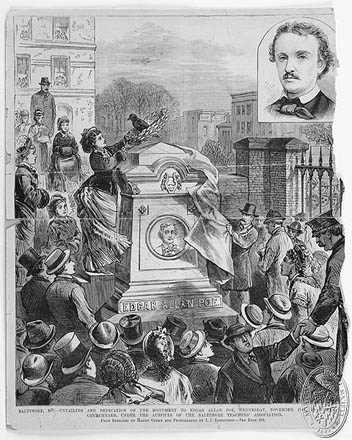
The poem turned out to be prophetic. Holmes outlived all of his writer-friends, including Longfellow, Lowell, Emerson, Hawthorne, and others. Holmes was, in fact, "The Last Leaf," just as he predicted. He died October 7, 1894 — exactly 45 years after the death of Edgar Poe, but not before contributing a poem for the dedication of a new Poe monument in Baltimore in 1875.

Not to worry, folks — Holmes is not being forgotten on his birthday. The city of his birth is hosting a pretty substantial birthday party for him this morning.

Thursday, August 6, 2009

Bicentennial of Tennyson

Speaking of bicentennials, today marks the 200th birthday of Alfred, Lord Tennyson. Born August 6, 1809, Tennyson went on to become an important canonical poet not only in his native England, which granted him the title of Poet Laureate, but also worldwide. Among his most well-known works are "The Charge of the Light Brigade," "Ulysses," the lengthy In Memoriam A.H.H., and Idylls of the King.

Poe praised Tennyson's work profusely. His final assessment in 1845 was that Tennyson was "a poet, who (in our own humble, but sincere opinion,) is the greatest that ever lived." Years later, friend Lambert A. Wilmer recalled, "I never knew him to speak in warm terms of admiration of any poetical writer, except Alfred Tennyson." Poe even accused other poets of plagiarizing from Tennyson, including Henry Wadsworth Longfellow. Perhaps ironically, a London critic in 1844 suggested Poe was the one trying to be like Tennyson: "Poe is a capital artist after the manner of Tennyson; and approaches the spirit of his original more closely than any of them."

In 1886, speculating on a trip to the United States, Tennyson mentioned to an interviewer a certain spot that he wanted to see. He said, "There is one spot in your country which I should like to visit — a spot, which as your poet, Fitz-Greene Halleck, finely expressed it, is hallowed ground, a pilgrim shrine, a mecca of the mind." The interviewer assumed he meant Mount Vernon, the home of American icon George Washington. "No," Tennyson responded. "I mean a long-neglected spot in the provincial town of Baltimore, where the greatest American genius lies buried. I mean the grave of Edgar Allan Poe." Years earlier, in 1875, Tennyson provided a poem to be read at the dedication of Poe's memorial monument:
Fate that once denied him,
And envy that once decried him,
And malice that belied him,
Now cenotaph his fame.
Happy 200th birthday, Lord Tennyson.

Wednesday, January 21, 2009

Rob on Poe

I wrote a special guest blog for the (very well-done) Read Street Blog at the Baltimore Sun about Poe's continuing legacy. Take a look and let me know what you think. This week has been and will continue to be full of guest writers on behalf of Poe's 200th birthday. I'm in some very good company, including a Pulitzer Prize-winner and several published mystery novelists.

Of course, Poe's legacy is international! I was also interviewed for "Sunday Breakfast" with Jose Barbosa on New Zealand's radio 95bFM. The whole podcast of the interview is here along with other chapters in their spotlight on Poe. I discuss Poe's diversity as a writer with a special emphasis on his criticism and the barely-known novel The Narrative of Arthur Gordon Pym of Nantucket.

Thursday, January 1, 2009

2009: The Year of Poe

2009 is upon us. Whether any government officially recognizes it or not, 2009 will be the Year of Poe. He is such an iconic figure in American literature, had his hands in so many different genres, accomplished so many milestones in writing... and, what's more, he's an American writer who is not only respected in other countries, but also adored.

I recently read someone's argument that Poe is, in essence, the first author you are forced to read in school that you are not ashamed to admit that you actually enjoy. This is probably true. No matter how much Shakespeare is tossed at you in your early years, for example, you'd never admit you like him until you develop a more sophisticated taste. Poe, on the other hand, appeals to intellectuals, to scholars, to mainstream readers, and to schoolyard boys and girls.

2009 will see celebrations of Poe and his works day in and day out (or so we hope). I'll post some important (and not-so-important) anniversaries right here on this blog as the year progresses. As the year goes on, I hope to open up many sides of this complicated man and introduce new pieces of information to even the most diehard fans.

But, to give others their due... Other bicentennial birthdays in 2009 include Abraham Lincoln, Charles Darwin, and Oliver Wendell Holmes, Sr. I might mention a bit about them as the year goes on, too!

Friday, December 19, 2008

One month to go

It's December 19 - which means we are exactly only one month away from the big bicentennial birthday!

I think I first realized that Poe's bicentennial was coming up back when I was a sophomore in college. That's when I really started getting deeply interested in Poe, read my first book on Poe (Silverman's book, Mournful and Never-ending Remembrance - now available in a new edition), and starting picking up details on his biography. I told myself that if I ever published anything it would be on Poe, and I set a personal goal of getting it published by 2009 for his birthday. At the time, I probably thought I was the only one that would know Poe was turning the big 200. Well, the good news is that I was wrong about that and also that I succeeded in my goal by publishing the Poe desk calendar with plenty of time to spare before Poe's birthday.

Tomorrow, by the way, is Edgar's sister Rosalie Poe's birthday. I wonder where she's buried. I would presume somewhere in Richmond but I've never come across information on it. Anyone out there know?

By the way, here's the link to the eBay sales page, in case you lost it.

Sunday, December 7, 2008

It's December!

It's December, which means we are getting close to the big Poe bicentennial in January. It also means we're close to the beginning of the Poe Calendar's starting day on January 1st. Once the year begins, I'll post about different anniversaries and events in the life and times of Poe (and a few of his acquaintances), including some that were cut from the calendar because of space issues, etc.

In the meantime, I'm hoping to expand my lecture tour in December but the well seems to have dried up. If there are any suggestions out there, let me know. As it is, it looks like my last lecture of the year (on Poe's "Longfellow War") will be at Bowdoin College on Tuesday, December 9 (rescheduled from last week).

I'm thinking there might be some libraries or historical societies that could squeeze me in for mid-December (despite the short notice) or early January; advice welcome.

If you haven't purchased your calendar yet, make sure to do it soon! Remember you can purchase on eBay using the very secure PayPal, or feel free to email me at robvelella@yahoo.com to buy from me directly.

Sunday, November 30, 2008

50 days

It's about 50 days away from the big day - January 19, 2009. My plans (right now) are to attend the first weekend of the "official" Edgar Allan Poe bicentennial celebration in Baltimore. The inimitable John Astin is reprising his impersonation of Poe himself. Tickets go on sale as of December 1, and I'm sure they will sell quickly (they tend to sell out anyway; this time around might just be quicker).

Other events are scheduled all over. Richmond is hosting a 24-hour birthday party at the Edgar Allan Poe Museum. Philadelphia has its own event planned, celebrating the grand re-opening of the Poe National Historic Site with refurbished house and brand new exhibits (and one-time equivalent of the Poet Laureate Daniel Hoffman). Shockingly, even the city of Poe's birth is taking part. Boston is infamous for its 199-year long snubbing of Poe but a small (and dedicated) group are trying to give him his due at Boston College. So, there are plenty of options as far as where to celebrate. Where will you be?

Just a reminder that you can spend all 365 days of 2009 celebrating Poe's 200th birthday... err, year. Click here to purchase your copy of the Poe bicentennial desk calendar.

Wednesday, November 5, 2008

Two months to go

We are only two months away from the beginning of a year-long celebration of Edgar Allan Poe. One of the most important and influential writers of the 19th century, Poe turns 200 years old on January 19, 2009. Celebrations of his bicentennial, however, will not fall only on that day; fellow Poeists are looking forward to 365 days of Poe events throughout the country.

This blog will help celebrate Poe every one of those days, through anniversaries (large and small), quotes, and discussions of the many sides of Poe. Comments are always welcome.