Charles Frederick Briggs and John Bisco signed a contract on December 23, 1844 to begin a new publication in New York. Only a couple weeks earlier, Briggs was struggling over what to name the new periodical. He settled on "The Broadway Journal."
Bisco was the brains that handled the business operations while Briggs utilized his established literary reputation to attract both contributors and readers. Briggs, however, was no fool and wanted an even bigger name to attract attention. He asked his close friend James Russell Lowell how to get in touch with Edgar Allan Poe.
The Broadway Journal rose and fell very quickly. Briggs and Bisco partnered with Poe because of his reputation — a reputation earned partly from "The Raven" but also from his harsh, relentless literary criticism. When Poe did the same sort of criticism for the Journal, Briggs was offended (particularly when Poe attacked Henry Wadsworth Longfellow, angering mutual friend J. R. Lowell).
The three business partners never quite came together. Briggs, who was also dealing with personal financial difficulties, attempted to buy out Bisco to take in more profit for himself. Instead, he abandoned the journal he helped start only about six months into the project. Poe considered selling his share of the company to another editor, a lion of New York periodicals named Evert Augustus Duyckinck, or the main proponent of copyright law Cornelius Mathews. Instead, he borrowed money from Horace Greeley and bought out John Bisco. As of October 1845, Poe was the sole owner of The Broadway Journal. Despite Poe's high hopes, the publication shut down with its January 3, 1846 issue (after which Poe vowed to start the Stylus, which never came to be).
Briggs continued to work in the publishing industry, editing several other magazines, journals, newspapers, and annuals. He had a somewhat long run on Putnam's Magazine, where he worked with notables like Parke Godwin (son-in-law of William Cullen Bryant) and George William Curtis. Little seems to be known about John Bisco outside his connection to Briggs and Poe.
Showing posts with label James Russell Lowell. Show all posts
Showing posts with label James Russell Lowell. Show all posts
Wednesday, December 23, 2009


Monday, December 7, 2009
Or Broadway Something...
 Charles Frederick Briggs was mostly known as a writer of satiric novels, particularly the then-famous The Adventures of Harry Franco. To his dismay, his title character also became his nickname (much like Poe was later referred to as "The Raven"). Wanting to do more, Briggs intended to start his own journal. He was struggling, however, with choosing a name.
On December 7, 1844, Briggs wrote his friend,* the literary critic James Russell Lowell: "I shall issue a prospectus in a day or two; the name will be, for the sake of individuality... the Broadway Journal, or Review, or Chronicle, or Broadway Something..."
Briggs wanted to emphasize the distinct New York flavor to his journal. Most periodicals were regional, after all (even Poe original aimed for Pennsylvanian readers when planning The Penn; he later renamed it The Stylus to appeal to a broader audience). The one which Briggs was planning would become The Broadway Journal with the help of his business-minded partner John Bisco.
In the same letter to Lowell, he asks about getting in touch with Poe. Poe came in as a co-editor and business partner. The venture, however, never turned a substantial profit and Bisco eventually bailed out. Oddly enough, Briggs had difficulty working with Poe, in part due to the vitriolic style of criticism which first drew him towards hiring Poe. He soon sold his portion of the business to Poe to break the partnership. By the fall of 1845, The Broadway Journal was solely under the control and ownership of Edgar Poe — it was the only journal and the only business Poe ever owned.
During his tenure there, Poe tweaked and republished a substantial portion of his major works; many of the versions featured in The Broadway Journal became the standard editions. He continued reviewing other writers, noticed newly-published works, updated his readers on local politics, and gave his theories on good literature.
Despite his best intentions (and even a vow to his friend Thomas Holley Chivers to "make a fortune of it yet"), Poe did not succeed in bringing the struggling journal to success. Its final issue was in January 1846. Nevertheless, the experience pushed him closer to producing The Stylus. Despite working in earnest, his plans never came to fruition.
*More work could be done considering their friendship. Lowell turned over all profits from his famous A Fable for Critics directly to Briggs. Certainly, some of the animosity Lowell will begin to feel towards Poe during the "Longfellow War" comes from Briggs's trash-talking, so to speak.
Saturday, November 21, 2009
In not the most gentle manner
Poe began a lecture tour on November 21, 1843 in Philadelphia. The broad topic was "The Poetry of America." This was an era of oratory and many writers knew that lectures and public readings would greatly boost their income. Other writers turned lecturers included James Russell Lowell, Oliver Wendell Holmes, and, of course, Ralph Waldo Emerson, who was so successful as a lecturer it qualifies as his full-time job.
 The purpose of this particular lecture was for Poe to discuss the state of American poetry and his literary theories. However, he couldn't resist wielding his tomahawk as a critic. He focused on the poor taste of his critical rival Rufus Wilmot Griswold, whose book The Poets and Poetry of America was published a year earlier and was clearly referenced in the lecture title. One periodical later noted "this book and its author were handled by the critical Lecturer in not the most gentle manner" (what a great euphemism!).
This could be yet another minor reason why the two men would build a major rivalry/enmity for one another. It was shortly after this, in January 1844, that Griswold wrote to Poe about "some cause of personal quarrel with you, which you will easily remember."
One review later remarked that the lecture "placed all the pseudo-critics, the Rev. Mr. Rufus Griswold, Esq. among others, to the blush."
Poe's lecture in Philadelphia was very successful. The Saturday Museum noted it had "quite a large, and certainly highly intelligent audience." According to the United States Gazette, "hundreds" were turned away, "unable to gain admission." The Saturday Courier noted that "it was a very learned critique, marked by the severity of illustration for which the author is so ably known."
Over about four months, Poe also lectured on the same topic in Reading, Pennsylvania and Baltimore, as well as Wilmington and Newark, Delaware. He begins another lecture tour on a similar topic in 1845, culminating in his strange appearance at the Boston Lyceum.
 The purpose of this particular lecture was for Poe to discuss the state of American poetry and his literary theories. However, he couldn't resist wielding his tomahawk as a critic. He focused on the poor taste of his critical rival Rufus Wilmot Griswold, whose book The Poets and Poetry of America was published a year earlier and was clearly referenced in the lecture title. One periodical later noted "this book and its author were handled by the critical Lecturer in not the most gentle manner" (what a great euphemism!).
This could be yet another minor reason why the two men would build a major rivalry/enmity for one another. It was shortly after this, in January 1844, that Griswold wrote to Poe about "some cause of personal quarrel with you, which you will easily remember."
One review later remarked that the lecture "placed all the pseudo-critics, the Rev. Mr. Rufus Griswold, Esq. among others, to the blush."
Poe's lecture in Philadelphia was very successful. The Saturday Museum noted it had "quite a large, and certainly highly intelligent audience." According to the United States Gazette, "hundreds" were turned away, "unable to gain admission." The Saturday Courier noted that "it was a very learned critique, marked by the severity of illustration for which the author is so ably known."
Over about four months, Poe also lectured on the same topic in Reading, Pennsylvania and Baltimore, as well as Wilmington and Newark, Delaware. He begins another lecture tour on a similar topic in 1845, culminating in his strange appearance at the Boston Lyceum.
Tuesday, November 17, 2009
Fate that once denied him
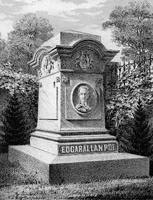
After over two decades buried in an unmarked corner of the cemetery at Baltimore's Westminster Church, Poe’s body was re-buried where people could see it from the street. A new memorial marker was dedicated on November 17, 1875.
 The monument was substantial. Money for it was raised by several parties, including a Baltimore schoolteacher named Sara Sigourney Rice. Rice kicked off a "pennies for Poe" campaign and even asked her students to perform public speeches to raise funds. The final $650 came from Philadelphian George William Childs. The design came from architect George A. Frederick, built by Colonel Hugh Sisson, with a stone medallion of Poe by artist Adalbert Volck (later replaced). The total cost of the new monument was equal today to over $28,000.
Despite all the hard work on the monument, Poe's birthday was incorrectly chiseled as January 20 instead of January 19. It has never been corrected. On his birthday ten years after his reburial, Poe's long-dead wife Virginia Poe was buried with him. Maria Clemm was buried there too, bringing the family trio together for their eternal rest.
The ceremony to dedicate the new monument included speeches from Neilson Poe, Poe's oft-maligned cousin. Several famous poets were invited to attend. The only one that made it was Walt Whitman, then age 56, who was still recovering from a stroke.
Letters, poems and remembrances were contributed his one-time fiancee Sarah Helen Whitman and his occasional enemy James Russell Lowell. Other acknowledgments came from John Greenleaf Whittier ("The extraordinary genius of Edgar Poe is now acknowledged the world over"), William Cullen Bryant (Poe is "distinguished alike for originality in the conception, skill in word-painting, and power over the mind of the reader") and even Henry Wadsworth Longfellow (who noted: "The fever called Living is conquered at last"). Some of the greatest lines in honor of Poe came from fellow 2009 bicentennial poets Alfred Lord Tennyson, who later said that "neglected spot" would be the first place he would visit on a trip to the United States, and Oliver Wendell Holmes. As Dr. Holmes wrote:
 The monument was substantial. Money for it was raised by several parties, including a Baltimore schoolteacher named Sara Sigourney Rice. Rice kicked off a "pennies for Poe" campaign and even asked her students to perform public speeches to raise funds. The final $650 came from Philadelphian George William Childs. The design came from architect George A. Frederick, built by Colonel Hugh Sisson, with a stone medallion of Poe by artist Adalbert Volck (later replaced). The total cost of the new monument was equal today to over $28,000.
Despite all the hard work on the monument, Poe's birthday was incorrectly chiseled as January 20 instead of January 19. It has never been corrected. On his birthday ten years after his reburial, Poe's long-dead wife Virginia Poe was buried with him. Maria Clemm was buried there too, bringing the family trio together for their eternal rest.
The ceremony to dedicate the new monument included speeches from Neilson Poe, Poe's oft-maligned cousin. Several famous poets were invited to attend. The only one that made it was Walt Whitman, then age 56, who was still recovering from a stroke.
Letters, poems and remembrances were contributed his one-time fiancee Sarah Helen Whitman and his occasional enemy James Russell Lowell. Other acknowledgments came from John Greenleaf Whittier ("The extraordinary genius of Edgar Poe is now acknowledged the world over"), William Cullen Bryant (Poe is "distinguished alike for originality in the conception, skill in word-painting, and power over the mind of the reader") and even Henry Wadsworth Longfellow (who noted: "The fever called Living is conquered at last"). Some of the greatest lines in honor of Poe came from fellow 2009 bicentennial poets Alfred Lord Tennyson, who later said that "neglected spot" would be the first place he would visit on a trip to the United States, and Oliver Wendell Holmes. As Dr. Holmes wrote:
His monument shall be his gentle verse,* People still leave "pennies for Poe" at this memorial today. This has become a tradition at the graves of famous figures, particularly writers. Poe did not originate the tradition, however.
Which eyes not yet created shall o'er read.
And tongues to be his being shall rehearse,
When all the breathers of this world are dead.
Saturday, October 24, 2009
Poe buys The Broadway Journal
The New York-based Broadway Journal was founded by Charles Frederick Briggs, who partnered with John Bisco. Both were Massachusetts natives by birth — Briggs from Nantucket, and Bisco from Worcester. Briggs was a relatively well-known writer, particularly for his novel The Adventures of Harry Franco; Bisco was most recently a school teacher in New Jersey, but Briggs referredt o him as "a shrewd yankee" who had previously worked with the Knickerbocker. Looking for more help on the literary end, Briggs contacted James Russell Lowell in a letter dated December 7, 1844: "Do you know of any available talent, or genius rather, in your neighborhood?"
Lowell helped Briggs partner with another Massachusetts-born figure: Edgar Poe. Poe became one-third owner in the project (he also published updated versions of "Ligeia," "William Wilson," and "The Tell-Tale Heart" in the newspaper).
Briggs left the project he founded within the first year, at least partially because he was annoyed at his new partner's bickering about Henry Wadsworth Longfellow. On October 24, 1845, John Bisco officially left the periodical too, allowing Poe to buy out his share for $50 — using an I. O. U. endorsed by Horace Greeley (who would later publish Poe's obituary in his own newspaper).
In other words, as of October 24, 1845, Poe was the sole owner of his own journal. The issue published the next day included the masthead listing Poe as "EDITOR AND PROPRIETOR."
It had been a dream of his for the majority of his career, whether he called it The Stylus or The Penn. However, taking over the Broadway Journal was not as ideal as Poe might have imagined. He was inheriting a journal with substantial financial problems (which is why Briggs abandoned ship) and immediately the company was in debt $140. Additionally, Poe's caustic reviews were starting to lose their novelty, resulting in negative responses from critics and readers alike. His recent Boston Lyceum fiasco was also still causing a stir. The Broadway Journal, with Poe at its helm, was defunct with only a few months.
Briggs would join in the assault on Poe's character after Poe's death. He published "The Personality of Poe" in 1877.
Lowell helped Briggs partner with another Massachusetts-born figure: Edgar Poe. Poe became one-third owner in the project (he also published updated versions of "Ligeia," "William Wilson," and "The Tell-Tale Heart" in the newspaper).
Briggs left the project he founded within the first year, at least partially because he was annoyed at his new partner's bickering about Henry Wadsworth Longfellow. On October 24, 1845, John Bisco officially left the periodical too, allowing Poe to buy out his share for $50 — using an I. O. U. endorsed by Horace Greeley (who would later publish Poe's obituary in his own newspaper).
In other words, as of October 24, 1845, Poe was the sole owner of his own journal. The issue published the next day included the masthead listing Poe as "EDITOR AND PROPRIETOR."
It had been a dream of his for the majority of his career, whether he called it The Stylus or The Penn. However, taking over the Broadway Journal was not as ideal as Poe might have imagined. He was inheriting a journal with substantial financial problems (which is why Briggs abandoned ship) and immediately the company was in debt $140. Additionally, Poe's caustic reviews were starting to lose their novelty, resulting in negative responses from critics and readers alike. His recent Boston Lyceum fiasco was also still causing a stir. The Broadway Journal, with Poe at its helm, was defunct with only a few months.
Briggs would join in the assault on Poe's character after Poe's death. He published "The Personality of Poe" in 1877.
Friday, October 16, 2009
The Boston Lyceum incident
Years before his death, Poe made his final trip to Boston. On October 16, 1845, dovetailing off the success of "The Raven," Poe presented a lecture at the Boston Lyceum. The fiasco that ensued has invited several interpretations in modern times, most recently by Philip Phillips of Middle Tennessee State University. What was Poe thinking?
Poe had been asked to present an original poem; James Russell Lowell was likely involved in setting up his appearance. We know that Poe disliked many of the prominent Massachusetts writers (not necessarily Bostonian, including Henry Wadsworth Longfellow, William Ellery Channing, and Ralph Waldo Emerson, not to mention his see-sawing responses to Nathaniel Hawthorne) so it might have been awkward for him. Yet, Poe was a Bostonian by birth. He moved there when he left the Allan family and his first book was published there with the byline "by a Bostonian."
 The evening on October 16 began with a long oration by Caleb Cushing (pictured at left), a well-known Massachusetts politician who had just returned from a mission to China. His two-and-a-half hour speech got first billing. Poe was next and, after a few quick stabs at Boston audiences, presented something he titled "The Messenger Star" — which was, in fact, his much earlier poem "Al Aaraaf," rather than the original poem expected.
The response was mixed. Some say people in the audience were baffled and confused; some may have left early (blame Cushing?). Editor of the Boston Evening Transcript Cornelia Wells Walter expressed hostility. But poet/editor/travel writer Thomas Wentworth Higginson was not only sympathetic but laudatory (though he admitted confusion too). He said he "felt that we had been under the spell of some wizard."
Poe later claimed it was a hoax, trying to prove that the Boston audience did not know good poetry. "Al Aaraaf," of course, is one of the most allegorical of Poe's poems (which New Englanders love, according to Poe) and also one of the thickest, full of confusing allusions and complicated alternating metrical schemes. The fact that Poe did not give the proper name and instead referred to it as "The Messenger Star" is evidence that he was not trying to play it straight. The poem was 16 years old when he read it, but it had been re-published in excerpts only a few months earlier in an article by J. R. Lowell. But, what did he really intend? Could he really have "hoaxed" anyone?
Poe had been asked to present an original poem; James Russell Lowell was likely involved in setting up his appearance. We know that Poe disliked many of the prominent Massachusetts writers (not necessarily Bostonian, including Henry Wadsworth Longfellow, William Ellery Channing, and Ralph Waldo Emerson, not to mention his see-sawing responses to Nathaniel Hawthorne) so it might have been awkward for him. Yet, Poe was a Bostonian by birth. He moved there when he left the Allan family and his first book was published there with the byline "by a Bostonian."
 The evening on October 16 began with a long oration by Caleb Cushing (pictured at left), a well-known Massachusetts politician who had just returned from a mission to China. His two-and-a-half hour speech got first billing. Poe was next and, after a few quick stabs at Boston audiences, presented something he titled "The Messenger Star" — which was, in fact, his much earlier poem "Al Aaraaf," rather than the original poem expected.
The response was mixed. Some say people in the audience were baffled and confused; some may have left early (blame Cushing?). Editor of the Boston Evening Transcript Cornelia Wells Walter expressed hostility. But poet/editor/travel writer Thomas Wentworth Higginson was not only sympathetic but laudatory (though he admitted confusion too). He said he "felt that we had been under the spell of some wizard."
Poe later claimed it was a hoax, trying to prove that the Boston audience did not know good poetry. "Al Aaraaf," of course, is one of the most allegorical of Poe's poems (which New Englanders love, according to Poe) and also one of the thickest, full of confusing allusions and complicated alternating metrical schemes. The fact that Poe did not give the proper name and instead referred to it as "The Messenger Star" is evidence that he was not trying to play it straight. The poem was 16 years old when he read it, but it had been re-published in excerpts only a few months earlier in an article by J. R. Lowell. But, what did he really intend? Could he really have "hoaxed" anyone?
Monday, September 21, 2009
Bicentennial of Sophia Peabody Hawthorne
 2009 is celebrating more than just Edgar Poe. Another figure who celebrates a bicentennial this year is Sophia Amelia Peabody, later Mrs. Nathaniel Hawthorne. I have no evidence that Sophia (pronounced with a hard i as So-fy-uh) interacted with Poe. But, it's interesting to consider what's happening in Hawthorne's home life while he interacts with Poe.
The April 1842 issue of Graham's Magazine included a brief preliminary review of Hawthorne's Twice-Told Tales, followed the next month by a more substantial full review. Hawthorne was living at the Utopian community Brook Farm, an ultimately unsuccessful Transcendental experiment. Hawthorne wasn't a believer in the experiment, but joined in the hopes of making enough money to support his future wife Sophia. He moved out in October. A few months later, Hawthorne published a humorous sketch on his contemporaries called "The Hall of Fantasy" in the February 1843 issue of James Russell Lowell's The Pioneer. The "Hall" of the title is the haven of quality writing that minor writers aspire to. "Mr. Poe," he wrote, "had gained ready admittance for the sake of his imagination, but was threatened with ejectment, as belonging to the obnoxious class of critics."* Poe's poem "Lenore" was published in the same issue.
The issue impressed Poe enough that he wanted to include Hawthorne as a contributor to his dream journal, The Penn. He wrote to J. R. Lowell asking him to serve as an intermediary on March 27, 1843. By then, Hawthorne had been married to Sophia for about eight months. Two days earlier, Hawthorne had complained to his friend Horatio Bridge about his money situation. "I did not come to see you, because I was very short of cash — having been disappointed in money that I had expected from three or four sources." Those sources likely included Lowell's The Pioneer, which had already gone out of business after only three issues. His financial situation wasn't getting much better when his first child was born. Sophia Peabody Hawthorne gave birth to Una Hawthorne on born March 3, 1844, after a particularly difficult delivery. Five months later, Poe wrote to Lowell and asked, "Do you ever see Mr Hawthorne? He is a man of rare genius."
Hawthorne's great letter to Poe was written from Salem, MA on June 17, 1846. In it, he informs Poe of the upcoming publication of Mosses from an Old Manse and praises Poe's ability to write tales (with a minor pot-shot at Poe's criticism). Five days later, his son Julian Hawthorne was born. After some delay, Godey's Lady's Book published Poe's essay "Tale-Writing — Nathaniel Hawthorne" in its November 1847 issue. By this time, Hawthorne's financial stress was alleviated by a government-appointed job at the Salem Custom-House. The job provided him decent income, but also stymied his literary output; he was forced out of the job in 1848.
Poe died in 1849, a year before the publication of Hawthorne's life-changing work, The Scarlet Letter. I can only speculate what Poe would have thought of the book. My guess is that he wouldn't have cared much for it. The heavy moral tone goes against Poe's theory of the "heresy of the didactic," not to mention how difficult it is to find a novel which Poe liked in general.
Anyway, happy 200th birthday to Sophia Amelia Peabody Hawthorne.
*When republished in Mosses from an Old Manse, Hawthorne excised many of these references. Though he meant it all in good spirit, Hawthorne's use of real names may have impeded his attempts at making money off his writing.
Friday, August 14, 2009
Poe's place in literary history
 Poe's place in literary history is occasionally questioned. Should he be considered a master of American literature? Does he deserve a place in the canon? Is he really important? I might be biased so take my opinion with a grain of salt (this post will shift away from my more academic tone and may, in fact, turn into starry-eyed gushing over my favorite author). Here's my argument: even if you remove the quality of Poe's work from the equation, Poe is one of the most important writers in American history.
The real evidence for this comes on August 14, 1835. It was on that date that the Trustees of the Richmond Academy began selecting their new English teacher. The fact that it was not Poe should solidify Poe's role in American literary history. Excluding his military stints, Poe only applied for two jobs outside of literature. The first was the job with the Richmond Academy teaching English. The second was a job with the Customs House in Philadelphia in 1841, hoping that a connection to Robert Tyler (brother of President John Tyler) would secure his employment. Neither role worked out. That means that Poe never had a job outside of literature; for his 40 short years, he would have no source of income besides his pen.
This is significant because no other major American writers in the first half of the United States were able to sustain themselves in such a manner. Washington Irving had a couple government jobs and was, for a time, part owner in a mercantile business. Henry Wadsworth Longfellow, James Russell Lowell, Oliver Wendell Holmes, and others held full-time teaching positions (at Harvard, in the case of all three). Nathaniel Hawthorne attempted to make a living as a farmer for a time before taking government jobs at two different Customs Houses (one in Boston, another in Salem, Massachusetts). Ralph Waldo Emerson had his ministry for a time and, later, a public lecturing career (he was also supported by an inheritance from the family of his first wife). Margaret Fuller struggled as a teacher in Providence before become a full-time journalist (and, then, nearly all of her writing was not literature but nonfiction).
Poe's financial failure is obvious. Nevertheless, his attempt is nothing less than historical, if not extraordinary. The fact that he stood the test of time is minor (so did the other writers I mentioned above) but, coupled with his lack of any other job outside of literature, Poe should be considered a trailblazer.
Odds were stacked against him, of course. The country was young, its literature younger, and the economy was not established for professional authors. Poe's critical work emphasized that the quality of American literature needed to improve and, as such, he fought against the puffing system which inhibited proper growth. He also railed against the lack of copyright (suggesting authors may as well slit their throats), the culture of republishing without authors' permission, and the tastes of American audiences which, he believed, did not recognize quality over popularity. All of these factors needed to change before an American could make money solely as an author. Poe missed out on those ideal conditions and did not survive into the American Renaissance of the 1850s. Even with all that, when he died at age 40, he showed no signs of turning away from his desired path.
For the sake of full disclosure, Poe was also hampered by bad decisions. He married before he had an established income and, in doing so, inherited not only a young wife but also a mother-in-law who needed his financial support (though, to Maria Clemm's credit, she occasionally provided minor assistance through odd jobs and, of course, begging). He also didn't stay in one place for too long, constantly moving when he needed to escape overdue rent payments or in an optimistic pursuit of greater opportunities — all the money he spent on rent and moving expenses could have been saved to buy a house. Other than that, he was thrifty, particularly in his clothing choices, but his challenges are already numerous.
Yes, Poe was a financial failure in his pursuit of the life of a professional author. But that failure was unprecedented — and it deserves our praise. Thanks to the Trustees of the Richmond Academy for (inadvertently) making it possible.
* Longfellow should be considered America's first successful professional poet as of 1854, when he retired from his professorship. However, Longfellow was gifted a mansion at age 35 thanks to his father-in-law and had saved up enough money from teaching for about 17 years before he had the solid footing to become a professional poet. Credit is deserved there as well, certainly, but he did not have the same challenges as Poe.
Wednesday, August 12, 2009
In memoriam: James Russell Lowell
 I have written about James Russell Lowell many times on this blog. He weaves in and out of the story of Poe so much, it's hard to separate the two. It's even harder, however, to distinctly categorize their relationship.
The December 1841 issue of Graham's Magazine printed Poe's first acknowledgment of Lowell, ten years his junior. In this edition of Poe's "Chapter on Autography," he wrote: "Mr. J. R. LOWELL, of Massachusetts, is entitled, in our opinion, to at least the second or third place among the poets of America. We say this on account of the vigor of his imagination — a faculty to be first considered in all criticism upon poetry." We know that Lowell was aware of the quick mention (though, for the series, Lowell's was a long entry) because he was given a heads-up by Charles J. Peterson in late October 1841.
When Poe read Lowell's "Rosaline" early the next year, Peterson reported that Poe was pleased and said "that no American poem equals it in the higher elements of song" and noted "Poe wishes to be remembered to you." In fact, it seems that it was through Peterson that Poe and Lowell first interacted — and for quite some time. In a letter dated February 17, 1842, Peterson notes "Poe laughed heartily when I told him you thought that he had a pique against Wakondah & its author" (e.g. Cornelius Mathews). And, in the same letter, "Poe sends his respects & says that he never allows personal love or hate to warp his criticisms." Why didn't the two just write directly to each other?
In fact, it seems the earliest extant direct correspondence is not until November 16, 1842, when Poe writes to Lowell offering to contribute to his new magazine, Pioneer ("The Tell-Tale Heart" will debut in its third issue). Poe praised the journal when it came out, noting it was edited "by a man whose genius and originality is at once the praise and wonder of his countrymen." Lowell later helped Poe correspond with Nathaniel Hawthorne, who Lowell convinced to be a contributor to the magazine Poe was founding, The Stylus.
Though they were cordial during this period and, in some cases, they praised one another, it's hard to call Poe and Lowell "friends." Certainly, by the mid 1840s, it would be even harder to do so. When Poe began his public attacks on Henry Wadsworth Longfellow, Lowell took the side of his friend and neighbor in Cambridge rather than Poe's. When Poe became one-third owner of the Broadway Journal and, later, sole owner, its founder Charles Frederick Briggs maligned Poe in private letters to his close friend James Russell Lowell — odd, considering Lowell helped secure Poe's partnership with his close friend Briggs (in fact, Lowell's A Fable for Critics was initially printed to raise money to help Briggs; in that poem, Lowell famously described Poe: "three fifths of him genius and two fifths sheer fudge"). Though Lowell had once referred to Poe's "genius," by 1845 he wrote to Briggs that "Poe, I am afraid, is wholly lacking in that element of manhood which, for want of a better name, we call character." Ouch.
Both sides are guilty for building enmity, and both were too proud and too stubborn to stop it from happening. I find it disappointing, as the two men could have been friends. Both were struggling writers interested in producing deep, important poetry. Both took serious care in writing their literary reviews (though each was also quite sensitive to being criticized). Each had a high appreciation of his own ability as a poet to the point of arrogance, mixed with an odd feeling of self-loathing when times got tough. Both had financial difficulties for much of their respective lives and ambitiously attempted to found a literary journal that would nudge American writing forward. Lowell's association with the abolitionists aside, this could have been a solid partnership.
Lowell died on August 12, 1891. Rest in peace, James Russell Lowell.
Tuesday, July 21, 2009
The Martha arrives in the United States
After 36 days at sea, an 11-year old Edgar A. Poe returned to the United States on July 21, 1820. The ship, named Martha, left Liverpool on June 16; it docked in New York City just over a month later and, as the local newspaper reported, passengers included "J & F Allan, E A Poe," and others. "J & F Allan," of course, are John and Frances Allan — Poe's foster-parents.
John Allan brought the family to England to expand his mercantile business in 1815, shortly after trade was re-opened after the War of 1812. Poe spent five of his most important formative years abroad. He visited Scotland (where his foster-father was born) and was educated in several London schools, including a boarding school at Stoke Newington run by Rev. John Bransby (an experience later fictionalized in "William Wilson"; the character in that story also has a schoolmaster named Bransby).
For the Allan family, the five years in England were not successful. Frances Allan's health continued to deteriorate (in fact, in 1819, a year before their return trip, John Allan reported "Frances begins to think she will never be able to cross the Atlantic"; she dies ten years later) and the Liverpool branch was not prospering.
Nevertheless, the experience overseas must have been influential on the young Poe. Though several other American writers spent time in Europe (especially Washington Irving — who dined with John Allan while overseas — as well as Henry Wadsworth Longfellow, Nathaniel Hawthorne and James Russell Lowell), each of them visited in their adult years; only Poe spent a major portion of his childhood there. Though he would never return to Europe, his first-hand experience with long sea voyages likely inspired his later fictional sea tales, most notably The Narrative of Arthur Gordon Pym of Nantucket.
John Allan brought the family to England to expand his mercantile business in 1815, shortly after trade was re-opened after the War of 1812. Poe spent five of his most important formative years abroad. He visited Scotland (where his foster-father was born) and was educated in several London schools, including a boarding school at Stoke Newington run by Rev. John Bransby (an experience later fictionalized in "William Wilson"; the character in that story also has a schoolmaster named Bransby).
For the Allan family, the five years in England were not successful. Frances Allan's health continued to deteriorate (in fact, in 1819, a year before their return trip, John Allan reported "Frances begins to think she will never be able to cross the Atlantic"; she dies ten years later) and the Liverpool branch was not prospering.
Nevertheless, the experience overseas must have been influential on the young Poe. Though several other American writers spent time in Europe (especially Washington Irving — who dined with John Allan while overseas — as well as Henry Wadsworth Longfellow, Nathaniel Hawthorne and James Russell Lowell), each of them visited in their adult years; only Poe spent a major portion of his childhood there. Though he would never return to Europe, his first-hand experience with long sea voyages likely inspired his later fictional sea tales, most notably The Narrative of Arthur Gordon Pym of Nantucket.
Saturday, June 20, 2009
In memoriam: C. F. Briggs
 Charles Frederick Briggs died today, June 20, in 1877. Who is C. F. Briggs, you ask?
A former sailor from Nantucket, Massachusetts, Briggs became moderately famous with his novel The Adventures of Harry Franco. Later, Briggs decided to enter the world of literary journalism. In December 1844, Briggs wrote to James Russell Lowell: "I have made arrangements for publishing the first number of my long talked of paper in January." He partnered with John Bisco and the publication was named The Broadway Journal.
It seems like Lowell was the real intermediary between Briggs and Poe (Lowell and Briggs were close enough that Lowell's 1848 book-length satirical poem A Fable for Critics was dedicated to Briggs, who also was given all its profits). Through a letter dated December 12, 1844, Lowell "introduced" the two. Briggs brought Poe into the fold as a contributor (his first contribution was a review of Elizabeth Barrett) but eventually tapped him as a business partner. Poe became one-third owner before both Bisco and Briggs jumped ship. Their departure made The Broadway Journal the only publication Poe ever owned, though it was a short-lived honor.
Despite their business partnership, Briggs and Poe cannot be considered friends. Briggs was trying to pressure Poe out of the journal as early as May 1845; instead, he gave up and left (as much because of Bisco as Poe). "I refused to do anything more with the journal," he wrote to Lowell by July 16. He also spread rumors of Poe's drinking (Poe had recently turned to the bottle after 18 months as a teetotaler) and referred to him as having a "characterless character" who was "utterly deficient of high motive."
Not that Poe was the good guy here either; he took a few stabs at his former business partner in print, including a mention in his infamous "Literati of New York" series. As he wrote, "Mr. Briggs has never composed in his life three consecutive sentences of grammatical English. He is grossly uneducated." Briggs responded by spreading rumors that Poe was in an insane asylum and noted that Poe is struck with "infirmities of mind and body." He also turned Poe into a satirical character in his serialized novel The Trippings of Tom Pepper.
I have recently found evidence that Briggs was buried on Staten Island. He's now on my "must-visit" list. RIP, "Harry Franco."
Saturday, May 23, 2009
Margaret Fuller at 199
 On May 23, 1810, Timothy and Margaret (Crane) Fuller welcomed their first (of eight) children. They named her Sarah Margaret Fuller — it would not be long after that the precocious child demanded she be referred to only as "Margaret." In fact, in her professional career — which spanned education, journalism, criticism, poetry, etc. — she went by that name, rather than the more conventional etiquette which would have her named "Miss Fuller."
The relationship between Poe and Fuller was, like many of Poe's interactions, complicated. Despite some comments against Fuller (he once called her an "old maid" and a "busybody") and her involvement in a strange personal interaction (involving Frances Osgood; I'll tell that tale another time), I believe Poe sincerely admired her work.
The earliest interaction I found was, oddly, over James Russell Lowell, who later became a sort of literary rival for both Fuller and Poe. A critic for the Daily Tribune in New York (presumed to be Fuller) strongly disagreed with Poe's review of Lowell. Charles Frederick Briggs wrote to his friend Lowell on January 17, 1845, about the disagreement: "Poe's criticism about your Conversations [on Some of the Old Poets] was extremely laudatory and discriminating; it was the female ass of the Tribune [e.g. Fuller] that misunderstood him."
The same month, Fuller noted Lowell's critical/biographical sketch of Poe. She noted that the article ("frank" and "earnest") introduced her to some of Poe's poetry which she never read before. She liked "The Haunted Palace" and "To Helen" enough to reprint them in the Tribune. The latter, she writes, is "of such distinguished beauty in thought, feeling, and expression, that we might expect the life unfolded from such a bud to have the sweetness and soft lustre of a rose." She was always very honest in her opinions of Poe. Later in 1845, she reviewed The Raven and Other Poems and suggested they were "all fragments" — suggesting that he was capable of better poetry, "with the exception of The Raven, which seems intended chiefly to show the writer's artistic skill." Nevertheless, she notes that the poems "breathe a passionate sadness, relieved sometimes by touches very lovely and tender" and show "a sweep of images, thronging and distant like a procession of moonlight clouds on the horizon."
Poe, in turn, acknowledged Fuller's "high genius." In 1846, he commended her daring review of Henry Wadsworth Longfellow. As he wrote, "it is one of the very few reviews of Longfellow's poems, ever published in America, of which the critics have not had abundant reason to be ashamed." When Fuller published Woman in the Nineteenth Century, her definitive work (regarded as the first major feminist work in the United States), Poe praised her fortitude. He called it "a book which few women in the country could have written, and no woman in the country would have published, with the exception of Miss Fuller." He particularly praised her for not manufacturing a false public persona. Instead, he wrote, her "personal character and her printed book are merely one and the same thing."
Happy 199th birthday to Margaret Fuller — a woman well ahead of her time! All the best for her bicentennial next year, in 2010!
Sunday, April 19, 2009
Griswold and Graham's
It's hard to tell for certain when the first edition of The Poets and Poetry of America hit book stores. It wasn't until April 18, 1842, however that the anthology's editor, Rufus Wilmot Griswold, was informed by publishers that it was finally published. As Carey & Hart (Philadelphia) wrote to Griswold (in New York): "We have at last published the 'Poets & Poetry of America' & a handsome Book it is."
The publisher must have rushed copies to important or influential literary figures on that first day. George Rex Graham in Philadelphia, the proprietor of the very popular Graham's Magazine, almost immediately jumped to take advantage of the rising star of Griswold. He wrote only a day later, April 19, 1842:
"Have you fully determined on assuming the Chaplaincy* and to abandon the editorial chair? Or could you find it in your heart to locate in Philadelphia? Let me hear from you, as I have a proposal to make. I like your book very much. We received it from Carey & Hart on yesterday, and although it will give offense to a few, it must be popular, and it will please every man of taste."
Graham had recently parted ways with his famous editor, Edgar Poe, who had miraculously increased circulation to 40,000, but resigned in late March. What really drove sales up was Poe's infamous critical review style, which was somewhat controversial. The Arcturus (edited by Cornelius Mathews and Evert Augustus Duyckinck) noted Poe's reviews as "elaborate" and "richly deserving of attention," though he was "somewhat over literal and minute, looking oftener to the letter than the spirit."Joseph Evans Snodgrass in the Saturday Visiter in Baltimore wrote that Poe was "an excellent reviewer" even though he was "at times, provokingly hypercritical." James Russell Lowell was a little less euphemistic and wrote that Poe occasionally mistook "his phial of prussic acid for his inkstand."

The "proposal" Graham wanted to offer Griswold was Poe's former role. Griswold seems to have accepted without hesitation and moved to Philadelphia to take the job with Graham's (leaving his family behind in New York). The transition was so quick, a rumor persisted (and still does in some circles) that Poe came to clean out his desk and saw Griswold already sitting there. The rumor is quite untrue. Nevertheless, Griswold was paid $1000 — $200 more per year than Poe — likely building up some of the animosity between the two.
Griswold's run on Graham's was significantly less successful than Poe's. Though he was able to bring in substantial writers (including James Fenimore Cooper and Henry Wadsworth Longfellow), he never earned much respect there. In fact, a year after he took over, George Lippard wrote, "It was Mr. Poe that made Graham's Magazine what it was a year ago; it was his intellect that gave this now weak and flimsy periodical a tone of refinement and mental vigor."
*Griswold had recently earned the title of "Reverend," though he never had a regular congregation.
The publisher must have rushed copies to important or influential literary figures on that first day. George Rex Graham in Philadelphia, the proprietor of the very popular Graham's Magazine, almost immediately jumped to take advantage of the rising star of Griswold. He wrote only a day later, April 19, 1842:
"Have you fully determined on assuming the Chaplaincy* and to abandon the editorial chair? Or could you find it in your heart to locate in Philadelphia? Let me hear from you, as I have a proposal to make. I like your book very much. We received it from Carey & Hart on yesterday, and although it will give offense to a few, it must be popular, and it will please every man of taste."
Graham had recently parted ways with his famous editor, Edgar Poe, who had miraculously increased circulation to 40,000, but resigned in late March. What really drove sales up was Poe's infamous critical review style, which was somewhat controversial. The Arcturus (edited by Cornelius Mathews and Evert Augustus Duyckinck) noted Poe's reviews as "elaborate" and "richly deserving of attention," though he was "somewhat over literal and minute, looking oftener to the letter than the spirit."Joseph Evans Snodgrass in the Saturday Visiter in Baltimore wrote that Poe was "an excellent reviewer" even though he was "at times, provokingly hypercritical." James Russell Lowell was a little less euphemistic and wrote that Poe occasionally mistook "his phial of prussic acid for his inkstand."

The "proposal" Graham wanted to offer Griswold was Poe's former role. Griswold seems to have accepted without hesitation and moved to Philadelphia to take the job with Graham's (leaving his family behind in New York). The transition was so quick, a rumor persisted (and still does in some circles) that Poe came to clean out his desk and saw Griswold already sitting there. The rumor is quite untrue. Nevertheless, Griswold was paid $1000 — $200 more per year than Poe — likely building up some of the animosity between the two.
Griswold's run on Graham's was significantly less successful than Poe's. Though he was able to bring in substantial writers (including James Fenimore Cooper and Henry Wadsworth Longfellow), he never earned much respect there. In fact, a year after he took over, George Lippard wrote, "It was Mr. Poe that made Graham's Magazine what it was a year ago; it was his intellect that gave this now weak and flimsy periodical a tone of refinement and mental vigor."
*Griswold had recently earned the title of "Reverend," though he never had a regular congregation.
Friday, February 27, 2009
Longfellow damns censorious Poe
 America's most beloved poet for the majority of the 19th century was Henry Wadsworth Longfellow, who was born this day, February 27, back in 1807. The relationship between Longfellow and Poe — if it can be called that — has become somewhat infamous. Poe made many strong statements against Longfellow (to put it lightly), and people today consider his "war" on Longfellow an example of Poe's declining mental health, a sign of his raging jealousy of successful poets, or of his endless enmity towards all things Boston.
Those superficial interpretations are great examples of how we oversimplify parts of Poe's life.
Poe and Longfellow never met face-to-face, though they certainly corresponded. As an editor, Poe contacted him to urge him to submit to Graham's Magazine (he did, but moreso under Poe's successor Rufus Griswold). Longfellow was one of the most popular poets of the day and, shortly after Poe's death, did what Poe was never able to do: sustain himself financially solely as a poet — no small feat!
Poe's criticism began as early as 1840, after Longfellow had published his collection Voices of the Night (unlike many poets of his generation, Longfellow generally released books of brand new poetry, rather than releasing piecemeal in magazines then collecting the so-called "fugitive" poems later; he had this option because he had a full-time job as a Harvard professor and didn't need constant money from his writing like Poe did). Poe noted that one particular poem in the collection was very similar to one by Lord Tennyson. He wrote (anonymously) of it as the "most barbarous class of literary robbery; that class in which, while the words of the wronged author are avoided, his most intangible, and therefore least defensible and least reclaimable property is purloined." The so-called "Longfellow War" continued with several accusations of plagiarism throughout the 1840s, especially in the Broadway Journal while Poe was its editor. It became such a heated feud that others, including James Russell Lowell and Margaret Fuller, jumped in and took sides (the former took Longfellow's, the latter took Poe's). The oddest to join in was the pseudonymous "Outis" (translates to "nobody") — which generally is agreed to be Poe himself as an attempt at keeping the spotlight a bit longer. But, even the friendly, non-confrontational Nathaniel Parker Willis noted that Longfellow was too free from criticism and that the controversy would "do him good to rouse him."
Critics or readers who think the Longfellow War is about plagiarism are overstating things. When Poe used the term "plagiarism," it didn't mean what it does today. In fact, it was the opposite of "originality." Like that quote above makes clear, it's not a word-for-word theft, but a theft of poetic ideas.
Poe was strung up as a bad guy in all of this, and critics and scholars today refer to it as Poe's attempt to destroy his own reputation — his "imp of the perverse," if you will. Others say it shows Poe was merely jealous of success, or he was inspired by his hatred of New England and the Boston elite literary circle. Even in Poe circles, there is no consensus and it still brings up debate. Longfellow, on the other hand, universally comes out squeaky clean, and didn't actually engage in the feud personally. After Poe's death, Longfellow noted that all was forgiven and called him "richly endowed with genius." He added, famously: "The harshness of his criticisms, I have never attributed to anything but the irritation of a sensitive nature, chafed by some indefinite sense of wrong."
Longfellow never publicly responded, but he did make an obscure response, which I have yet to see noted by Poe scholars. In his journal in 1845, Longfellow wrote a line in verse: "In Hexameter sings serenely a Harvard professor / In Pentameter him damns censorious Poe." Amidst these accusations of imitation, Longfellow carefully noted that this impromptu couplet was an imitation of another poem, thereby admitting his guilt as a plagiarist.
And it's quite true: Longfellow often lifted ideas from other poems. He was incredibly well-read and often paid homage to his influences. He wasn't ground-breaking as a poet; he did not significantly experiment with poetic structure or invent anything new. Instead, he went back to classic poems — especially European poems — and copied their meter. Remember, of course, that this was a time (the 1840s in particular) where we as Americans were really trying to define and create an American literature — Emerson asked for it, as did Lowell and Fuller. But, instead of trying to be distinctly American, Longfellow said he was trying to be "universal" (read: "European"). Poe, on the other hand, was part of this newly-developing world of American literature that, as Emerson said, aimed to be "free" from the "courtly muses of Europe."
So, was Poe right?
If anyone is interested, I will be speaking much more in-depth on "A War of the Words: Poe's Battle With Longfellow" on Thursday, April 9 at the Cambridge Center for Adult Education, Brattle Street in Cambridge, Massachusetts (the former home of Margaret Fuller!). The lecture is free and open to the public. Later, in October, I'll be making a similar presentation at the Poe Bicentennial Conference in Philadelphia.
In the meantime, I cheerily wish Henry Wadsworth Longfellow a happy 202nd birthday.
Sunday, February 22, 2009
A Fable for James Russell Lowell
 It was on this day in 1819 that James Russell Lowell was born. Over the next 72 years, he would lead a diverse life — as a professor, a poet, an editor, a critic, an ambassador, and as an ardent abolitionist. His most famous connection to Poe comes from his book-length satirical poem A Fable for Critics,* in which he writes:
There comes Poe with his Raven, like Barnaby Rudge,
Three fifths of him genius and two fifths sheer fudge,
Who talks like a book of iambs and pentameters,
In a way to make people of common sense damn metres,
Who has written some things quite the best of their kind,
But the heart somehow seems all squeezed out by the mind,
Who — But hey-day! What's this? Messieurs [Cornelius] Mathews and Poe,
You mustn't fling mud-balls at Longfellow so (But, more on him in a few days)...
Poe did not leave this mention unanswered. He reviewed A Fable for Critics (rather late) in March 1849 for the Southern Literary Messenger. Unfortunately, Poe proves Lowell's characterization to be accurate by spending far too much time writing about the Fable's structure and poetic meter: "Mr. L. should not have meddled with the anapaestic [sic] rhythm; it is exceedingly awkward in the hands of one who knows nothing about it and who will persist in fancying that he can write it by ear." He also spends too much time judging Lowell's abolitionism rather than looking at the poem independently. Reading the review, I keep thinking, "Lighten up, Poe! It's a joke!" Having read A Fable for Critics, I have to say, I always laugh like crazy, regardless of what meter he used — though I'd agree with Poe that Lowell's attempt at a "plot" is weak.
It's easy to assume from this information that Lowell hated Poe and Poe hated Lowell. But, as is often the case, things are quite a bit more complicated than that.
Poe actually liked Lowell's poetry. For one example, well before Lowell's potshot against him, Poe wrote that he was surprised Rufus Griswold didn't dedicate more space to Lowell in the ground-breaking anthology The Poets and Poetry of America in 1842 (Griswold actually gave Lowell less space by the 1851 edition). A bit earlier, in the December 1841 issue of Graham's Magazine, Poe ranked Lowell to "at least the second or third place among the poets of America. We say this on account of the vigor of his imagination — a faculty to be first considered in all criticism upon poetry" (though, even here, he notes that Lowell doesn't quite have an ear for meter).
I believe Poe appreciated Lowell because of similar aesthetic theories (very disparate from Lowell's close friend Longfellow's theories, but more on that in an upcoming entry). Besides the spirits and sadness in some of Lowell's works which Poe undoubtedly appreciated, Lowell placed the aesthetic beauty of a poem as its foremost quality. He also believed that the poet held a special role because he had an insight that the general population lacked. Poe must have agreed; he once wrote, a writer must "explain the unexplainable."
 Lowell and Poe had a falling out for a couple of reasons. For one, Lowell was a New Englander (Elmwood, at right, is where he lived the majority of his life, from birth to death, in Cambridge, MA) and, like many New Englanders, was an abolitionist — a quick turn-off to Southerners like Poe ("Out from the land of bondage 'tis decreed our slaves shall go," Lowell wrote in the poem "On the Capture of Fugitive Slaves Near Washington" in 1845). Additionally, Lowell was sucked into that dreaded idea that poetry should teach lessons (like Longfellow believed) or that poetry could be used for social reform (like Emerson and the Transcendentalists believed). Poe hated both didacticism and Transcendentalism, and the snot-nosed Boston literary culture that embraced Emerson, Longfellow, and Lowell.
This dislike of New England came to a head in the mid-1840s, when Poe paid special critical attention to Lowell's good friend and neighbor Henry Wadsworth Longfellow. Too endeared by Longfellow to look at Poe's criticism objectively, he took his neighbor's side in the conflict. And that endearment is what led to the quote from A Fable for Critics above.
Even amidst the beginnings of the "Longfellow War," however, in 1843 Lowell was the first to publish Poe's now-famous story "The Tell-Tale Heart" in his short-lived journal Pioneer. The journal only lasted three issues and, upon its cancellation, Poe lamented it as "a most severe blow to the cause—the cause of a Pure Taste." In fact, the prospectus for the Pioneer sounds strikingly like the prospectus for Poe's dream-project The Stylus. Around this time, Lowell also referred to Poe as having "that indescribable something which men have agreed to call genius.” Lowell later helped Poe find his way to a role at the Broadway Journal because of his connection to a very good friend named Charles Frederick Briggs (to whom A Fable for Critics was dedicated). Shortly after, Lowell helped set-up a prestigious speaking engagement for Poe in Boston in late 1845. Of course, Poe's "Messenger Star" poem turned out to be... well, that will be a post for another day, perhaps.
In the meantime — if I haven't bored you too much already — here's a great example of Lowell's more typical poetry, an excerpt from "To the Dandelion":
Dear common flower, that grow'st beside the way,
Fringing the dusty road with harmless gold,
First pledge of blithesome May,
Which children pluck, and, full of pride, uphold,
High-hearted buccaneers, o'erjoyed that they
An Eldorado in the grass have found.
Or, perhaps, an excerpt from "The Syrens":
The sea is lonely, the sea is dreary,
The sea is restless and uneasy;
Thou seekest quiet, thou art weary,
Wandering thou knowest not whither;—
Our little isle is green and breezy,
Come and rest thee! O come hither!
Come to this peaceful home of ours
Where evermore
The low west-wind creeps panting up the shore
To be at rest among the flowers;
Full of rest, the green moss lifts,
As the dark waves of the sea
Draw in and out of rocky rifts,
Calling solemnly to thee
With voice deep and hollow,—
"To the shore
Follow! O follow!
To be at rest forevermore!
For evermore!"
Happy birthday, James Russell Lowell.*
 Above: Your fearless blogger paying his respects at the grave of James Russell Lowell, Mount Auburn Cemetery
* I had difficulty finding a full version of the Fable online so I started transposing it from an 1888 edition I own (you're welcome).
**My apologies for the extra-long entry. Poe and Lowell intertwine so much and, from there, branch out into so many other stories; the number of tags on this post has to be a record-breaker. And, of course, I am a big fan of Lowell (not just Poe)!
Tuesday, February 17, 2009
Presidents Day and Literature
A special (belated) Presidents Day edition of the Poe Calendar...
Edgar A. Poe did not have many run-ins with presidents — as you might imagine — and, for the most part, his fiction writing veered far away from politics. Even in his critical work and his editorials he rarely ventured into politics and, when he did, it had more to do with publishing law than anything else. Still, there are a couple of opportunities to connect Poe with Presidents.
One example actually connects to a presidential candidate. In the relatively-obscure 1839 story "The Man That Was Used Up," Poe satirizes the warrior-turned-hero image common in the 19th century (and today). He took aim specifically at General Winfield Scott, a general during the War of 1812. Under President Andrew Jackson, Scott also helped oversee the removal of some 4,000 members of the Cherokee Nation — now known as the infamous "Trail of Tears." "Old Fuss and Feathers," as he was called, was considered a hero and an indomitable force, despite being captured at one point and also receiving various injuries throughout his storied military career. In Poe's story, the famous hero, A. B. C. Smith, turns out to have been so broken apart over the years that he is, quite literally, "used up" and in need of assembly. Years later, in 1852 (after Poe's death), Winfield Scott would be a candidate for president under the Whig Party.
Poe almost had a run-in with a sitting president, too. In the early 1840s, Poe's very good friend Frederick Thomas pointed out how many people were getting great appointments to political jobs under John Tyler's new administration. Thomas was a close friend of Robert Tyler, the new president's son. He arranged for a meeting between Poe and Tyler, hoping that Poe could be procured a customhouse job in Philadelphia. Poe took the opportunity to voice that, conveniently, he had been a supporter of Whig politics (a statement that can't be backed up with sincere evidence). However, in preparing to meet Tyler, Poe nervously turned to drink — and missed the meeting.
However, politics and literature aren't so disparate. Here is a quick list of literary figures in the 19th century who were granted political appointments by certain presidents. Just to name a few:
*James Fenimore Cooper — United States Consul to France (1826), appointed by John Quincy Adams
*Washington Irving — Secretary to the American Legation in London (1829), appointed by Andrew Jackson, later Minister to Spain (1842), appointed by John Tyler
*Nathaniel Hawthorne — United States Consul to Liverpool (1853), appointed by Franklin Pierce (also spent several years at the Boston and Salem Customhouse, appointed by Massachusetts Democrats)
*James Russell Lowell — Minister to the Court of Spain (1877), appointed by Rutherford B. Hayes, later promoted to Minister to England (1880)
Edgar A. Poe did not have many run-ins with presidents — as you might imagine — and, for the most part, his fiction writing veered far away from politics. Even in his critical work and his editorials he rarely ventured into politics and, when he did, it had more to do with publishing law than anything else. Still, there are a couple of opportunities to connect Poe with Presidents.
One example actually connects to a presidential candidate. In the relatively-obscure 1839 story "The Man That Was Used Up," Poe satirizes the warrior-turned-hero image common in the 19th century (and today). He took aim specifically at General Winfield Scott, a general during the War of 1812. Under President Andrew Jackson, Scott also helped oversee the removal of some 4,000 members of the Cherokee Nation — now known as the infamous "Trail of Tears." "Old Fuss and Feathers," as he was called, was considered a hero and an indomitable force, despite being captured at one point and also receiving various injuries throughout his storied military career. In Poe's story, the famous hero, A. B. C. Smith, turns out to have been so broken apart over the years that he is, quite literally, "used up" and in need of assembly. Years later, in 1852 (after Poe's death), Winfield Scott would be a candidate for president under the Whig Party.
Poe almost had a run-in with a sitting president, too. In the early 1840s, Poe's very good friend Frederick Thomas pointed out how many people were getting great appointments to political jobs under John Tyler's new administration. Thomas was a close friend of Robert Tyler, the new president's son. He arranged for a meeting between Poe and Tyler, hoping that Poe could be procured a customhouse job in Philadelphia. Poe took the opportunity to voice that, conveniently, he had been a supporter of Whig politics (a statement that can't be backed up with sincere evidence). However, in preparing to meet Tyler, Poe nervously turned to drink — and missed the meeting.
However, politics and literature aren't so disparate. Here is a quick list of literary figures in the 19th century who were granted political appointments by certain presidents. Just to name a few:
*James Fenimore Cooper — United States Consul to France (1826), appointed by John Quincy Adams
*Washington Irving — Secretary to the American Legation in London (1829), appointed by Andrew Jackson, later Minister to Spain (1842), appointed by John Tyler
*Nathaniel Hawthorne — United States Consul to Liverpool (1853), appointed by Franklin Pierce (also spent several years at the Boston and Salem Customhouse, appointed by Massachusetts Democrats)
*James Russell Lowell — Minister to the Court of Spain (1877), appointed by Rutherford B. Hayes, later promoted to Minister to England (1880)
Monday, February 16, 2009
Maria Poe Clemm (1790-1871)
Maria Poe was the sister of David Poe, Jr., father of Edgar Poe, making her, by blood, his aunt. When Poe married Maria's daughter Virginia Clemm, she became his mother-in-law by marriage — she also became his "mother" by choice. Poe, Virginia, and Maria were a very close and very loving three-part family from then on. She served, at times, as Poe's adviser, as a financial aid and, occasional, as a literary agent — all in small ways, of course. There is some debate out there that she was a worse influence on Poe than a help, but I'll leave that aside to tell her tragic story today.
Maria outlived two husbands, three children, and one son-in-law before her death on February 16, 1871. When Poe died in 1849, she didn't hear about it right away, and missed his funeral. She left the Fordham Cottage shortly after. She may have given (not sold) the rights to all of her son-in-law's works to a man named Rufus Griswold — a controversial move for many reasons. Besides rumors that Griswold tricked her into this, Griswold was a hated enemy of Poe's and, technically, Maria didn't have the right to sell anything because Poe's closest next of kin was his sister Rosalie Poe in Richmond. Nevertheless, Griswold promised Maria that she would benefit from the multi-volume editions of Poe's works he edited. Or, so he said.
In the 22 years after Poe's death, she struggled to survive. Her only income would have come from doing odd jobs like sewing, selling off autographs of her son-in-law — and, of course, sales from Griswold's collected works of Poe. She was promised that, after the publisher had enough profit to cover initial printing costs, all profit would go to Maria. Desperate, she turned to several people for monetary hand-outs, including Senator Charles Sumner, Harvard President Jared Sparks, poet James Russell Lowell, and, quite famously, Henry Wadsworth Longfellow.
Maria's fourteen surviving letters to Longfellow are a chronicle of her struggles after Poe's death. In March 1850, She offered him a few volumes of Poe's collected works that the publisher had given her (at $2 apiece) and he willingly bought several, thinking she would get the money. She didn't. She was living in Lowell, Massachusetts at the time (the home of Nancy "Annie" Richmond, one of Poe's infatuations at the end of his life) and she requested Longfellow kindly to give her a few of his autographs for "friends" (she likely sold them).
By December 1852, Maria was living in Milford, Connecticut, having left Lowell due to poor health. She planned on heading further South, to family in Louisiana. By February 1857, she was in Brooklyn instead. Later that year, she reported she suffered from "inflammation of the lungs."
By October 1858, she was living with the Johnston family in Alexandria, Virginia. She noted that she was still waiting for the publishers to finish bringing in enough profit from their initial publication of Poe's collected works by Griswold. Eight years after its printing, the publisher most certainly had covered their costs; Maria would never see profit from Griswold's edition.
Maria Clemm never made it further South than Virginia and Maryland. Her plans to Louisiana came up just as the country was on the eve of Civil War, not making travel for an old lady advisable. For a time, she instead found herself in Muskingham, Ohio. She finally was put up in the Church Home in Baltimore by about 1863, if not earlier. It was essentially a nursing home but, years before, it had been a hospital — the same hospital were Edgar Poe died on October 7, 1849. Maria died, perhaps unknowingly, in the same building where her beloved son-in-law had died 22 years earlier. She was 81 years old, and penniless.
Till the end of her life, she defended Poe as best she could. To James Russell Lowell in 1850, she wrote: "He was noble, generous, affectionate, and most amiable (Dr. Griswold's assertion notwithstanding). Poor poor Eddie, it matters little to him now, but it almost breaks my heart to hear him spoken of so unkindly and untrue." We could ask today, did Griswold cause more harm to Poe, or to Mrs. Clemm?
Maria outlived two husbands, three children, and one son-in-law before her death on February 16, 1871. When Poe died in 1849, she didn't hear about it right away, and missed his funeral. She left the Fordham Cottage shortly after. She may have given (not sold) the rights to all of her son-in-law's works to a man named Rufus Griswold — a controversial move for many reasons. Besides rumors that Griswold tricked her into this, Griswold was a hated enemy of Poe's and, technically, Maria didn't have the right to sell anything because Poe's closest next of kin was his sister Rosalie Poe in Richmond. Nevertheless, Griswold promised Maria that she would benefit from the multi-volume editions of Poe's works he edited. Or, so he said.
In the 22 years after Poe's death, she struggled to survive. Her only income would have come from doing odd jobs like sewing, selling off autographs of her son-in-law — and, of course, sales from Griswold's collected works of Poe. She was promised that, after the publisher had enough profit to cover initial printing costs, all profit would go to Maria. Desperate, she turned to several people for monetary hand-outs, including Senator Charles Sumner, Harvard President Jared Sparks, poet James Russell Lowell, and, quite famously, Henry Wadsworth Longfellow.
Maria's fourteen surviving letters to Longfellow are a chronicle of her struggles after Poe's death. In March 1850, She offered him a few volumes of Poe's collected works that the publisher had given her (at $2 apiece) and he willingly bought several, thinking she would get the money. She didn't. She was living in Lowell, Massachusetts at the time (the home of Nancy "Annie" Richmond, one of Poe's infatuations at the end of his life) and she requested Longfellow kindly to give her a few of his autographs for "friends" (she likely sold them).
By December 1852, Maria was living in Milford, Connecticut, having left Lowell due to poor health. She planned on heading further South, to family in Louisiana. By February 1857, she was in Brooklyn instead. Later that year, she reported she suffered from "inflammation of the lungs."
By October 1858, she was living with the Johnston family in Alexandria, Virginia. She noted that she was still waiting for the publishers to finish bringing in enough profit from their initial publication of Poe's collected works by Griswold. Eight years after its printing, the publisher most certainly had covered their costs; Maria would never see profit from Griswold's edition.
Maria Clemm never made it further South than Virginia and Maryland. Her plans to Louisiana came up just as the country was on the eve of Civil War, not making travel for an old lady advisable. For a time, she instead found herself in Muskingham, Ohio. She finally was put up in the Church Home in Baltimore by about 1863, if not earlier. It was essentially a nursing home but, years before, it had been a hospital — the same hospital were Edgar Poe died on October 7, 1849. Maria died, perhaps unknowingly, in the same building where her beloved son-in-law had died 22 years earlier. She was 81 years old, and penniless.
Till the end of her life, she defended Poe as best she could. To James Russell Lowell in 1850, she wrote: "He was noble, generous, affectionate, and most amiable (Dr. Griswold's assertion notwithstanding). Poor poor Eddie, it matters little to him now, but it almost breaks my heart to hear him spoken of so unkindly and untrue." We could ask today, did Griswold cause more harm to Poe, or to Mrs. Clemm?
Thursday, February 12, 2009
The first lost "Lenore"
Years before he lost his Lenore in "The Raven," Poe used the name in a poem aptly titled "Lenore."
It was first titled "A Pæan" (a poem of praise, but often directed toward the dead) and its lines were spoken by a bereaved husband — with no mention of Lenore — in 1831. Poe, always re-writing and revising, went back to "A Pæan" and substantially changed it a dozen years later. And so, Poe's first usage of the name "Lenore" came to be, in the February 1843 issue of The Pioneer, a journal edited by James Russell Lowell.
The name itself is relatively meaningless (though some biographers, notably Kenneth Silverman, enjoy trying to find a connection to someone in Poe's life, including his brother William Henry Leonard Poe — which, let's be honest, is a big stretch). However, the name was based on Poe's staunch poetic logic: in order to evoke emotion, words need to use appropriate sounds. As I explained in an earlier blog post, Poe loves the inherent melancholy in a long, protracted "O" sound, and he seems to enjoy the "L" sound too — it pops up in "Lenore," "Annabel Lee," "Eulalie," "Ulalume"...
Former equivalent of the poet laureate Daniel Hoffman made an important comment about this poem, which I completely agree with: for a poet that emphasizes the logical composition of poetry so much, Poe really made it easy on himself when he named his character "Guy De Vere" in this poem. You might also notice another word, "Nevermore," that makes a triumphant return in "The Raven". Take a look. This is the 1843 version from The Pioneer:
AH, broken is the golden bowl!
The spirit flown forever!
Let the bell toll! — A saintly soul
Glides down the Stygian river!
And let the burial rite be read —
The funeral song be sung —
A dirge for the most lovely dead
That ever died so young!
And, Guy De Vere,
Hast thou no tear?
Weep now or nevermore!
See, on yon drear
And rigid bier,
Low lies thy love Lenore!
"Yon heir, whose cheeks of pallid hue
With tears are streaming wet,
Sees only, through
Their crocodile dew,
A vacant coronet —
False friends! ye loved her for her wealth
And hated her for her pride,
And, when she fell in feeble health,
Ye blessed her — that she died.
How shall the ritual, then, be read?
The requiem how be sung
For her most wrong'd of all the dead
That ever died so young?"
Peccavimus!
But rave not thus!
And let the solemn song
Go up to God so mournfully that she may feel no wrong!
The sweet Lenore
Hath "gone before"
With young hope at her side,
And thou art wild
For the dear child
That should have been thy bride —
For her, the fair
And debonair,
That now so lowly lies —
The life still there
Upon her hair,
The death upon her eyes.
"Avaunt! — to-night
My heart is light —
No dirge will I upraise,
But waft the angel on her flight
With a Pæan of old days!
Let no bell toll!
Lest her sweet soul,
Amid its hallow'd mirth,
Should catch the note
As it doth float
Up from the damned earth —
To friends above, from fiends below, th' indignant ghost is riven —
From grief and moan
To a gold throne
Beside the King of Heaven?"
It was first titled "A Pæan" (a poem of praise, but often directed toward the dead) and its lines were spoken by a bereaved husband — with no mention of Lenore — in 1831. Poe, always re-writing and revising, went back to "A Pæan" and substantially changed it a dozen years later. And so, Poe's first usage of the name "Lenore" came to be, in the February 1843 issue of The Pioneer, a journal edited by James Russell Lowell.
The name itself is relatively meaningless (though some biographers, notably Kenneth Silverman, enjoy trying to find a connection to someone in Poe's life, including his brother William Henry Leonard Poe — which, let's be honest, is a big stretch). However, the name was based on Poe's staunch poetic logic: in order to evoke emotion, words need to use appropriate sounds. As I explained in an earlier blog post, Poe loves the inherent melancholy in a long, protracted "O" sound, and he seems to enjoy the "L" sound too — it pops up in "Lenore," "Annabel Lee," "Eulalie," "Ulalume"...
Former equivalent of the poet laureate Daniel Hoffman made an important comment about this poem, which I completely agree with: for a poet that emphasizes the logical composition of poetry so much, Poe really made it easy on himself when he named his character "Guy De Vere" in this poem. You might also notice another word, "Nevermore," that makes a triumphant return in "The Raven". Take a look. This is the 1843 version from The Pioneer:
AH, broken is the golden bowl!
The spirit flown forever!
Let the bell toll! — A saintly soul
Glides down the Stygian river!
And let the burial rite be read —
The funeral song be sung —
A dirge for the most lovely dead
That ever died so young!
And, Guy De Vere,
Hast thou no tear?
Weep now or nevermore!
See, on yon drear
And rigid bier,
Low lies thy love Lenore!
"Yon heir, whose cheeks of pallid hue
With tears are streaming wet,
Sees only, through
Their crocodile dew,
A vacant coronet —
False friends! ye loved her for her wealth
And hated her for her pride,
And, when she fell in feeble health,
Ye blessed her — that she died.
How shall the ritual, then, be read?
The requiem how be sung
For her most wrong'd of all the dead
That ever died so young?"
Peccavimus!
But rave not thus!
And let the solemn song
Go up to God so mournfully that she may feel no wrong!
The sweet Lenore
Hath "gone before"
With young hope at her side,
And thou art wild
For the dear child
That should have been thy bride —
For her, the fair
And debonair,
That now so lowly lies —
The life still there
Upon her hair,
The death upon her eyes.
"Avaunt! — to-night
My heart is light —
No dirge will I upraise,
But waft the angel on her flight
With a Pæan of old days!
Let no bell toll!
Lest her sweet soul,
Amid its hallow'd mirth,
Should catch the note
As it doth float
Up from the damned earth —
To friends above, from fiends below, th' indignant ghost is riven —
From grief and moan
To a gold throne
Beside the King of Heaven?"
Saturday, February 7, 2009
Charles Dickens with his raven

A special birthday tribute to a writer from across the pond, Charles Dickens (who still has a few years yet before he turns 200). I like to use Dickens as an example of what was happening in American literature because, though he wasn't American, he was the best-selling novelist in the United States for a time. American literature (and especially the American novel) had a slow start, and Americans were looking to mother England and its long-standing tradition of literature. Of course, there's also the whole international copyright issue, which meant that much of Dickens's work was published in the United States without legal permission. Ah well.
Our own Edgar Poe connects with Dickens in a couple of ways and I'm sure I'll mention the others throughout the year. Today, however, I'd like to connect one of Dickens's lesser-known novels with Poe's most famous poem.
Barnaby Rudge: A Tale of the Riots of 'Eighty, like most of Dickens's works, originally was printed in serialized form, in this case between 1840 and 1841. Poe was working in Philadelphia for Graham's Magazine at the time and reviewed Dickens's work in the February 1842 issue (of which I happen to have a first printing). The long review — nearly 12 columns — applauds Dickens's efforts, with an occasional negative criticism peppered throughout ("Mr Dickens fails peculiarly in pure narration").
The majority of Poe's praise is directed towards Dickens's ability to present dramatis personae — dramatic characters. Such skill "sustain[s] the high fame of Mr. Dickens as a delineator of character... Their traits are founded in acute observation of nature, but are exaggerated to the utmost admissible extent." He does find a flaw or two, and one particular one which he emphasizes: Dickens included as a character a talking raven. He wrote:
The raven, too, intensely amusing as it is, might have been made, more than we now see it, a portion of the conception of the fantastic Barnaby. Its croakings might have been prophetically heard in the course of the drama.And thus, the concept of a talking raven that serves as a prophet was first crafted by Poe — and, by the way, those are Poe's italics, not mine.
In this review, we see another connection that Poe will make between Barnaby Rudge and his own poem "The Raven" in just a couple years. Poe questions that "no work of fiction can fully suit, at the same time, the critical and the popular taste". He would challenge this assertion very specifically in "The Raven", as he explains in its companion essay "The Philosophy of Composition" using nearly those exact same words.
Poe didn't deny Dickens's inspiration, either. He mentioned Barnaby Rudge in "The Philosophy of Composition" and many other writers knew it too. James Russell Lowell, for example, famously referred to Poe in A Fable for Critics (1848) as coming "with his Raven, like Barnaby Rudge."
Dickens, by the way, was inspired to include a raven character because he himself owned a pet raven named Grip. After Grip's death, Dickens had him stuffed and mounted in a glass case. The connection between Dickens's raven and Poe's was strong enough that Poe collector Richard Gimbel purchased the stuffed Grip and added it to his collection (now preserved at the Philadelphia Free Library). I had the good fortune of seeing Grip, in his current form, in January and was proud to think that it was from this little guy (actually, he's quite large!) that we eventually had "Once upon a midnight dreary..."
Happy birthday, Mr. Dickens.
Thursday, January 29, 2009
Once upon a midnight dreary...
"The Raven" was likely already in print when the Evening Mirror published it on January 29, 1845. The American Review was authorized to print it in its February issue, which was likely already out by January 29. The American Review, however, did not print the poet's name, and instead attributed the poem to the curious pseudonym "Quarles." Whether the American Review or the Evening Mirror printed it first, both had permission to legitimately print it and, either way, "The Raven" was first published some time in January 1845, and one of those early editions came out today, January 29 — the first time Poe's name was attached to "The Raven."
In thinking about where I wanted to go with this blog post, I debated on several options. "The Raven" by itself merits some discussion as Poe's most famous, most popular, and most successful poem. The story of its composition (which necessitates a discussion of Poe's theme of "the death of a beautiful woman" as "the most poetical topic in the world") and its publication (supposedly after George Rex Graham turned it down!) is fascinating. Nonetheless, I'll focus more on the importance of the January 29, 1845 date and introduce Nathaniel Parker Willis to this blog.
Willis was the editor of the Evening Mirror when it printed "The Raven." He introduced the poem with his now-famous note:

To understand Willis's writing, you must understand his personality; the two were intrinsically linked. A typically Willis essay took you, the reader, into his study, where he described to you his elaborate desk, the pen he held, the view from out his window to the wooded glen in his back yard by the Hudson River. He would tell you, the reader, that his wealth was not inherited like kings and princes — he was an American, and it was democracy and capitalism that made him successful. He was, after all, a regular fellow who happened to make it big — and you, the reader, could some day have the same luck.
In reality, Willis's success came from his over-the-top personality; his arsenal included a conviviality that did not allow exceptions to his offers of friendship, a wit and humor that made all others laugh, and a handsome face with wispy, innocent curls hanging by his temples (at least as a younger man; as the beard became fashionable, Willis adopted the popular haggled, sort of unkempt look that Longfellow, James Russell Lowell, and others adopted). This personality, of course, was chosen, rather than his natural personality — chosen because Willis knew it would lead him far. It meant he made friends with publishers, writers, and politicians (including Mary Todd Lincoln), and it meant that even readers who never met him would say, "What a great guy! I should read his poetry!" Some, however, saw through this, including Longfellow, a fellow Portland-born poet who spent an evening with Willis at the Astor House in New York. After their meal, Longfellow noted how fake Willis was and admitted he suddenly liked his poetry a lot less.
But, Willis was a huge friend to Poe, and that relationship didn't seem fake. Willis had suffered nearly as much tragedy in his life as Poe — his own wife Mary Stace had died in childbirth in 1845 just as Poe's wife Virginia was in the final stages of tuberculosis. Willis published an ad in his Home Journal (the periodical he helped found for which he was editor is now known as Town & Country Magazine) asking for financial support to his friend Poe and his dying wife — unsolicited by Poe, by the way. Willis sent financial assistance, offers of work, and requests for writing to Poe throughout his life.
Willis also, of course, played an important role after Poe's death. Ultimately, it's hard to determine, however, if Willis can be labeled a "friend" of Poe. After Poe's death, Willis — in his unending battle to become everyone's friend — built up a convivial relationship with someone with whom he should have sparred over Poe: Rufus Wilmot Griswold. But, more on him later.
I'll conclude with what has likely become the most famous word ever written by Poe, in celebration of today's anniversary: "Nevermore."
In thinking about where I wanted to go with this blog post, I debated on several options. "The Raven" by itself merits some discussion as Poe's most famous, most popular, and most successful poem. The story of its composition (which necessitates a discussion of Poe's theme of "the death of a beautiful woman" as "the most poetical topic in the world") and its publication (supposedly after George Rex Graham turned it down!) is fascinating. Nonetheless, I'll focus more on the importance of the January 29, 1845 date and introduce Nathaniel Parker Willis to this blog.
Willis was the editor of the Evening Mirror when it printed "The Raven." He introduced the poem with his now-famous note:

We are permitted to copy (in advance of publication) from the 2d No. of the American Review, the following remarkable poem by EDGAR POE. In our opinion, it is the most effective single example of "fugitive poetry" ever published in this country; and unsurpassed in English poetry for subtle conception, masterly ingenuity of versification, and consistent, sustaining of imaginative lift and "pokerishness." It is one of these "dainties bred in a book" which we feed on. It will stick to the memory of everybody who reads it.Willis was a very important character in the story of Poe — not to mention the story of the development of American literature. He knew everyone, and counted among his friends Henry Wadsworth Longfellow, Washington Irving, Charles Dickens, and countless other literary and public figures. He was the highest-paid magazine writer of his day (he was the success story that Poe would have envied), earning the equivalent of over $300,000 a year, though his writing was cheap, frilly, and today is (rightfully) forgotten.
To understand Willis's writing, you must understand his personality; the two were intrinsically linked. A typically Willis essay took you, the reader, into his study, where he described to you his elaborate desk, the pen he held, the view from out his window to the wooded glen in his back yard by the Hudson River. He would tell you, the reader, that his wealth was not inherited like kings and princes — he was an American, and it was democracy and capitalism that made him successful. He was, after all, a regular fellow who happened to make it big — and you, the reader, could some day have the same luck.
In reality, Willis's success came from his over-the-top personality; his arsenal included a conviviality that did not allow exceptions to his offers of friendship, a wit and humor that made all others laugh, and a handsome face with wispy, innocent curls hanging by his temples (at least as a younger man; as the beard became fashionable, Willis adopted the popular haggled, sort of unkempt look that Longfellow, James Russell Lowell, and others adopted). This personality, of course, was chosen, rather than his natural personality — chosen because Willis knew it would lead him far. It meant he made friends with publishers, writers, and politicians (including Mary Todd Lincoln), and it meant that even readers who never met him would say, "What a great guy! I should read his poetry!" Some, however, saw through this, including Longfellow, a fellow Portland-born poet who spent an evening with Willis at the Astor House in New York. After their meal, Longfellow noted how fake Willis was and admitted he suddenly liked his poetry a lot less.
But, Willis was a huge friend to Poe, and that relationship didn't seem fake. Willis had suffered nearly as much tragedy in his life as Poe — his own wife Mary Stace had died in childbirth in 1845 just as Poe's wife Virginia was in the final stages of tuberculosis. Willis published an ad in his Home Journal (the periodical he helped found for which he was editor is now known as Town & Country Magazine) asking for financial support to his friend Poe and his dying wife — unsolicited by Poe, by the way. Willis sent financial assistance, offers of work, and requests for writing to Poe throughout his life.
Willis also, of course, played an important role after Poe's death. Ultimately, it's hard to determine, however, if Willis can be labeled a "friend" of Poe. After Poe's death, Willis — in his unending battle to become everyone's friend — built up a convivial relationship with someone with whom he should have sparred over Poe: Rufus Wilmot Griswold. But, more on him later.
I'll conclude with what has likely become the most famous word ever written by Poe, in celebration of today's anniversary: "Nevermore."
Subscribe to:
Posts (Atom)