Showing posts with label Virginia Poe. Show all posts

Wednesday, December 30, 2009

I have made up my mind not to die

Edgar Poe watched his wife slowly die over about five years. Virginia Eliza Clemm Poe was no longer the "child-bride" incessantly referred to by Poe biographers and middle school teachers. She was twenty years old when she had her first major tuberculosis-induced coughing fit. She had been married to Poe for over six years. She and Poe were quite in love... And Poe watched her deteriorate at what should have been the prime of her life.

After the final stage of his wife's illness was made public, several literary friends tried to make an appeal for her support. It wasn't entirely clear what was happening, but most people would have likely known the death sentence of "consumption." It was reported that Poe himself was also suffering from his own illness. Poe took it upon himself to write a letter in response to the great but perpetually convalescent Nathaniel Parker Willis (pictured at right) on December 30, 1846: "I am getting better... The truth is, I have a great deal to do; and I have made up my mind not to die 'til it is done."

At this stage in his life, Poe had published several books, become well-known as a fierce literary critic, had become one of the most well-known (yet underpaid) poets of his generation, had watched the Broadway Journal fail under his leadership, but he was determined to start a new journal, The Stylus, and become financially stable. He had every reason to be resolute and optimistic.

Nevertheless, exactly one month after his letter to Willis, Virginia Poe died in New York. The Stylus was never produced. And Poe himself died less than three years after he made his conviction not to die.

Tuesday, November 17, 2009

Fate that once denied him

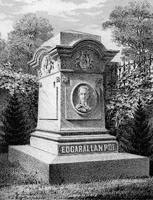
After over two decades buried in an unmarked corner of the cemetery at Baltimore's Westminster Church, Poe’s body was re-buried where people could see it from the street. A new memorial marker was dedicated on November 17, 1875.

The monument was substantial. Money for it was raised by several parties, including a Baltimore schoolteacher named Sara Sigourney Rice. Rice kicked off a "pennies for Poe" campaign and even asked her students to perform public speeches to raise funds. The final $650 came from Philadelphian George William Childs. The design came from architect George A. Frederick, built by Colonel Hugh Sisson, with a stone medallion of Poe by artist Adalbert Volck (later replaced). The total cost of the new monument was equal today to over $28,000.

Despite all the hard work on the monument, Poe's birthday was incorrectly chiseled as January 20 instead of January 19. It has never been corrected. On his birthday ten years after his reburial, Poe's long-dead wife Virginia Poe was buried with him. Maria Clemm was buried there too, bringing the family trio together for their eternal rest.

The ceremony to dedicate the new monument included speeches from Neilson Poe, Poe's oft-maligned cousin. Several famous poets were invited to attend. The only one that made it was Walt Whitman, then age 56, who was still recovering from a stroke.

Letters, poems and remembrances were contributed his one-time fiancee Sarah Helen Whitman and his occasional enemy James Russell Lowell. Other acknowledgments came from John Greenleaf Whittier ("The extraordinary genius of Edgar Poe is now acknowledged the world over"), William Cullen Bryant (Poe is "distinguished alike for originality in the conception, skill in word-painting, and power over the mind of the reader") and even Henry Wadsworth Longfellow (who noted: "The fever called Living is conquered at last"). Some of the greatest lines in honor of Poe came from fellow 2009 bicentennial poets Alfred Lord Tennyson, who later said that "neglected spot" would be the first place he would visit on a trip to the United States, and Oliver Wendell Holmes. As Dr. Holmes wrote:
His monument shall be his gentle verse,
Which eyes not yet created shall o'er read.
And tongues to be his being shall rehearse,
When all the breathers of this world are dead.
* People still leave "pennies for Poe" at this memorial today. This has become a tradition at the graves of famous figures, particularly writers. Poe did not originate the tradition, however.

Thursday, September 17, 2009

Poe and politics

Frederick William Thomas came to visit Poe at his house (then on Coates Street in Philadelphia) on September 17, 1842. Years later, he described Poe's home life in the so-called Quaker City:
He lived in a rural home on the outskirts of the city. His house was small, but comfortable inside for one of the kind. The rooms looked neat and orderly, but everything about the place wore an air of pecuniary want. Although I arrived late in the morning Mrs. Clemm, Poe's mother-in-law, was busy preparing for his breakfast. My presence possibly caused some confusion, but I noticed that there was delay and evident difficulty in procuring the meal. His wife entertained me. Her manners were agreeable and graceful... She and her mother showed much concern about Eddie, as they called Poe, and were anxious to have him secure work.
Thomas was a writer himself and, throughout his 60 years, lived in Providence, Charleston, Baltimore, Cincinnati — though it was in Philadelphia that he met Edgar Poe. Thomas maintained a long, frequent correspondence with Poe, three years his junior; letters between the two are very frank, honest, and interesting. Thomas also got his hands dirty in politics and campaigned on behalf of William Henry Harrison, who died shortly after his presidential inauguration. Harrison's successor, the "accidental president" John Tyler, compensated Thomas for his support by granting him a clerkship at the Treasury Department in Washington, D.C.

Thomas hoped his connection with the new president would lead to a job for his friend Poe. Their September 1842 meeting was to discuss this possibility. Robert Tyler, son of the new president, was in town and would likely show his support for granting Poe a government job, Thomas believed. But, Poe knew his preferred path: even as Thomas chatted with Poe about obtaining a government post, Poe chatted about creating his own literary journal. Nevertheless, the struggling writer/critic was somewhat intrigued by government work, which he had heard was easy money. Thomas implied the job was all but his already; Robert Tyler was "remarkably fond of poetry." He agreed to meet Thomas the next morning.

Thomas likely didn't hear from Poe for several days. A letter from Poe dated September 21, 1842 excuses his absence:
I am afraid you will think that I keep my promises but indifferently well, since I failed to make my appearance at Congress Hall on Sunday, and I now, therefore, write to apologize... Upon reaching home Saturday night, I was taken with a severe chill and fever — the latter keeping me company the next day. I found myself too ill to venture out, but, nevertheless, would have done so had I been able to obtain the consent of all parties.
Poe blamed both illness and his wife for not allowing him to meet with Tyler, the president's son. Was he really sick? Was his wife concerned about his health? Or, as biographer Kenneth Silverman concludes, was he just nursing a hangover after a night's drinking? When Poe realized he had missed a good opportunity (apparently, the job promised an annual salary of $1,500 — nearly double what he was making at Graham's Magazine), he wrote he still wanted to pursue the job, "if he [Tyler] can look over matters & get me the Inspectorship I will join the Washingtonians" — a temperance group (years later, Poe did, in fact, join a temperance organization).

Saturday, August 15, 2009

Birth of Virginia Clemm

Happy birthday to Virginia Eliza Clemm, who was born August 15, 1822.* She would have been 187 today.

What more can be said about Virginia that hasn't been said here already? I've wrote about the only surviving letter from Poe to his wife, their unusual marriage (and uncertain anniversary date), and the Valentine's poem she wrote to her husband — just to name a few. Today, I'd like to introduce the Poe work which is most inspired by Virginia. It is not "The Raven," nor is it "Annabel Lee." It is, in fact, the short story "Eleonora."

First published in the 1841 issue of The Gift, the story features an unnamed narrator who lives a life of isolation with his cousin and aunt. The setting is paradisaical, known as the Valley of the Many-Coloured Grass. Untrodden by strangers, the land is full of beautiful flowers and trees as well as a River of Silence. In this paradise, the narrator falls in love with his cousin — but she was sick, "made perfect in loveliness only to die." She worries that when she dies, her cousin will move on and fall in love with another. He promises that would never happen.

Her death, the narrator says, kicks off "the second era of my existence." This new life, however, is not as idyllic as it had been. The Valley of the Many-Coloured Grass does not survive after Eleonora's death:
The star-shaped flowers shrank into the stems of the trees, and appeared no more. The tints of the green carpet faded, and one by one the ruby-red asphodels withered away... And life departed from our paths; for the tall flamingo flaunted no longer his scarlet plumage before us, but flew sadly from the vale into the hills, with all the gay, glowing birds that had arrived in his company. And the golden and silver fish swam down through the gorge at the lower end of our domain, and bedecked the sweet river never again... And then, lastly, the voluminous cloud uprose, and abandoning the tops of the mountains to the dimness of old, fell back into the regions of Hesper, and took away all its manifold golden and gorgeous glories from the Valley of the Many-Coloured Grass.
The narrator leaves and moves to an unnamed city. There, he marries Ermengarde, not fearing the vow he had made. Eleonora appears to him and blesses his new union, saying "Thou art absolved... for reasons which shall be made known to thee in Heaven."

The story clearly references the idealism Poe had with his marriage (the biggest clue that this story is autobiographical is the inclusion of the aunt/mother-in-law character; she plays no clear role in the story but is a definite reference to Maria Clemm). Virginia was just beginning to show signs of tuberculosis — the illness which would kill her in five years. Poe was already feeling guilty that he might have to consider other women as potential second wives. Jumping the gun a bit? Maybe, but the more important aspect of the story is the idealism of the Valley of the Many-Coloured Grass, and how this paradise dies with the wife.

A couple lines from this story are often quoted, though it doesn't seem most know the origin of these quotes. This might sound familiar:
Men have called me mad; but the question is not yet settled,whether madness be or be not the loftier intelligence — whether much that is glorious — whether all that is profound — does not spring from disease of thought, from moods of mind exalted at the expense of the general intellect. They who dream by day are cognizant of many things which escape the dreamers by night.
Happy birthday, Virginia.

* I have found one source that lists her birthday as August 22. The majority of sources, however, use the August 15 date.

Sunday, July 19, 2009

The Red Death returns

Poe often republished his works, particularly when he was editor/owner of the Broadway Journal. My guess is that, always looking to fill space, he constantly had new versions of his previously-published works on hand. One example is the July 19, 1845 issue of the Broadway Journal, when Poe published a work formerly known as "The Mask of the Red Death: A Fantasy." This new version was renamed "The Masque of the Red Death." The minor shift from "Mask" to "Masque" is no small matter; Poe carefully calculated each and every word he used in his major works. The new title emphasizes the party scene in the story, putting it in the possession or control of the Red Death — and making it just that much more ominous.

If you don't know the story, I'd be surprised. Briefly, it follows a wealthy prince named Prospero, who invites his friends and fellow royals into his "castellated abbey" to avoid the plague raging outside. As his townspeople die out, he believes he will be perfectly safe and even throws a masquerade party to celebrate his sagacity. The massive gala takes place throughout seven rooms, each decorated with a specific color theme. The only room that most guests avoid is the final room, a black chamber with a foreboding ebony clock. When a strange-looking guest appears, wearing the garb of a victim of the plague, Prospero confronts him and, well, no words sum it up better than the final words in the story: "And Darkness and Decay and the Red Death held illimitable dominion over all."

Despite being one of Poe's popular mainstream works, "The Masque of the Red Death" has invited substantial critical commentary too. Often, it is read as an allegory about the inevitability of death — a reading complicated by Poe's outspoken dislike of using allegory. Particularly inviting to scholars is the question of the disease. Some suggest it stands in for tuberculosis, a disease which Poe had personal experience with; his wife Virginia was suffering from it at the time the story was written. Poe also witnessed a cholera epidemic while in Baltimore and the "red death" may reference that disease. Bubonic plague, also known as the black death, is another candidate, especially because of the symbolism of the final black room.

If you ask me, the "Red Death" is the "Red Death" and nothing more. In creating a fictitious disease, Poe makes the story about all disease, not any specific one. But, it is because of this debate and these questions of "What did Poe mean?" which help the story be more than just a scary tale but one of depth and value. Overall, "The Masque of the Red Death" stands as one of Poe's most important — and most entertaining — prose works.

*The image at the top right is by Harry Clarke, published in 1919, with an added red tint. I couldn't resist.

Monday, July 13, 2009

A wedding and a death

At a ceremony held at St. John's Protestant Episcopal Church in Baltimore, presided over by "Rev. Mr. Wyatt," William Clemm Jr. married Maria Poe on July 13, 1817.

Maria Poe was the younger sister of David Poe, Jr. — other siblings were John Hancock Poe, William Poe, George Washington Poe, Samuel Poe, and Elizabeth Poe. She was William Clemm's second wife and their marriage would produce three children: Henry Clemm, Virginia Marie Clemm, and Virginia Eliza Clemm (the first Virginia died as an infant; her younger sister was born the same year and given her name as an honor). That second Virginia Clemm would later marry Edgar A. Poe.

Very little is known about the marriage of William Clemm and Maria Poe Clemm. He already had five children from his first marriage and very little property or money when he had his second marriage. His first wife, in fact, was Maria's first cousin Harriet Poe. He died in 1826 and left what little he had to the five children from his first marriage. It's likely he never met Edgar Poe, who was living overseas with the Allans at the time of this marriage.

A relative of Clemm, presumably a nephew, became minister of the Methodist Episcopal Church in Baltimore — and presided over the three-minute burial service held after Poe's death in 1849.

Today also marks the death of George Rex Graham in 1894. Over his 81-year life, he experienced a series of ups and downs. Between 1839 and 1840, he acquired the Saturday Evening Post and then merged two Philadelphia journals to create Graham's Magazine. Shortly after, he hired Poe as his book review editor at the salary of $800 a year. Though Poe questioned the "namby-pamby" magazine on occasion, he helped lead it to become one of the most prominent publications in the country. Graham was concerned about his writers: his magazine was one of the first in the U. S. to copyright each issue and some writers (if they were paid at all) were granted an average five times more than other magazines. After Poe left, Graham hired Rufus Wilmot Griswold to replace him.

Nevertheless, Graham was pushed into bankruptcy in 1848 and lost controlling interest of both the Saturday Evening Post and Graham's Magazine. The latter magazine ceased publication in 1858. At the age of 70, Graham lost his eyesight and relied on the financial assistance of publisher George William Childs. The one-time powerhouse of American publishing, Graham died in obscurity in Orange, New Jersey on July 13, 1894 and was buried in Philadelphia's Laurel Hill Cemetery — apparently unmarked (I could not find it after three or four attempts).

Tuesday, July 7, 2009

To My Mother

Somewhat lacking in deep literary merit yet undoubtedly sentimental, the poem "To My Mother" needs very little commentary to understand. Despite its title, the emotional, very personal poem (perhaps Poe's most personal) is not about the poet's birth mother Eliza Arnold Poe, nor is it about the woman who raised him, foster-mother Frances Allan. Instead, it is about the mother of his dead wife.

Though Poe's wife Virginia had died in 1847, Poe continued living with and supporting her mother, Maria Poe Clemm (who was also his aunt, sister of his father). He wrote a sonnet to his mother-in-law, who he nicknamed "Muddy" (presumably because of its similarity to "mother"), which was published on July 7, 1849 in the Flag of Our Union newspaper. In its entirety:
To My Mother

Because I feel that, in the heavens above,
The angels, whispering to one another,
Can find, among their burning terms of love,
None so devotional as that of 'mother' —
Therefore by that sweet name I long have called you —
You, who are more than mother unto me,
And fill my heart of hearts, where Death installed you,
In setting my Virginia's spirit free.
My mother — my own mother — who died early —
Was but the mother of myself; but you
Are mother to the one I loved so dearly,
And thus are dearer than the mother I knew;
By that infinity with which my wife
Was dearer to my soul than its soul-life.
Perhaps ironically, this same date, July 7, in 1835 marked the death of Poe's grandmother, Elizabeth Cairnes Poe. The wife of David Poe Sr. (a veteran of the American Revolution who was friends with General La Fayette), she was 79 years old when she died. Her daughter, Maria Clemm (the subject of the poem above), was taking care of her at the time as well as utilizing the pension the widow Poe was receiving for her husband's Revolutionary service — this pension was the small family's main means of financial support. Poe had lived with her in Baltimore for a time.

Friday, June 12, 2009

Poe's only surviving letter to his wife

There is only one surviving letter written by Poe to his wife Virginia. The letter begins:
"My Deart Heart, My dear Virginia! our Mother [e.g. Maria Clemm, Virginia's mother and Poe's aunt/mother-in-law] will explain to you why I stay away from you this night. I trust the interview I am promised,* will result in some substantial good for me, for your dear sake, and hers—Keep up your heart in all hopefulness, and trust yet a little longer."
He then assures here, "I shall be with you tomorrow P.M. and be assured until I see you, I will keep in loving remembrance your last words and your fervent prayer!"

Virginia at this time was very ill with tuberculosis. Emphasizing his dependence on the younger woman, Poe asks her to survive just a little longer. It is because of her, he notes, that he has been able to be strong after the recent failure of the Broadway Journal. "In my last great disappointment, I should have lost my courage but for you—my darling little wife you are my greatest and only stimulus now to battle with this uncongenial, unsatisfactory and ungrateful life." Certainly a heavy burden for a dying woman to bear!

The brief letter is signed "Your devoted Edgar." That devotion is clear. As Biographer Kenneth Silverman wrote, "Although he treated many others abrasively, falsely, or manipulatively, with Virginia he seems always to have been soft, concerned, nearly reverential."

But he could not count on her forever. Around this same time, a visitor already noted she was "almost a disrobed spirit, and when she coughed it was made certain that she was rapidly passing away." At the time Poe wrote this only extant letter to his wife, she was only six months away from death.

*Circumstances surrounding this letter are unclear; it is not even known where Poe was when he wrote to his wife. It's possible he was working on building subscriptions for The Stylus (an "interview" is not necessarily job-related at this time; it could refer to any scheduled interaction between people).

**The image of the letter is courtesy of the web site "Knowing Poe." The original is part of the collection of the University of Virginia.

Wednesday, June 3, 2009

The scandalous Elizabeth F. Ellet

Elizabeth F. Ellet is the female equivalent of Rufus W. Griswold: jealous, petty, cruel, and an instigator who lashed out against others without reason. For example, she threw herself into the strange "affair" between Frances Sargent Osgood and Poe, for whom she had a romantic interest. After tricking Mrs. Virginia Poe into showing her some of Mrs. Osgood's letters, she suggested to Mrs. Osgood that their contents would lead to shameful scandal. Though today, most accounts suggest that the flirtation between Osgood and Poe was purely innocent, she was convinced to have Poe destroy the letters. A minor controversy ensued which involved Margaret Fuller, Anne Lynch, and Ellet's pistol-wielding brother (which eventually also pulled in Thomas Dunn English — but that story will be told here later this summer). Mr. Samuel Osgood accused Ellet of scandal-mongering, but she placed the blame squarely on Mr. and Mrs. Poe. Virginia died in 1847 and at least one friend suggested Ellet's forced scandal exacerbated her illness such that it could be claimed "Mrs. E. had been her murderer." Griswold, of course, was involved as well — he also had a crush on Osgood; she even dedicated a book to him.

But, if you think that controversy was confusing, nothing compares to what Ellet did to Rufus Griswold.

Griswold was not a nice man, certainly, but there are a few incidents that beg sympathy. In 1852, he broke off a loveless marriage with his second wife, Charlotte Myers (their relationship is still confusing) so that he could marry a woman named Harriet McCrillis. Ellet stepped in and urged Myers (a complete stranger) not to grant the divorce and for McCrillis (a complete stranger) not to marry Griswold. Nevertheless, the divorce was made official and Griswold married McCrillis. Ellet did not quit.

She continued writing to Myers, urging her to seek a repeal of the divorce. Myers gave in and the matter was to be brought before the Philadelphia Court of Common Pleas. While awaiting the court date, Griswold's house caught fire, leaving him brutally disfigured; he lost his eyebrows, eyelashes, and seven of his fingernails to the fire. In 1856, the Court date arrived and neither Myers nor Griswold bothered to show up — but Mrs. Ellet did, serving as a character witness against Griswold. The divorce was not repealed, but Griswold's third wife Harriet McCrillis left him amidst the public scandal over the possible bigamy — she never saw her husband again before his death from tuberculosis in 1857. Shortly before his death, Griswold published a pamphlet to publicly address the scandal, Statement of the Relations of Rufus W. Griswold with Charlotte Myers (called Charlotte Griswold) [and] Elizabeth F. Ellet... With Particular Reference to Their Late Unsuccessful Attempt to Have Set Aside the Decree Granted in the Case of Griswold vs. Griswold. One friend suggested that Ellet had "goaded Griswold to his death."

Frankly, there was no apparent reason why Ellet got involved in Griswold's romantic life. She did not seem to exhibit any romantic feelings towards him (her messages to Poe were more than clear, if not sultry). Griswold had always treated her well in his criticism and even helped her publish her popular book The Women of the American Revolution (1845). Ellet deserves no more complicated a description than "a bad person."

Nevertheless, rest in peace, Elizabeth. She died this day, June 3, in 1877. Today she is buried in Green-Wood Cemetery in Brooklyn — the same cemetery where lies Rufus Griswold.

Saturday, May 16, 2009

The Unusual Marriage of the Poes

The marriage which joined Edgar A. Poe to his teenage cousin Virginia Clemm was certainly unusual — and it has nothing to do with their blood relations or the bride's age.

There is a signed document (a not-so-good reproduction is pictured at right) dated May 16, 1836 which serves as the couple's official marriage bond. A deputy clerk named Thomas W. Cleland served as witness and testified that Virginia was, in fact, "of the full age of twenty-one years" (she was 13). The ceremony was officiated by a Presbyterian minister and attendees included Virginia's mother Maria Clemm (the younger sister of Poe's father), Poe's on-and-off boss Thomas W. White, and White's daughter Eliza (a young lady with whom Poe may have flirted for a time). The document from the city of Richmond was made under the agreement "that whereas marriage is shortly intended to be had and solemnized between... Edgar A. Poe and Virginia E. Clemm." It was signed 173 years ago today.

The question is: When did they really get married?

Several months earlier, on September 22, 1835, the Clerk of the Baltimore County Court issued a marriage license for Edgar and Virginia. She was 13; he was 27. There is debate if a marriage really took place (Arthur Hobson Quinn believes it impossible, Kenneth Silverman believes it to be likely). It seems, nevertheless, that the majority side with Quinn: Poe did not marry his 13-year old cousin.*

Instead, he married his 13-and-a-half-year old cousin on this date — May 16 — in 1836.

Those that believe the "secret" first marriage to be the "true" one suggested that the second "marriage" in 1836 was more public because, now only a few months shy of age 14, Virginia was of a more socially-acceptable age to marry. It's the difference between being just a month over age 13 or being just three months shy of 14. Reverend Amasa Converse did not seem to have a problem that the young woman was obviously not 21 years old as was claimed (for most of her life, she was described as "childlike" in appearance, even when in her 20s). The happy newlyweds then spent a couple days in Petersburg, Virginia.

I say this nonchalantly to prove a minor point: Virginia's age at marriage wasn't as shocking then as it seems today. Marriage at such a young age does not appear rampant in this period, but it also doesn't seem particularly uncommon. Poe seems to have been somewhat embarrassed, however, and occasionally (as on the wedding certificate) suggested that Virginia was older or that he himself was younger. For those that want to paint Poe as a pedophile, he did not take advantage of her. Unlike some, I will not psychoanalyze his writing (i.e. "Annabel Lee" or "Berenice") for examples that prove Virginia was, well, virginal. Poe's own words are better suited: most believe he was sincere when he said he slept alone and did not "assume the position of husband" for two years at least. Some suggest the couple never consummated their marriage at all.

Within 11 years of their marriage, Virginia would die of tuberculosis at the age of 24 — and, today, 162 years after her death, most still refer to her as Poe's "child bride," forced to never grow up in historical memory.

*As for the blood relationship, this was not entirely unusual either. I may write about this more in-depth in a later entry.

Tuesday, May 12, 2009

Death of "Fanny" Osgood

On May 12, 1850, poet Frances Sargent Osgood died after a struggle with tuberculosis. She was 38 years old.

In the 1840s, she became estranged from her painter husband, Samuel Stillman Osgood, who was tempted enough by one of several discoveries of gold in California that he left his wife and children to find some. During their estrangement, "Fanny" Osgood (as she was known) carried on a very public flirtation with Edgar A. Poe — whose wife Virginia was very much still alive. In 1845, even while Virginia was writing Poe a Valentine, her husband was writing one to Osgood.

Biographers continue to debate the sort of relationship that Osgood and Poe shared, and the range is fairly wide. Some say their flirtation was purely platonic, an innocent game of poetry. Others suggest the couple went so far as to have a bastard child together, Fanny Fay, who died just over a year later and may have inspired Poe's poem "Ulalume" ("It was surely October / On this very night of last year / That I journeyed —I journeyed down here! — / That I brought a dread burden down here — / On this night of all nights in the year..."). That unlikely story was actually sparked by the rumor-mongering New Yorker Elizabeth F. Ellet, though it still has its believers today.

Here's an example of the "scandalous" poetry between the two.
"Impromtu. To Kate Carol" (1845)
When from your gems of thought I turn
To those pure orbs, your heart to learn,

I scarce know which to prize most high —

The bright i-dea, or the bright dear-eye.

Kate Carol was one of a handful of pseudonyms that Osgood used; another was Violet Vane (though they don't appear to be very secret). Regardless of her relationship with Poe, "Mrs. Osgood" was an accomplished poet and prose writer. Her popularity made her one of the most widely-read women writers of her day, especially as a contributor to many of the more popular magazines — including Graham's Magazine and Godey's Lady's Book. Over a century and a half after her death, however, Osgood is almost universally denounced as a trashy sentimentalist who embodied the stereotypical "safe" writing of women of her day. This critique comes especially from feminist critics, who can't help but cringe at reading some of her poetry, including "Song" ("Call me pet names, dearest! Call me a bird, / That flies to thy breast at one cherishing word, / That folds its wild wings there, ne'er dreaming of flight...").

Mrs. Osgood also carried on a simple flirtation with Poe's greatest enemy, Rufus Wilmot Griswold. Griswold was on the receiving end of a couple "romantic" poems, as well as the dedication of a volume of poetry. This minor rivalry for Osgood's (platonic?) affection may have been one more motivation behind Griswold's posthumous attacks on Poe. Either way, Osgood later did reunite with her husband the painter. Always frail, her death by tuberculosis in 1850 was not unexpected. She is today buried in Mount Auburn Cemetery in Cambridge, Massachusetts — alongside her husband and little Fanny Fay.

*The portrait above is by Samuel Stillman Osgood. He also painted one of his "competitor," Edgar A. Poe — before he grew his now-iconic mustache.

Tuesday, April 7, 2009

The Poe family leaves Philadelphia

Though Poe had his work published throughout the United States, the Edgar Allan Poe National Historic Site specifically commemorates his time in Philadelphia — considered to be his most prolific, most lucrative, and happiest period. Here, he published "The Gold-Bug," "The Murders in the Rue Morgue," "The Black Cat," and "The Tell-Tale Heart" (to name a few). He lived in several homes throughout the city, the last of which was the one here on Spring Garden St. It is also the only of his Philadelphia homes still standing.

This post, however, is about the end of that several-year period in 1844. Poe and his wife Virginia left their Spring Garden home early on April 6, traveling via train to Perth Amboy, New Jersey and from there taking a steamer to New York. Virginia, who Poe called "Sissy," was already sick with tuberculosis and would die within three years. Nevertheless, they were optimistic and hoped that a relocation to New York would solve their problems.

The next day, April 7, Poe wrote to his mother-in-law Maria Clemm, still in Philadelphia. "We started in good spirits, but did not get here until nearly 3 o'clock... Sissy coughed none at all." The day was a rainy one and Poe left Virginia behind on the boat while he tried to find a place to board. He found a boarding-house at 130 Greenwich Street in lower Manhattan and went back for Virginia. They celebrated their arrival in style:
Last night, for supper, we had the nicest tea you ever drank, strong & hot — wheat bread & rye bread — cheese — tea-cakes (elegant) a great dish (2 dishes) of elegant ham, and 2 of cold veal, piled up like a mountain and large slices — 3 dishes of the cakes, and every thing in the greatest profusion. No fear of starving here... I feel in excellent spirits & have'nt drank a drop.
Poe concludes the letter by noting that Sissy cried later that night because she missed her mother — and the family cat, Catterina.

The letter has been analyzed by several Poe scholars, who question the veracity of their big meal, how they could have afforded it, why Poe was sure to note he wasn't drinking, why Virginia was crying, and how juvenile she must be for missing the cat (she was 21 years old at this point).

Either way, Poe's time in New York will be a struggle, financially and emotionally. Yet, here he will also meet one of his greatest successes with the publication of "The Raven." And don't think that New York has forgotten their adopted son. Walking tours of Greenwich focusing on Poe are offered, and the last home in which Poe lived — the Poe Cottage in Fordham — is open to the public.

Saturday, February 14, 2009

A Poe Valentine's Day

As you spread love, chocolate, and flowers this February 14, keep in mind that Poe got into the spirit of Valentine's Day himself. Here are a few examples:

-An acrostic poem written by Poe's wife Virginia, February 14, 1846

Ever with thee I wish to roam —
Dearest my life is thine.
Give me a cottage for my home
And a rich old cypress vine,
Removed from the world with its sin and care
And the tattling of many tongues.
Love alone shall guide us when we are there —
Love shall heal my weakened lungs;
And Oh, the tranquil hours we'll spend,
Never wishing that others may see!
Perfect ease we'll enjoy, without thinking to lend
Ourselves to the world and its glee —
Ever peaceful and blissful we'll be.

(These are the only surviving words written by Virginia. If it's not enough of a tearjerker, check out this musical rendition by an acquaintance of mine.)

Knowing that his wife was dying, Poe kept up flirtations with other women. The same day Virginia presented the above poem, Poe wrote this to Frances Osgood:

-A Valentine February 14, 1846

For her this rhyme is penned, whose luminous eyes,
Brightly expressive as the twins of Leda,
Shall find her own sweet name, that nestling lies
Upon the page, enwrapped from every reader.
Search narrowly the lines!- they hold a treasure
Divine- a talisman- an amulet
That must be worn at heart. Search well the measure-
The words- the syllables! Do not forget
The trivialest point, or you may lose your labor
And yet there is in this no Gordian knot
Which one might not undo without a sabre,
If one could merely comprehend the plot.
Enwritten upon the leaf where now are peering
Eyes scintillating soul, there lie perdus
Three eloquent words oft uttered in the hearing
Of poets, by poets- as the name is a poet's, too,
Its letters, although naturally lying
Like the knight Pinto- Mendez Ferdinando-
Still form a synonym for Truth- Cease trying!
You will not read the riddle, though you do the best you can do.


This next one was written to Marie Louise Shew, a woman who had served as a volunteer nurse as Virginia was dying. It is likely meant platonically.

-To M. L. S.--, dated February 14, 1847

Of all who hail thy presence as the morning-
Of all to whom thine absence is the night-
The blotting utterly from out high heaven
The sacred sun- of all who, weeping, bless thee
Hourly for hope- for life- ah! above all,
For the resurrection of deep-buried faith
In Truth- in Virtue- in Humanity-
Of all who, on Despair's unhallowed bed
Lying down to die, have suddenly arisen
At thy soft-murmured words, "Let there be light!"
At the soft-murmured words that were fulfilled
In the seraphic glancing of thine eyes-
Of all who owe thee most- whose gratitude
Nearest resembles worship- oh, remember
The truest- the most fervently devoted,
And think that these weak lines are written by him-
By him who, as he pens them, thrills to think
His spirit is communing with an angel's.

Poe was surprised in 1848 when he heard that a poem was dedicated to him at a Valentine's party that year. The author, Sarah Helen Whitman, was very, very close to becoming Poe's second wife. Here is the Valentine poem she wrote for him:

-The Raven, February 14, 1848

Raven, from the dim dominions
On the Night's Plutonian shore,
Oft I hear thy dusky pinions
Wave and flutter round my door—
See the shadow of thy pinions
Float along the moon-lit floor;

Often, from the oak-woods glooming
Round some dim ancestral tower,
In the lurid distance looming—
Some high solitary tower—
I can hear thy storm-cry booming
Through the lonely midnight hour.

When the moon is at the zenith,
Thou dost haunt the moated hall,
Where the marish flower greeneth
O'er the waters, like a pall—
Where the House of Usher leaneth,
Darkly nodding to its fall:

There I see thee, dimly gliding—
See thy black plumes waving slow—
In its hollow casements hiding,
When their shadow yawns below,
To the sullen tarn confiding
The dark secrets of their woe:—

See thee, when the stars are burning
In their cressets, silver clear—
When Ligeia's spirit yearning
For the earth-life, wanders near—
When Morella's soul returning,
Weirdly whispers "I am here."

Once, within a realm enchanted,
On a far isle of the seas,
By unearthly visions haunted,
By unearthly melodies,
Where the evening sunlight slanted
Golden through the garden trees—

Where the dreamy moonlight dozes,
Where the early violets dwell,
Listening to the silver closes
Of a lyric loved too well,
Suddenly, among the roses,
Like a cloud, thy shadow fell.

Once, where Ulalume lies sleeping,
Hard by Auber's haunted mere,
With the ghouls a vigil keeping,
On that night of all the year,
Came thy souding pinions, sweeping
Through the leafless woods of Weir!

Oft, with Proserpine I wander
On the Night's Plutonian shore,
Hoping, fearing, while I ponder
On thy loved and lost Lenore—
On the demon doubts that sunder
Soul from soul forevermore;

Trusting, though with sorrow laden,
That when life's dark dream is o'er,
By whatever name the maiden
Lives within thy mystic lore,
Eiros, in that distant Aidenn,
Shall his Charmion meet once more.

Monday, February 2, 2009

Virginia's funeral

Virginia Clemm Poe died on January 30. Her obituary in the New York Daily Tribune her death "of plumonary consumption, in the 25th year of her age, VIRGINIA ELIZA, wife of EDGAR A. Poe". A young Walt Whitman also made a notice of her death in the Brooklyn Eagle. On February 2, 1847, her funeral was held and she was buried (for the first time).

Not having a lot of money at this point, Poe turned to his landlord, John Valentine, in Fordham, New York. The Valentine family had taken an interest in the Poes and were willing to have Virginia buried in their family plot in a Dutch Reformed Church near the cottage they rented to the Poes (seen in the image at right, the Fordham Cottage is open to the public!). Funeral attendees included Nathaniel Parker Willis, Mary Valentine, Sarah Anna Lewis (presumably), Poe's cousin Elizabeth Rebecca Herring, and possibly Evert Augustus Duyckinck, Cornelius Mathews, and other (then) important literary figures. It was a cold afternoon and Poe wore the great grey coat he was issued at West Point — which had previously been used as a blanket by Virginia on her deathbed.

It is speculated that it was only a few hours after Virginia's that Poe, realizing he had no image of his wife, commissioned a water color portrait (possibly painted by Mary Louise Shew). For a time, it was believed this, a portrait of her corpse, was the only image of Virginia in existence. Some time ago, however, a more flattering oil portrait was found in the possession of the Herring family.

Mary Louise Shew, a friend who had served as an amateur nurse in Virginia's final days, helped arrange for the funeral. After Virginia's death, she tried to take care of Poe, who was suddenly ill. She also helped make the controversial diagnosis that Poe had a brain lesion or brain congestion — leading to more modern speculation about his death two years and eight months later.

Shortly after Virginia's funeral, possibly a day or two, Poe scribbled out a couplet — the beginning of a poem he never finished:

Deep in earth my love is lying
And I must weep alone

Friday, January 30, 2009

In memoriam: Virginia Clemm Poe

On January 30, 1847, Virginia Eliza Clemm Poe died after a five-year battle with tuberculosis at the age of 24. Though she is often referred to as Edgar Poe's "child bride," it's important to note that after 11 years of marriage, we can presume she grew up a bit.

We don't tend to talk much about her character; not even I have a personal opinion if she was a strong woman, intelligent, artistic, or good at housekeeping. She has sort of been relegated to a background character in the life of Poe. Even so, discussing Poe requires discussion of his wife, and that discussion can be romantic, awkward, confusing, or apologetic. The truth is, yes, Poe married his first-cousin when she was 13 (he was 27). No, it was not unusual to marry your cousin in those days and, from what I've seen, especially among poorer families in the South. But, just to make a point, others who married their first cousins include two signers of the Declaration of Independence (a couple others opted for second cousins), writer H. G. Wells, and (fellow bicentennial) Charles Darwin. As far as the age difference, women did marry young in those days. But, I would quickly point out that Virginia was unusually young for marriage, even at this time period. I can't dispute that.

Of course, there has been dispute as far as the kind of relationship Mr. and Mrs. Poe shared. The doting husband called his wife "Sissy" as a nickname, and many scholars believe they shared more of a sibling partnership. Many also believe that the couple never consummated their marriage (especially if you believe "Annabel Lee" stood in for Virginia as the "maiden there lived whom you may know"), while others suggest that they held off until a more appropriate age.

My personal opinion is that Poe was madly in love with his wife. But, to Poe, love was not physical but poetic and, because he existed on this higher plane of artistic passion, his relationship can't compare to our modern definitions of marriage. Even if their relationship was sexual (which I believe is possible, but I fall into the camp that believes it didn't happen right away), it was not the primary part of their marriage. This relationship was based on love - and there's nothing wrong with that, especially for a 19th century coupling. When she died, of course he was devastated.

Nevertheless, there is a rumor that Poe never got over the death of his wife, and that her sickness and death defined all of his writing and forced him to become an alcoholic. I would dispute some of these rumors, if you don't mind.

First, though much of Poe's writing emphasizes death and, more specifically, deaths of women, not all of them do. One of his most famous, for example, "The Tell-Tale Heart," shows no signs of illness or of women dying. Further, Poe's use of the theme of dying women is for artistic purposes - as explained in my last blog post on "The Raven." As far as Poe never getting over Virginia's death, well, there is likely some truth to that - just as they say today, you never truly stop loving someone. But, Poe was looking for his second wife even while Virginia was still alive and, in some cases, was encouraged by Virginia to do so.

Drinking, of course, is always a contentious discussion with Poe. I would argue that his drinking problems first manifested as a university student (anything unusual about college students experimenting with alcohol?) and, sure, he drank throughout his life. But, it was after Virginia's death that Poe joined a temperance society and took a vow of sobriety. We can argue about this for quite some time and never really find the source of Poe's drinking, how much he drank, how affected he was by alcohol, etc.

All this aside, here's to Virginia Clemm Poe, to whom this blog is respectfully dedicated today.