Poe's works published in December are very representative of his overall bibliography. They include his mournful, sound-focused poem "Ulalume" (December 1847 issue of the American Whig Review), for example, as well as several tales:
• "Bon-Bon," featuring a devil who eats philosophers' souls like chocolates (December 1, 1832 issue of the Philadelphia Saturday Courier)
• "The Conversation of Eiros and Charmion," considered one of the first apocalyptic future stories (December 1839 issue of Burton's Gentleman's Magazine)
• "The Man of the Crowd," a strange urban tale of identity or the lack thereof and secret sin (December 1840 issue of Graham's Magazine)
•one of the installments to the real-life crime story "The Mystery of Marie Roget" (second part in the December 1842 Snowden's Ladies' Companion)
• the humorous "The Literary Life of Thingum Bob, Esq." (December 1844 issue of the Southern Literary Messenger)
• the grotesque hoax-like "The Facts in the Case of M. Valdemar" (December 1845 issue of the American Review)
• the critical theory essay "The Poetic Principle" (December 1848 issue of the Southern Literary Messenger)
• the first installment of his only play Politian, though he never completed it (December 1835 issue of the Southern Literary Messenger).
In this snapshot of Poe's works, you see it all: poetry, horror, hoax, humor, science fiction, detective stories, literary theory, experimental works and even ones that defy a single identifiable genre (I'm thinking of "The Man of the Crowd" in particular here). It goes to show that Poe was not only a horror writer — in fact, he wasn't even primarily a horror writer. We should have the same problem categorizing Poe as the narrator in "The Man of the Crowd" has with defining the title character.
I've hoped that the way we define Poe as a writer can be broadened. Ultimately, there's nothing wrong with labeling him primarily for his horror works but it's also very important that we look beyond it. The problem I have as a Poeist is people that judge Poe solely for a couple of works which, ultimately, are not representative of his whole body of works. And, unfortunately, we don't just define him as a writer by these few works, but as a man as well.
What makes a man write a story about a man who goes crazy and kills an old man just because of a weird eye before chopping up the body parts to conceal his crime? What kind of man writes a revenge tale where a character lures another into a wine cellar to brick him in alive? How does someone write about a tormented narrator whose obsession over his lost love manifests as a lost, ominous black bird? The definition readers often have of Poe are based on those three works ("The Tell-Tale Heart," "The Cask of Amontillado," and "The Raven").
It might be just as useless to ask these questions: What makes a man write a humor story about a man so full of himself that he dares to engage the devil in a debate about philosophy, only to learn the philosophers he mentions have been taken by the devil? What kind of man writes a tale about how urbanization causes us to feel alone while crowded by hundreds of thousands of strangers? How does someone write about how modern technology or techniques can attempt to defy death but ultimately leave us punished for this challenge to God? There is no commonality that generally expressed all of Poe's writing. He should be honored for the "absolute idiosyncrasy" of his wide range of works, the same type of idiosyncrasy which distinguishes the man of the crowd.
Poe was, in case you can't tell, exploring the minds of his readers, not himself. He dove into pop culture, emerging science, and postulated about the future. He found common fears and exploited them just as often as he heightened humor to the level of absurdity. He knew the difference between high quality writing and "just for fun" reading.
It would be nice to see Poe studied, particularly at a younger reading level, identifying all of this. Poe wasn't crazy, he wasn't obsessed with death, he was just a mirror of his own times — and he happened to write really, really well. He is part of his time, his cultural context — and yet, he stands out somehow. He is the man of the crowd.
Showing posts with label obscure works. Show all posts
Showing posts with label obscure works. Show all posts
Monday, December 28, 2009


Friday, December 4, 2009
Terror is of the soul
Poe's collection of short stories Tales of the Grotesque and Arabesque was issued circa December 4, 1839. His publishers Lea & Blanchard limited its production run, despite protest from the author. It was his first collection of prose, though he had previously published a novel and, well, a controversial textbook on seashells in addition to a couple books of poetry.
Poe's early works were somewhat sensational and he was occasionally criticized for "Germanic" stories, what we might call Gothic romance today. In Poe's introduction to the book, he responds to those accusations with the now-famous line, "I maintain that terror is not of Germany, but of the soul." In fact, I believe that's exactly what Poe was doing throughout his career: mirroring the general thoughts and feelings of his reading audience (okay, except for that seashell thing).
Burton's Gentleman's Magazine announced the book's publication, noting that its title "pretty well indicates their [stories'] character." In case you're like me, you might need more help on the terms "Grotesque" and "Arabesque." They are architectural terms, after all, and not often used in literary discussions today. Poe, however, might have been inspired by fellow writer Sir Walter Scott, who used the terms in his essay "On the Supernatural in Fictitious Composition."
 Both terms refer to a type of complex Islamic art style used in walls and carpets, especially in mosques. Poe used "arabesque" in this way in his essay on "The Philosophy of Furniture" (what? You haven't read Poe's tips on interior design?). In the case of this book, however, Poe may have been trying to create categories within Gothic fiction much like the categories within architecture.
Some scholars define the "grotesque" stories as those where the character becomes a caricature or satire, as in "The Man That Was Used Up," a story which questions the nature of a war hero (likely modeled on General Winfield Scott). The "arabesque" stories are often psychological as in "The Fall of the House of Usher." Other scholars say "grotesque" means blood and gore, while "arabesque" means terror on a metaphysical level. Ultimately, there is no way to accurately define Poe's intentions for these terms, and scholars who attempt a laundry list of "grotesques" and "arabesques" often end up with different results.
*The picture is an arabesque-style tile from the Wazir Khan Mosque in Lahore, Pakistan, circa late 18th century.
Poe's early works were somewhat sensational and he was occasionally criticized for "Germanic" stories, what we might call Gothic romance today. In Poe's introduction to the book, he responds to those accusations with the now-famous line, "I maintain that terror is not of Germany, but of the soul." In fact, I believe that's exactly what Poe was doing throughout his career: mirroring the general thoughts and feelings of his reading audience (okay, except for that seashell thing).
Burton's Gentleman's Magazine announced the book's publication, noting that its title "pretty well indicates their [stories'] character." In case you're like me, you might need more help on the terms "Grotesque" and "Arabesque." They are architectural terms, after all, and not often used in literary discussions today. Poe, however, might have been inspired by fellow writer Sir Walter Scott, who used the terms in his essay "On the Supernatural in Fictitious Composition."
 Both terms refer to a type of complex Islamic art style used in walls and carpets, especially in mosques. Poe used "arabesque" in this way in his essay on "The Philosophy of Furniture" (what? You haven't read Poe's tips on interior design?). In the case of this book, however, Poe may have been trying to create categories within Gothic fiction much like the categories within architecture.
Some scholars define the "grotesque" stories as those where the character becomes a caricature or satire, as in "The Man That Was Used Up," a story which questions the nature of a war hero (likely modeled on General Winfield Scott). The "arabesque" stories are often psychological as in "The Fall of the House of Usher." Other scholars say "grotesque" means blood and gore, while "arabesque" means terror on a metaphysical level. Ultimately, there is no way to accurately define Poe's intentions for these terms, and scholars who attempt a laundry list of "grotesques" and "arabesques" often end up with different results.
*The picture is an arabesque-style tile from the Wazir Khan Mosque in Lahore, Pakistan, circa late 18th century.
Thursday, December 3, 2009
The fatal resemblance
On December 3, 1844, the Paris, France-based newspaper La Quotidienne began publishing installments of "James Dixon, ou la funeste resemblance" (which translates to "James Dixon, or the fatal resemblance"). Though it included a byline of Gustave Brunet, the story was, in fact, an adaptation of Poe's doppelganger story "William Wilson." This was two years before Charles Beaudelaire began his translations of Poe. The same Paris newspaper would soon publish a controversial translation of "The Murders in the Rue Morgue."
As I've noted elsewhere, French readers have long been devoted followers of Poe. I would say that their appreciation for Poe could never be overstated. An entire book has been written about it, so I could never do it justice here. But, to get an idea, besides the admiration of Charles Baudelaire, Poe is credited as the main inspiration for the Symbolist poetry movement that took hold in France, particularly the work of Stephane Mallarmé. This "James Dixon" is the first known translation of Poe's work into French so, in a sense, this one started it all.
More than that, however, the publication of "James Dixon, ou la funeste resemblance" is the first known version of the work of Poe in any language other than English. Even during his lifetime, Poe was becoming a figure of world literature. Some foreigners find it ironic (or, in the case of Baudelaire, unconscionable) that Poe earned greater respect outside of his native country. I would argue that he has come to be much better appreciated here in the United States since then, but that most Americans make their assessment of him based on a very narrow selection of his works. Many readers in countries like France, Spain, England, the Czech Republic, Russia, and scores of others in Europe and South America in particular do not consider Poe a horror writer. They embrace the full span of his various works, including science fiction, comedy, and romantic poetry. I've been particularly surprised to see how much non-American readers have come to love strange works like Eureka and The Narrative of Arthur Gordon Pym of Nantucket.
I have two questions: If you are an American, when do you think we will come to know Poe beyond his horror works? If you are from elsewhere, what has been your experience with Poe?
As I've noted elsewhere, French readers have long been devoted followers of Poe. I would say that their appreciation for Poe could never be overstated. An entire book has been written about it, so I could never do it justice here. But, to get an idea, besides the admiration of Charles Baudelaire, Poe is credited as the main inspiration for the Symbolist poetry movement that took hold in France, particularly the work of Stephane Mallarmé. This "James Dixon" is the first known translation of Poe's work into French so, in a sense, this one started it all.
More than that, however, the publication of "James Dixon, ou la funeste resemblance" is the first known version of the work of Poe in any language other than English. Even during his lifetime, Poe was becoming a figure of world literature. Some foreigners find it ironic (or, in the case of Baudelaire, unconscionable) that Poe earned greater respect outside of his native country. I would argue that he has come to be much better appreciated here in the United States since then, but that most Americans make their assessment of him based on a very narrow selection of his works. Many readers in countries like France, Spain, England, the Czech Republic, Russia, and scores of others in Europe and South America in particular do not consider Poe a horror writer. They embrace the full span of his various works, including science fiction, comedy, and romantic poetry. I've been particularly surprised to see how much non-American readers have come to love strange works like Eureka and The Narrative of Arthur Gordon Pym of Nantucket.
I have two questions: If you are an American, when do you think we will come to know Poe beyond his horror works? If you are from elsewhere, what has been your experience with Poe?
Friday, November 27, 2009
Three Sundays in a Week
"A Succession of Sundays" was first printed in the November 27, 1841 issue of the Saturday Evening Post. The story, now known as "Three Sundays in a Week," depicts a grumpy Uncle Rumgudgeon who refuses to grant his nephew Bobby permission to marry his daughter and, therefore, inherit a portion of Rumgudgeon's estate. The uncle, being sly, says he would only offer his blessing when "three Sundays came together in one week."
Determined, with comedic effect, the traveling nephew finds a way to have three Sundays fall in one week. Two sea captains are confused by the date, both having come from different time zones and because of how they travel. One swears that yesterday was Sunday, while the other swears that's tomorrow. In fact, the day of their conversation was a Sunday. In other words, bringing these perceptions together, even Rumgudgeon admits these are "Three Sundays all in a row!"
Certainly not one of Poe's greatest, but it's another example of his humor. In this case, it's mixed in with a little of that version of science fiction that Poe plays with (to greater degrees of success) in more well-known works like "The Balloon-Hoax." It also shows a tiny bit of ratiocination, that imaginative problem-solving that refuses to dismiss the unusual. It calls to mind his essay on "Maelzel's Chess-Player," for example.
"Three Sundays in a Week" became the standard title when it was republished with that name in the May 10, 1845 issue of the Broadway Journal. It was translated into Spanish and published i February 1857 in Madrid's El Museo Universal. That publication is considered the first of Poe's works translated into Spanish. This light-hearted tale was almost certainly an influence on Around the World in 80 Days (1873) by Jules Verne — an admitted Poe fan. As in Poe's story, characters in Verne's novel lose a day by traveling west around the world or gain a day by going east.
Determined, with comedic effect, the traveling nephew finds a way to have three Sundays fall in one week. Two sea captains are confused by the date, both having come from different time zones and because of how they travel. One swears that yesterday was Sunday, while the other swears that's tomorrow. In fact, the day of their conversation was a Sunday. In other words, bringing these perceptions together, even Rumgudgeon admits these are "Three Sundays all in a row!"
Certainly not one of Poe's greatest, but it's another example of his humor. In this case, it's mixed in with a little of that version of science fiction that Poe plays with (to greater degrees of success) in more well-known works like "The Balloon-Hoax." It also shows a tiny bit of ratiocination, that imaginative problem-solving that refuses to dismiss the unusual. It calls to mind his essay on "Maelzel's Chess-Player," for example.
"Three Sundays in a Week" became the standard title when it was republished with that name in the May 10, 1845 issue of the Broadway Journal. It was translated into Spanish and published i February 1857 in Madrid's El Museo Universal. That publication is considered the first of Poe's works translated into Spanish. This light-hearted tale was almost certainly an influence on Around the World in 80 Days (1873) by Jules Verne — an admitted Poe fan. As in Poe's story, characters in Verne's novel lose a day by traveling west around the world or gain a day by going east.
Saturday, November 7, 2009
The Kentucky Tragedy
On November 7, 1825, in Frankfort, Kentucky, an attorney named Jereboam O. Beauchamp fatally stabbed politician Solomon P. Sharp. Beauchamp had been an admirer of Sharp until he heard that the focus of his admiration had allegedly fathered an illegitimate child with Anna Cooke, though Sharp denied paternity of the stillborn child. Beauchamp and Cooke became engaged, but Cooke convinced him to kill Sharp as a condition of marriage. He agreed, and they married in June 1824.
 Beauchamp kept his end of the bargain, and stabbed Sharp to death. Only four days later, he was caught and, after a trial proved his guilt, he was sentenced to death by hanging. Cooke attempted to kill herself with laudanum to show her commitment to her husband. Her attempt failed. Awaiting execution shortly after, Beauchamp was visited by his wife in his cell; she concealed a knife on her visit. The two attempted a suicide pact. Beauchamp's jailers found him mid-stab, and rushed him to the gallows so that his conviction be carried through. He became the first person legally executed in the commonwealth of Kentucky. She died shortly after, and the two were buried in the same coffin, positioned in an eternal embrace.
The story became a scandalous national headline, earning the nickname "The Kentucky Tragedy."
Edgar Poe fictionalized the event in his only play, Politian, in November 1835. Poe’s play, left incomplete and never performed, reinvented the true event in the vein of a Greek tragedy. Thomas Holley Chivers also reinvented the true story as a piece of fiction, in his play Conrad and Eudora. William Gilmore Simms and Robert Penn Warren also used the event for inspiration.
Politian is one of Poe's many forgotten works. One contemporary reviewer noted that Poe had great talent as a writer but it was "wasted on trifles." But, his choice to base a story on true crime would be revisited in "The Mystery of Marie Roget," and he would continuously take real-life inspiration for most of his fiction.
*The engraving above dates to about 1835. Yes, this event earned so much widespread attention, it was being turned into artwork.
 Beauchamp kept his end of the bargain, and stabbed Sharp to death. Only four days later, he was caught and, after a trial proved his guilt, he was sentenced to death by hanging. Cooke attempted to kill herself with laudanum to show her commitment to her husband. Her attempt failed. Awaiting execution shortly after, Beauchamp was visited by his wife in his cell; she concealed a knife on her visit. The two attempted a suicide pact. Beauchamp's jailers found him mid-stab, and rushed him to the gallows so that his conviction be carried through. He became the first person legally executed in the commonwealth of Kentucky. She died shortly after, and the two were buried in the same coffin, positioned in an eternal embrace.
The story became a scandalous national headline, earning the nickname "The Kentucky Tragedy."
Edgar Poe fictionalized the event in his only play, Politian, in November 1835. Poe’s play, left incomplete and never performed, reinvented the true event in the vein of a Greek tragedy. Thomas Holley Chivers also reinvented the true story as a piece of fiction, in his play Conrad and Eudora. William Gilmore Simms and Robert Penn Warren also used the event for inspiration.
Politian is one of Poe's many forgotten works. One contemporary reviewer noted that Poe had great talent as a writer but it was "wasted on trifles." But, his choice to base a story on true crime would be revisited in "The Mystery of Marie Roget," and he would continuously take real-life inspiration for most of his fiction.
*The engraving above dates to about 1835. Yes, this event earned so much widespread attention, it was being turned into artwork.
Saturday, October 31, 2009
A Very Poe Halloween
 Looking for ways to celebrate this Halloween the Poe way? Here are my top five* recommendations (I'm hoping it's a good mix of "the classics" with a couple lesser-known ones sprinkled in).
"Metzengerstein" (1832) — Poe's first published tale features a long-standing family rivalry. When the patriarch of one family dies, a young man becomes the rightful heir to his estate. However, the mischievous young man is known for his "shameful debaucheries — flagrant treacheries — unheard-of atrocities." Compared with Caligula, we are told this man "out-heroded Herod." When he finds a mysterious, ill-mannered, rogue horse, he obsesses into breaking it in — no matter the cost.
"Berenice" (original 1835 version, before the more "repulsive" section was self-censored) — "Misery is manifold," the narrator (Egeaus) says at the beginning of the story. As he prepares to marry his cousin Berenice, he tells the reader how both are afflicted with disease — she, a physical one, he a more mental one. When Berenice's disease kills her, or so the narrator thinks, his monomaniacal obsession over the one part of her that never shrivels from disease (her teeth) leads him to one final repulsive act.
"The Fall of the House of Usher" (1839) — A true haunted house in the strictest sense, Roderick Usher is overcome by feelings of dread and doom, while his twin sister Madeline is sick and dying. The narrator rides up to visit in the middle of all of it. Soon, Madeline dies and is locked in the family crypt. Trying to cheer up Roderick is fruitless, until finally: "Not hear it? — yes, I hear it, and have heard it. Long — long — long — many minutes, many hours, many days, have I heard it — yet I dared not — oh, pity me, miserable wretch that I am! — I dared not — I dared not speak! We have put her living in the tomb!"
"Life in Death" (later "The Oval Portrait," 1842) — A wounded traveler makes his way into a mysterious castle to rest in a room with walls covered in paintings. Arrested by one particularly striking portrait, he reads a book which explains its origins. "But it could have been neither the execution of the work, nor the immortal beauty of the countenance, which had so suddenly and so vehemently moved me." Indeed, the provenance of the portrait is much more horrible than the traveler imagined.
"The Masque of the Red Death" (originally 1842, but I'm recommending the 1845 version) — When a plague sweeps over the land, the "sagacious" Prince Prospero invites scores of his friends to escape sickness in his abbey. There, he throws a masquerade throughout seven large chambers to celebrate their success at staving off death. But, as the clock chimes midnight, a strange uninvited guest arrives daring to imitate the disease which rages outside the castle walls. "His vesture was dabbled in blood — and his broad brow, with all the features of the face, was besprinkled with the scarlet horror."
"The Facts in the Case of M. Valdemar" (1845) — Mr. Valdemar is dying of tuberculosis and volunteers for his friend's experiments with Mesmerism, specifically an attempt at putting a person in a trance just as he is at the edge of death. He is successful and, in his trance, Valdemar reports he no longer feels pain but is still dying. "I now feel that I have reached a point of this narrative at which every reader will be startled into positive disbelief. It is my business, however, simply to proceed." I leave it up to you, the reader, to proceed. This story probably has the single most memorable ending of any story ever written.
Happy Halloween reading!
*Okay, so I had trouble choosing only five. Choosing only six wasn't too easy either, but that's what I did.
Thursday, October 29, 2009
Autographs, cont'd
Continued from a very, very early post in Poe Calendar Blog history.
The October 29, 1841 issue of the Philadelphia Inquirer reviewed Poe's recent chapter on "Autography" — an unusual work in which Poe analyzed the signatures of well-known literary figures and described the authors' personality based on them. The review called the chapter, "The most singular, and at the same time, the most interesting article" in Graham's Magazine that month. It also caused quite a stir, as some of the authors were not pleased by Poe's characterization.
Though Poe's attempts at "autography" date back to 1836, the review likely referred to a revival of the idea in the November 1841 issue of Graham's. If you're curious how they'd cause a stir, keep in mind that Poe is not a trained handwriting analyst. In fact, he's really just looking for an excuse to give his personal opinion on these people (and their writing, but not their handwriting). Here are a few entries from that issue:
*Actually, he was the Smith Professor of Modern Languages.
The October 29, 1841 issue of the Philadelphia Inquirer reviewed Poe's recent chapter on "Autography" — an unusual work in which Poe analyzed the signatures of well-known literary figures and described the authors' personality based on them. The review called the chapter, "The most singular, and at the same time, the most interesting article" in Graham's Magazine that month. It also caused quite a stir, as some of the authors were not pleased by Poe's characterization.
Though Poe's attempts at "autography" date back to 1836, the review likely referred to a revival of the idea in the November 1841 issue of Graham's. If you're curious how they'd cause a stir, keep in mind that Poe is not a trained handwriting analyst. In fact, he's really just looking for an excuse to give his personal opinion on these people (and their writing, but not their handwriting). Here are a few entries from that issue:
The MS. of Mr. IRVING has little about it indicative of his genius. Certainly, no one could suspect from it any nice finish in the writer's compositions; nor is this nice finish to be found. The letters now before us vary remarkably in appearance; and those of late date are not nearly so well written as the more antique. Mr. Irving has travelled much, has seen many vicissitudes, and has been so thoroughly satiated with fame as to grow slovenly in the performance of his literary tasks. This slovenliness has affected his hand-writing. But even from his earlier MSS. there is little to be gleaned, except the ideas of simplicity and precision. It must be admitted, however, that this fact, in itself, is characteristic of the literary manner, which, however excellent, has no prominent or very remarkable features.Poe was ultimately just taking part of the kind of literary gossip that was making the periodical industry thrive, be it in Philadelphia or New York, though the latter city really perfectly celebrity author gossip. For the rest of his "Chapters on Autography," visit the Poe Society of Baltimore.
Mr. BRYANT'S MS. puts us entirely at fault. It is one of the most common-place clerk's hands which we ever encountered, and has no character about it beyond that of the day-book and ledger. He writes, in short, what mercantile men and professional penmen call a fair hand, but what artists would term an abominable one. Among its regular up and down strokes, waving lines and hair-lines, systematic taperings and flourishes, we look in vain for the force, polish, and decision of the poet. The picturesque, to be sure, is equally deficient in his chirography and in his poetical productions.
Mr. HALLECK'S hand is strikingly indicative of his genius. We see in it some force, more grace, and little of the picturesque. There is a great deal of freedom about it, and his MSS. seem to be written currente calamo, but without hurry. His flourishes, which are not many, look as if thoughtfully planned, and deliberately, yet firmly executed. His paper is very good, and of a blueish tint — his seal of red wax.
Mr. WILLIS, when writing carefully, would write a hand nearly resembling that of Mr. Halleck ; although no similarity is perceptible in the signatures. His usual chirography is dashing, free, and not ungraceful, but is sadly deficient in force and picturesqueness.
It has been the fate of this gentleman to be alternately condemned ad infinitum, and lauded ad nauseam — a fact which speaks much in his praise. We know of no American writer who has evinced greater versatility of talent ; that is to say, of high talent, often amounting to genius ; and we know of none who has more narrowly missed placing himself at the head of our letters.
The paper of Mr. Willis's epistles is always fine and glossy. At present, he employs a somewhat large seal, with a dove, or carrier-pigeon, at the top, the word "Glenmary" at bottom, and the initials "N. P. W." in the middle.
H. W. LONGFELLOW, (Professor of Moral Philosophy* at Harvard,) is entitled to the first place among the poets of America — certainly to the first place among those who have put themselves prominently forth as poets. His good qualities are all of the highest order, while his sins are chiefly those of affectation and imitation — an imitation sometimes verging upon downright theft.
His MS. is remarkably good, and is fairly exemplified in the signature. We see here plain indications of the force, vigor, and glowing richness of his literary style; the deliberate and steady finish of his compositions. The man who writes thus may not accomplish much, but what he does, will always be thoroughly done. The main beauty, or at least one great beauty of his poetry, is that of proportion ; another, is a freedom from extraneous embellishment. He oftener runs into affectation through his endeavors at simplicity than through any other cause. Now this rigid simplicity, and proportion are easily perceptible in the MS., which, altogether, is a very excellent one.
Mrs. HALE is well known for her masculine style of thought. This is clearly expressed in her chirography, which is far larger, heavier, and altogether bolder than that of her sex generally. It resembles in a great degree that of Professor Lieber, and is not easily deciphered.
Mr. COOPER'S MS. is very bad — unformed, with little of distinctive character about it, and varying greatly in different epistles. In most of those before us a steel pen has been employed, the lines are crooked, and the whole chirography has a constrained and school-boyish air. The paper is fine, and of a bluish tint. A wafer is always used. Without appearing ill-natured, we could scarcely draw any inferences from such a MS. Mr. Cooper has seen many vicissitudes, and it is probable that he has not always written thus. Whatever are his faults, his genius cannot be doubted.
Mrs. E. F. ELLET has published one or two books, exclusively of a volume of poems, but is chiefly known to the literary world by her numerous contributions to the Magazines. As a translator from the Italian, she has acquired an enviable reputation. Her hand, of which the signature above scarcely conveys a full idea, is clear, neat, forcible and legible; just such a hand as one would desire for copying MSS. of importance. We have observed that the writers of such epistles as those before us, are often known as translators, but seldom evince high originality or very eminent talent of any kind.
*Actually, he was the Smith Professor of Modern Languages.
Sunday, September 20, 2009
This shape was peculiar
Continuing the series of Poe works published in September issues, I realized I almost neglected one of the most interesting and spirited of Poe's tales. "The Oblong Box" was first published in the September 1844 issue of Godey's Lady's Book (and, part of a trend of concurrent publications, similar to "The Raven," it was also published in the August 28, 1844 issue of the Philadelphia Dollar Newspaper).
"The Oblong Box" is a mixture of some of Poe's greatest story-telling elements. Set as a variation of the sea adventure tale, the story follows an unnamed narrator traveling by boat (the Independence) from Charleston, South Carolina to New York. On board, he bumps into his old friend Cornelius Wyatt, who is traveling with his wife and two sisters. The narrator is suspicious that his friend has rented three state-rooms, not to mention the cargo he brought aboard: an oblong box, ("this shape was peculiar," we are told) and a fairly large one at that — "about six feet in length by two and half in breadth." The box is made of pine and emits a slight odor. As a reader, you might already know what's in the box, but the narrator sure didn't.
Instead, he assumes (oddly) that the box housed a copy of The Last Supper that Wyatt recently acquired. He grows more suspicious, however, when he realizes how those three state-rooms are being used. One is for the two sisters, the other seems to be empty, and the third is for Wyatt, his wife, and the mysterious box. At night, however, Wyatt's wife leaves the room and spends the rest of the night in the empty room. After she leaves, the narrator hears the box being opened, followed by his friend's audible sobs. When the Independence is caught in a hurricane and breaks apart, Wyatt refuses to get in a lifeboat and leave the box behind. Instead, he goes down with the ship.
Some time later, the narrator meets the captain of the ship, who reveals what was in that box, why Wyatt refused to part with it, and why his "wife" left the state-room every night.
In addition to elements of the sea tale, the ending proves "The Oblong Box" is a horror story. The mystery behind the box, however, also implies it is a part of Poe's developing "ratiocination" method of tale-telling. More than all this, however, is the amazing symbolism in the story. Wyatt refuses to part with his precious cargo while aboard a ship named Independence, of all things. The voyage from South Carolina also echoes Poe's own trip from there via steamboat.
Oddly, Arthur Hobson Quinn notes that Poe offered the tale to Nathaniel Parker Willis, who suggested it be included in a new annual gift-book founded by Rufus Griswold. The Opal, which was edited first by Willis and later by Sarah Josepha Hale, was subtitled "A Pure Gift for the Holidays." Packed with religious or moral tales and poems for Christmas, "The Oblong Box" would have been an odd fit.
"The Oblong Box" is a mixture of some of Poe's greatest story-telling elements. Set as a variation of the sea adventure tale, the story follows an unnamed narrator traveling by boat (the Independence) from Charleston, South Carolina to New York. On board, he bumps into his old friend Cornelius Wyatt, who is traveling with his wife and two sisters. The narrator is suspicious that his friend has rented three state-rooms, not to mention the cargo he brought aboard: an oblong box, ("this shape was peculiar," we are told) and a fairly large one at that — "about six feet in length by two and half in breadth." The box is made of pine and emits a slight odor. As a reader, you might already know what's in the box, but the narrator sure didn't.
Instead, he assumes (oddly) that the box housed a copy of The Last Supper that Wyatt recently acquired. He grows more suspicious, however, when he realizes how those three state-rooms are being used. One is for the two sisters, the other seems to be empty, and the third is for Wyatt, his wife, and the mysterious box. At night, however, Wyatt's wife leaves the room and spends the rest of the night in the empty room. After she leaves, the narrator hears the box being opened, followed by his friend's audible sobs. When the Independence is caught in a hurricane and breaks apart, Wyatt refuses to get in a lifeboat and leave the box behind. Instead, he goes down with the ship.
Some time later, the narrator meets the captain of the ship, who reveals what was in that box, why Wyatt refused to part with it, and why his "wife" left the state-room every night.
In addition to elements of the sea tale, the ending proves "The Oblong Box" is a horror story. The mystery behind the box, however, also implies it is a part of Poe's developing "ratiocination" method of tale-telling. More than all this, however, is the amazing symbolism in the story. Wyatt refuses to part with his precious cargo while aboard a ship named Independence, of all things. The voyage from South Carolina also echoes Poe's own trip from there via steamboat.
Oddly, Arthur Hobson Quinn notes that Poe offered the tale to Nathaniel Parker Willis, who suggested it be included in a new annual gift-book founded by Rufus Griswold. The Opal, which was edited first by Willis and later by Sarah Josepha Hale, was subtitled "A Pure Gift for the Holidays." Packed with religious or moral tales and poems for Christmas, "The Oblong Box" would have been an odd fit.
Sunday, September 13, 2009
I don't care who the devil he is
My last post was about one of Poe's most famous horror stories published in September. To balance it out, I have to write about one of my absolute favorite Poe works. "Never Bet the Devil Your Head" was first published in the September 1841 issue of Graham's Magazine. The story is a comedy, and possibly one of Poe's most successful in that genre.
The narrator/author responds to critics who note that he has never written a moral tale (Poe, after all, despised didacticism). So, the narrator tells the story of Toby Dammit, a man of many vices prone to rhetorical bets introduced with the idiomatic, "I'll bet the devil my head..." One day, he and his companion come across a covered bridge with a turnstile in the middle. Dammit, looking for some fun, bets the devil his head that he can jump clear over that turnstile.
Besides the ironic humor, and the clear criticism of moral tales, "Never Bet the Devil Your Head" is also a satire on Transcendentalism. As Dammit approaches the bridge, his friend notes he is in an unusually happy mood and may, in fact, "be affected with the transcendentals," a disease.
After losing his head, the narrator notes "he did not long survive his terrible loss." After his death, the narrator sends a bill to the Transcendentalists but "the scoundrels refused to pay it." Instead, Toby Dammit's body was ground into dog's meat — perhaps a fitting fate for one who was afflicted with the disease of the transcendentals.
I think Poe here was responding to the Transcendental idea of communing directly with God or "the over-soul." If one can communicate with God, why can't he also communicate with the Devil? The result, of course, is disastrous (and hilarious). As a "moral tale," the story satirizes not only the Transcendentalists and their writings but also of popular writing in general. Poe, of course, called didacticism in literature a "heresy" which detracted from the inherent art of writing. But feel free to forget that stuff. Ultimately, "Never Bet the Devil Your Head" is simply a funny story — and very much worth reading. I've got one more post on my favorite of Poe's September stories coming soon.
For more on Poe's battles with Transcendentalism, mark your calendar for October 31. I'll be presenting a talk called "Poe vs. Transcendentalism" — in Concord, Massachusetts, of course.
The narrator/author responds to critics who note that he has never written a moral tale (Poe, after all, despised didacticism). So, the narrator tells the story of Toby Dammit, a man of many vices prone to rhetorical bets introduced with the idiomatic, "I'll bet the devil my head..." One day, he and his companion come across a covered bridge with a turnstile in the middle. Dammit, looking for some fun, bets the devil his head that he can jump clear over that turnstile.
He insisted upon leaping the stile, and said he could cut a pigeon-wing over it in the air. Now this, conscientiously speaking, I did not think he could do... I therefore told him, in so many words, that he was a braggadocio, and could not do what he said. For this I had reason to be sorry afterward;—for he straightway offered to bet the Devil his head that he could.Right on cue, a mysterious stranger arrests their attention when he clears his throat. He decides to take Dammit up on his bet — to the dismay of the narrator, who notes, "I don't care who the devil he is." Misgivings of his friend aside, Dammit gracefully jumps over the turnstile — though as he reaches the apex of his leap, things change: his body makes it over, but his head does not ("what might be claimed a serious injury," the narrator notes). The mysterious gentleman claims the head and walks off. It turns out that, directly above the turnstile, was a thin, razor-sharp metal bar. The moral of the story? "Never bet the devil your head."
Besides the ironic humor, and the clear criticism of moral tales, "Never Bet the Devil Your Head" is also a satire on Transcendentalism. As Dammit approaches the bridge, his friend notes he is in an unusually happy mood and may, in fact, "be affected with the transcendentals," a disease.
After losing his head, the narrator notes "he did not long survive his terrible loss." After his death, the narrator sends a bill to the Transcendentalists but "the scoundrels refused to pay it." Instead, Toby Dammit's body was ground into dog's meat — perhaps a fitting fate for one who was afflicted with the disease of the transcendentals.
I think Poe here was responding to the Transcendental idea of communing directly with God or "the over-soul." If one can communicate with God, why can't he also communicate with the Devil? The result, of course, is disastrous (and hilarious). As a "moral tale," the story satirizes not only the Transcendentalists and their writings but also of popular writing in general. Poe, of course, called didacticism in literature a "heresy" which detracted from the inherent art of writing. But feel free to forget that stuff. Ultimately, "Never Bet the Devil Your Head" is simply a funny story — and very much worth reading. I've got one more post on my favorite of Poe's September stories coming soon.
For more on Poe's battles with Transcendentalism, mark your calendar for October 31. I'll be presenting a talk called "Poe vs. Transcendentalism" — in Concord, Massachusetts, of course.
Tuesday, August 25, 2009
Great Astronomical Discoveries
GREAT ASTRONOMICAL DISCOVERIES
Lately Made
BY SIR JOHN HERSCHEL, L.L.D, F.R.S, &c.
At The Cape of Good Hope.
BY SIR JOHN HERSCHEL, L.L.D, F.R.S, &c.
At The Cape of Good Hope.
So read the headline in the August 25, 1835 issue of the New York Sun, supposedly a reprint from the Edinburgh Journal of Science. The article proudly reported that Sir John Herschel, the son of an astronomer who followed his father's footsteps, had built the most powerful telescope in the world. His discoveries were nothing less than amazing.
Throughout the series of six articles which ran daily through August 31, readers were told how Sir John aimed his powerful telescope at the moon. It was powerful enough, it was reported, that its view was "fully equal to that which the naked eye commands of terrestrial objects at the distance of a hundred yards." He saw there oceans, "treeless deserts" and forests.
In fact, he claimed that what he saw conclusively answered the question of whether or not the moon was inhabited. It was reported that "he classified nine species of mammalia, and five of ovipara," including a type of reindeer, elk, and a bipedal tail-less beaver which lived in huts and knew how to make fire. Most shocking was probably the bat-like creatures, as described in the fourth article:

We denominated them as Vespertilio-homo, or man-bat; and they are doubtless innocent and happy creatures, notwithstanding that some of their amusements would but ill comport with our terrestrial notions of decorum.The article also tantalizingly notes that the author of the article faithfully suppressed parts of Sir John's observations by request.
Later nicknamed "The Great Moon Hoax," this article may or may not have really fooled many people (a retraction was never issued). Though presented as an account by Sir John's assistant, the article's real author is assumed to be a journalist named Richard Locke (Sir John Herschel, by the way, was a real astronomer, who likely wasn't pleased by his inclusion).
The story was certainly an influence on Edgar Poe, who became a renowned hoaxster in his own right. An early one included its own "great astronomical discoveries" and its first installment was published two months before "The Great Moon Hoax." The story, "The Unparalleled Adventure of One Hans Pfaal," describes the title character's attempts to visit the moon in a balloon. Later, the same newspaper that published "The Great Moon Hoax," the New York Sun, published Poe's "The Balloon-Hoax" in 1844.
Saturday, August 15, 2009
Birth of Virginia Clemm
 Happy birthday to Virginia Eliza Clemm, who was born August 15, 1822.* She would have been 187 today.
What more can be said about Virginia that hasn't been said here already? I've wrote about the only surviving letter from Poe to his wife, their unusual marriage (and uncertain anniversary date), and the Valentine's poem she wrote to her husband — just to name a few. Today, I'd like to introduce the Poe work which is most inspired by Virginia. It is not "The Raven," nor is it "Annabel Lee." It is, in fact, the short story "Eleonora."
First published in the 1841 issue of The Gift, the story features an unnamed narrator who lives a life of isolation with his cousin and aunt. The setting is paradisaical, known as the Valley of the Many-Coloured Grass. Untrodden by strangers, the land is full of beautiful flowers and trees as well as a River of Silence. In this paradise, the narrator falls in love with his cousin — but she was sick, "made perfect in loveliness only to die." She worries that when she dies, her cousin will move on and fall in love with another. He promises that would never happen.
Her death, the narrator says, kicks off "the second era of my existence." This new life, however, is not as idyllic as it had been. The Valley of the Many-Coloured Grass does not survive after Eleonora's death:
The star-shaped flowers shrank into the stems of the trees, and appeared no more. The tints of the green carpet faded, and one by one the ruby-red asphodels withered away... And life departed from our paths; for the tall flamingo flaunted no longer his scarlet plumage before us, but flew sadly from the vale into the hills, with all the gay, glowing birds that had arrived in his company. And the golden and silver fish swam down through the gorge at the lower end of our domain, and bedecked the sweet river never again... And then, lastly, the voluminous cloud uprose, and abandoning the tops of the mountains to the dimness of old, fell back into the regions of Hesper, and took away all its manifold golden and gorgeous glories from the Valley of the Many-Coloured Grass.The narrator leaves and moves to an unnamed city. There, he marries Ermengarde, not fearing the vow he had made. Eleonora appears to him and blesses his new union, saying "Thou art absolved... for reasons which shall be made known to thee in Heaven."
The story clearly references the idealism Poe had with his marriage (the biggest clue that this story is autobiographical is the inclusion of the aunt/mother-in-law character; she plays no clear role in the story but is a definite reference to Maria Clemm). Virginia was just beginning to show signs of tuberculosis — the illness which would kill her in five years. Poe was already feeling guilty that he might have to consider other women as potential second wives. Jumping the gun a bit? Maybe, but the more important aspect of the story is the idealism of the Valley of the Many-Coloured Grass, and how this paradise dies with the wife.
A couple lines from this story are often quoted, though it doesn't seem most know the origin of these quotes. This might sound familiar:
Men have called me mad; but the question is not yet settled,whether madness be or be not the loftier intelligence — whether much that is glorious — whether all that is profound — does not spring from disease of thought, from moods of mind exalted at the expense of the general intellect. They who dream by day are cognizant of many things which escape the dreamers by night.Happy birthday, Virginia.
* I have found one source that lists her birthday as August 22. The majority of sources, however, use the August 15 date.
Monday, August 3, 2009
A mesmeric republication
Poe often revised and reprinted his works to purposefully improve them and expand his audience. Other times, his works were reprinted without his permission, thanks to the piracy-laden culture of reprinting in American publishing (in some cases, publishers would sell the works to other publishers, without checking with the writer). One example of this is the August 3, 1844 issue of the New World in New York, which reprinted the tale "Mesmeric Revelation," likely without Poe's authorization.
But, what prompted them to republish the work was not so much getting attention thanks to Poe's name, but the inherent interest of the story. The editor wrote: "Mr. Poe cannot, on so serious a subject, trifle with his readers: yet more extraordinary statements can hardly be conceived... we recommend it [e.g. the tale] to the perusal of our readers and invite them to draw their own conclusions."
Poe's story was being republished because it was believed to be a true account.
"Mesmeric Revelation" features a a mesmerist ("animal magnetism," as developed by Franz Mesmer, believed that the fluids in the body could be manipulated with magnets, allowing for a trance-like state similar to hypnotism) who wants to determine if the soul can survive after death. The mesmerist, coyly named "Mr. P.," puts Mr. Vankirk into a "mesmeric sleep." While in this trance, Vankirk and the mesmerist engage in a metaphysical discussion touching upon topics like the true nature of God ("What then is God?" Vankirk's answer is, "I cannot tell."). Vankirk dies while in this trance (much like Poe's similar, more horrific story, "The Facts in the Case of M. Valdemar") and, though Mr. P. tries to bring him back, Vankirk refuses because of his experience and "keenly redefined perception" from transitioning to what is, in essence, the afterlife.
The German-born Franz Mesmer introduced his process in the 1770s, making public spectacles of his discoveries, sometimes accompanied by a glass armonica, a musical instrument developed by Benjamin Franklin. Mesmer died in 1815, but his animal magnetism (he apparently never used the term "mesmerism") lived on, particularly through a traveling practitioner named Charles Lafontaine. In the 1840s, Scottish physician James Braid saw Lafontaine and developed a similar process which earned the name "hypnosis."
"Mesmeric Revelation" was republished several more times in the next few months. One reader responded that the story was likely true, but the "revelations" of Mr. Vankirk were hallucinations. One notable reprint was in the American Phrenological Journal in 1845. That journal, purportedly a one of science rather than literature, noted their belief in the story, though they were not attempting to convince readers. As they introduced: "We simply lay it before our readers, soliciting that they do by it as we have done, think it over fully, and form their own conclusions... Read and re-read." The editors later published a retraction.
Certainly, Poe's story made a stir (to his amusement). We can only speculate if Poe truly believed in mesmerism. The first lines of the "Mesmeric Revelation" are curious: "Whatever doubt may still envelop the rationale of mesmerism, its startling facts are now almost universally admitted." I would argue that Poe was, as he often did, appealing to the interests of his reading audience, rather than showing his personal interests. His italics on the term "facts" in that quote may be the hint...
But, what prompted them to republish the work was not so much getting attention thanks to Poe's name, but the inherent interest of the story. The editor wrote: "Mr. Poe cannot, on so serious a subject, trifle with his readers: yet more extraordinary statements can hardly be conceived... we recommend it [e.g. the tale] to the perusal of our readers and invite them to draw their own conclusions."
Poe's story was being republished because it was believed to be a true account.
"Mesmeric Revelation" features a a mesmerist ("animal magnetism," as developed by Franz Mesmer, believed that the fluids in the body could be manipulated with magnets, allowing for a trance-like state similar to hypnotism) who wants to determine if the soul can survive after death. The mesmerist, coyly named "Mr. P.," puts Mr. Vankirk into a "mesmeric sleep." While in this trance, Vankirk and the mesmerist engage in a metaphysical discussion touching upon topics like the true nature of God ("What then is God?" Vankirk's answer is, "I cannot tell."). Vankirk dies while in this trance (much like Poe's similar, more horrific story, "The Facts in the Case of M. Valdemar") and, though Mr. P. tries to bring him back, Vankirk refuses because of his experience and "keenly redefined perception" from transitioning to what is, in essence, the afterlife.
The German-born Franz Mesmer introduced his process in the 1770s, making public spectacles of his discoveries, sometimes accompanied by a glass armonica, a musical instrument developed by Benjamin Franklin. Mesmer died in 1815, but his animal magnetism (he apparently never used the term "mesmerism") lived on, particularly through a traveling practitioner named Charles Lafontaine. In the 1840s, Scottish physician James Braid saw Lafontaine and developed a similar process which earned the name "hypnosis."
"Mesmeric Revelation" was republished several more times in the next few months. One reader responded that the story was likely true, but the "revelations" of Mr. Vankirk were hallucinations. One notable reprint was in the American Phrenological Journal in 1845. That journal, purportedly a one of science rather than literature, noted their belief in the story, though they were not attempting to convince readers. As they introduced: "We simply lay it before our readers, soliciting that they do by it as we have done, think it over fully, and form their own conclusions... Read and re-read." The editors later published a retraction.
Certainly, Poe's story made a stir (to his amusement). We can only speculate if Poe truly believed in mesmerism. The first lines of the "Mesmeric Revelation" are curious: "Whatever doubt may still envelop the rationale of mesmerism, its startling facts are now almost universally admitted." I would argue that Poe was, as he often did, appealing to the interests of his reading audience, rather than showing his personal interests. His italics on the term "facts" in that quote may be the hint...
Friday, July 31, 2009
Silence like a sea that overwhelms
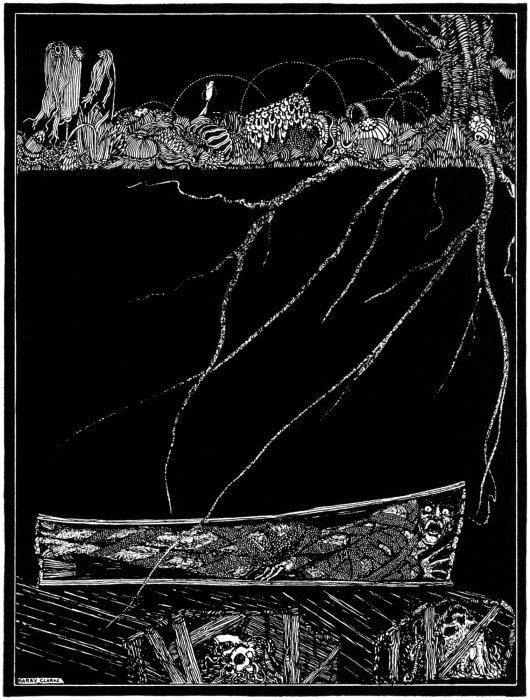 Perhaps the quintessential Poe short story that few have read, "The Premature Burial" was published for the first time in the July 31, 1844 issue of Philadelphia's Dollar Newspaper. Only a few of Poe's works feature the concept of being buried alive, yet, for some reason, I often read that Poe was obsessed that he would be buried prematurely. It's hard to say if this is true but I have yet to find any evidence at all that Poe was personally concerned with being buried alive.
Instead, Poe was responding to the popular concern about premature burial among his readers. Poe was, after all, a pop culture writer trying to appeal to a mass audience (the most obvious piece of evidence is that "The Premature Burial" was published in a cheap newspaper, not a high-end book). Even Poe's only novel was a direct response to the common interest of the masses.
I could argue that the reason American readers were suddenly interested in stories about premature burial is based on a general interest in death at the time. Concepts of death shifted from a Puritan "dirty death" point of view to a more romantic Victorian idealism. Medical science, however, was beginning to help define the moments where life and death meet at the same time that Spiritualism, galvanism, and similar movements were becoming popular. All of this created, I think, a sort of anxiety over death. Coffins in Poe's time could be affixed with bells and other emergency devices in case the "deceased" suddenly awoke after burial, organizations like the "Society for the Prevention of People Being Buried Alive" were formed, and it was reported that hundreds of people were mistakenly pronounced dead while, in fact, still living.
Can you blame Poe for writing a story like "The Premature Burial"? As Poe writes in this tale,
It may be asserted, without hesitation, that no event is so terribly well adapted to inspire the supremeness of bodily and of mental distress, as is burial before death. The unendurable oppression of the lungs — the stifling fumes from the damp earth — the clinging to the death garments — the rigid embrace of the narrow house — the blackness of the absolute Night — the silence like a sea that overwhelms — the unseen but palpable presence of the Conqueror Worm — these things, with thoughts of the air and grass above, with memory of dear friends who would fly to save us if but informed of our fate, and with consciousness that of this fate they can never be informed... We know of nothing so agonizing upon Earth — we can dream of nothing half so hideous in the realms of the nethermost Hell.In addition to being written specifically to appeal to popular tastes, what makes the story so quintessentially Poe? Well, its vaguely frightening storyline is not based on blood, guts, violence, or the supernatural. Instead, it's a psychological story that creeps you out more than scares you. And, also very Poe-like, the story turns out to be a comedy at the end. Who knew??
By the way, Poe's other stories which feature premature burial are "Berenice," "The Cask of Amontillado" and, most notably, "The Fall of the House of Usher."
*Above, "The Premature Burial," as illustrated by Harry Clarke, 1919.
Thursday, June 25, 2009
The night of the twenty-fifth of June
"I remember the buzz of curiosity which his advent excited within the college precincts on the night of the twenty-fifth of June." Thus says the narrator of Poe's obscure tale, "Mystification," originally published in June 1837 as "Von Jung, the Mystific." The comedic tale was the only major work which Poe published that year, amidst the backdrop of the Panic of 1837.
The community at the "University of G——n" was abuzz on June 25 that year, so says the story, because of the arrival of the Baron Ritzner Von Jung, a Hungarian nobleman who many described as "the most remarkable man in the universe." Ironic, perhaps, because our narrator notes he is "by no means a handsome man — perhaps rather the reverse." Of course, what makes him interesting is that he has made mystification his "scientific" pursuit. Though the narrator questions the Baron's ability, he admits that "we were chums."
Amidst conversation on June 25, a man nicknamed Hermann ("he was one of the greatest asses in all Christendom") took a sudden interest in the Baron's words about the traditional duello. Hermann takes issue. He says:
The narrator (curiously named "Mr. P—") serves as a go-between among the two men as they make a gentlemanly exchange airing their grievances. As it turns out, the Baron had planted a book on dueling for Hermann which was purposely mystifying and written in a way to confuse. Hermann, however, attempted to follow the instructions of the book without comprehending a word of it. In fact, it was "a horribly absurd account of a duel between two baboons." Rather than admitting his confusion, Hermann fell right into the "Mystific" trap.
The community at the "University of G——n" was abuzz on June 25 that year, so says the story, because of the arrival of the Baron Ritzner Von Jung, a Hungarian nobleman who many described as "the most remarkable man in the universe." Ironic, perhaps, because our narrator notes he is "by no means a handsome man — perhaps rather the reverse." Of course, what makes him interesting is that he has made mystification his "scientific" pursuit. Though the narrator questions the Baron's ability, he admits that "we were chums."
Amidst conversation on June 25, a man nicknamed Hermann ("he was one of the greatest asses in all Christendom") took a sudden interest in the Baron's words about the traditional duello. Hermann takes issue. He says:
"Your opinions, allow me to say, Baron Von Jung, although in the main correct,Uh-oh. Furious at being challenged, the Baron takes a moment to compose himself before trying to prove he is a true gentleman. Rather than venturing on violence for this insult, he says he will throw a bottle of wine at Hermann's reflection in the mirror, which he does, believing it proves him a true gentleman.
are in many nice points discreditable to yourself and to the University of which
you are a member. In a few respects they are even unworthy of serious
refutation. I would say more than this, Sir, were it not for the fear of giving
you offence, (here the speaker smiled blandly,) I would say, Sir, that your
opinions are not the opinions to be expected from a gentleman."
The narrator (curiously named "Mr. P—") serves as a go-between among the two men as they make a gentlemanly exchange airing their grievances. As it turns out, the Baron had planted a book on dueling for Hermann which was purposely mystifying and written in a way to confuse. Hermann, however, attempted to follow the instructions of the book without comprehending a word of it. In fact, it was "a horribly absurd account of a duel between two baboons." Rather than admitting his confusion, Hermann fell right into the "Mystific" trap.
Tuesday, June 9, 2009
Poe's final (and forgotten) prose work
Poe's final short story (if it can be called that) was published in the June 9, 1849, issue of Boston's The Flag of Our Union. This final published prose work by Poe, "Landor's Cottage," is more appropriately labeled a "sketch." It is now a relatively-unknown Poe work.
The manuscript for this sketch was written much earlier than its first publication. Poe references the work in a letter to Nancy "Annie" Richmond of Lowell, Massachusetts in a letter to her circa January 21, 1849, according to the Baltimore Edgar Allan Poe Society. The next day, coincidentally, Frederick Gleason of The Flag of Our Union wrote to Poe, inviting him to become a regular contributor.
Poe had some difficulty publishing "Landor's Cottage." In September 1848, Poe wrote to Eli Bowen (former editor of the Columbia Spy), who had recently become editor of the Miner's Journal in Pottsville, Pennsylvania. The duo seem to have agreed that the sketch was not appropriate for that journal. He then submitted the manuscript to the American Metropolitan Magazine in New York. By March 1849, the magazine sent it back to Poe, unpublished. A few months later, The Flag of Our Union picked it up and published it with the subheading "A Pendant to 'The Domain of Arnheim'," referring to an earlier sketch by Poe.
 But, what is "Landor's Cottage" about? Mary Gove Nichols, a friend and neighbor of Poe in New York, noted that it was about Poe's time in his small cottage in the Fordham area of The Bronx, New York (pictured at right as it looks today). Modern scholars do not seem to disagree. Nancy Richmond has been identified as the "Annie" in the story, a nickname she later adopted as her legal name. In the sketch, Poe meets Annie and describes her eyes as "spiritual gray" and her hair as "light chestnut."
Certainly, an interesting, if not unfortunate, final prose work — definitely not one which has cemented Poe's legacy (feel free to challenge me on the value of "Landor's Cottage"; I'd love to hear what others think). Only one other new work will see print before Poe's death. You'll hear more about it next month.
The manuscript for this sketch was written much earlier than its first publication. Poe references the work in a letter to Nancy "Annie" Richmond of Lowell, Massachusetts in a letter to her circa January 21, 1849, according to the Baltimore Edgar Allan Poe Society. The next day, coincidentally, Frederick Gleason of The Flag of Our Union wrote to Poe, inviting him to become a regular contributor.
Poe had some difficulty publishing "Landor's Cottage." In September 1848, Poe wrote to Eli Bowen (former editor of the Columbia Spy), who had recently become editor of the Miner's Journal in Pottsville, Pennsylvania. The duo seem to have agreed that the sketch was not appropriate for that journal. He then submitted the manuscript to the American Metropolitan Magazine in New York. By March 1849, the magazine sent it back to Poe, unpublished. A few months later, The Flag of Our Union picked it up and published it with the subheading "A Pendant to 'The Domain of Arnheim'," referring to an earlier sketch by Poe.
 But, what is "Landor's Cottage" about? Mary Gove Nichols, a friend and neighbor of Poe in New York, noted that it was about Poe's time in his small cottage in the Fordham area of The Bronx, New York (pictured at right as it looks today). Modern scholars do not seem to disagree. Nancy Richmond has been identified as the "Annie" in the story, a nickname she later adopted as her legal name. In the sketch, Poe meets Annie and describes her eyes as "spiritual gray" and her hair as "light chestnut."
Certainly, an interesting, if not unfortunate, final prose work — definitely not one which has cemented Poe's legacy (feel free to challenge me on the value of "Landor's Cottage"; I'd love to hear what others think). Only one other new work will see print before Poe's death. You'll hear more about it next month.
Monday, June 1, 2009
The chess-playing robot is debunked
 People were astounded by the accomplishments of a robot which not only was capable of playing chess, but which frequently beat its human competitors. "The Turk," as the robot was called (pictured in an engraving at right), had been touted throughout Europe by Wolfgang von Kempelen before being brought to the United States by Johann Nepomuk Mälzel in 1825. On June 1, 1828, however, a writer for the Baltimore Gazette questioned the authenticity of this modern marvel in an essay titled "The Chess-Player Discovered."
Edgar Poe may have witnessed this same automaton in action while in Richmond circa 1835. Poe, however, was not easily fooled and, perhaps more importantly, often questioned the sort of wonders he witnessed. In April 1836, the Southern Literary Messenger published Poe's own take of the chess-playing robot. The essay, titled "Maelzel's Chess-Player," tried to be more specific than the previous articles which debunked the robot hoax. Viewing the mystery almost like a game of chess, Poe analyzes the possible explanation for this marvelous "technology." He knows intuitively that it isn't possible, that it must be a fake — "the only question is the I manner in which human agency is brought to bear," he writes. Ultimately, Poe concludes that a very small person is operating the contraption from within, hiding in concealed compartments.
The reality is that The Turk had already been exposed as a fraud at least as early as June 1, 1828 — eight years before Poe's essay. What's important about Poe's story is the analysis he does, the step-by-step process, the method of debunking as much as possible before reaching his final conclusion. "Maelzel's Chess-Player" is, ultimately, a precursor to the "ratiocination" process which Poe will create in his character C. Auguste Dupin in "The Murders in the Rue Morgue." Yes, "Maelzel's Chess-Player" is another step towards Poe's invention of the modern detective story.
Poe, of course, was a hoaxster himself — among his most famous hoaxes is "The Balloon-Hoax," a story which suggested a gas balloon was able to cross the Atlantic Ocean in only three days. Poe would later borrow the name of the man who created The Turk in another hoax-like story about creating gold.
Saturday, May 30, 2009
Poe and Sarah Hale
 On May 30, 1844, the influential "editress" (as she called herself) Sarah Josepha Hale wrote to Edgar A. Poe. Poe had submitted a tale to Nathaniel Parker Willis in the hopes of it getting published in The New Mirror. Instead, Willis thought it better placed in an annual called The Opal; though he had edited its first issue (perhaps ironically, this annual gift-book was originally founded by none other than Rufus Wilmot Griswold), he no longer held that role. The new editor was Sarah Josepha Hale, better known as the long-time editor of Godey's Lady's Book for forty years, but best known (unfortunately) as the author of "Mary Had a Little Lamb."
Willis had accepted Poe's submission before turning it over to Hale. Poe was now unsure if his tale would be published at all and wrote directly to Hale to secure its appearance in The Opal. As he wrote, Poe wanted Hale "be so kind as to take it, unseen, upon Mr. Willis' testimony in its favor." Hale's response is apparently lost, but likely written on May 30, 1844. Poe refers to this now-missing letter as a "kind and very satisfactory one." He agrees to the pathetic payment of 50 cents per page (compare to Graham's Magazine's $4 or $5 per page).
It was not published in The Opal, as Willis anticipated. Instead, "The Oblong Box" was published in the September issue of Godey's. The story is an odd mesh of horror, mystery, and sea adventure, unlike any other Poe tale. Highly recommended!
More important here is the interaction between Poe and Hale, a woman who some (including me!) consider among the most powerful and influential women of her generation. Her first awareness of Poe was through her son, David Emerson Hale, who was a classmate of Poe's at West Point. When David mentioned to his mother that there was a poet among them, Mrs. Hale inquired about him. Under Hale, Poe published one poem and six stories (including "The Cask of Amontillado") in Godey's Lady's Book — something which Poe could not have been too happy with. Though it was the highest-circulating magazine of its day, it was trashy and sentimental, with more colored fashion-plates than worthwhile content.
Friday, May 22, 2009
Doyle/Holmes and Poe/Dupin
 Today celebrates the 150th anniversary of the birth of Sir Arthur Conan Doyle, who was born May 22, 1859. The British author is today remembered as the creator of the well-known recurring character Sherlock Holmes. Holmes's first appearance was in the novel A Study in Scarlet (1887). The character was modeled after a former university professor under whom the author studied.
Nevertheless, the iconic fictional detective would not have existed but for Edgar A. Poe.
In 1841, Poe published "The Murders in the Rue Morgue," widely considered the first modern detective story. Poe's well-known recurring fictional "detective" character is C. August Dupin — a socially-awkward yet highly intelligent gentleman who relies on a combination of logic and imagination. With him, as always, is his nameless friend, who serves as both bumbling sidekick and the first-person narrator of Dupin's exploits.
Doyle, you might recall, introduced his fictional detective, Sherlock Holmes, as a socially-awkward yet highly intelligent gentleman as well, and all of his stories include his assistant Watson, who serves as both bumbling sidekick and the first-person narrator of Holmes's exploits. In other words, Poe created the model of fictional detectives which Doyle popularized (I won't say "perfected," as I'm not too familiar with his works).
Of course, Doyle does pay an homage of sorts to his source of inspiration. In the aforementioned A Study in Scarlet, the Watson character attempts to pay Holmes a "compliment" in chapter 2:
"It is simple enough as you explain it," I said, smiling. "You remind me of Edgar Allan Poe's Dupin. I had no idea that such individuals did exist outside of stories."Sherlock Holmes rose and lit his pipe. "No doubt you think that you are complimenting me in comparing me to Dupin," he observed. "Now, in my opinion, Dupin was a very inferior fellow... He had some analytical genius, no doubt; but he was by no means such a phenomenon as Poe appeared to imagine."
Holmes's snide remarks aside, it is now generally understood that Doyle's work owes more than a little to Poe's. Incidentally, there are detractors who suggest that Poe was not the first to write a mystery story. This is true enough, yet Poe's model allows the mystery to be solved by a specific individual who makes it his role to deduce the answer. At the time "The Murders in the Rue Morgue" was published, there was not a single professional detective anywhere in the country — in fact, the word "detective" was not yet coined. Poe referred to the process Dupin uses not as "detection" but "ratiocination" — and it has part of the word "imagination" right there in it.
Oddly, Poe found writing these stories a little boring. As he wrote, "where is the ingenuity in unraveling a web which you yourself... have woven for the express purpose of unraveling?" Good question, coming from a guy who liked to play hoaxes on his audience. In fact, Poe even parodied the very genre he invented. The little-known tale "Thou Art the Man!" is Poe's burlesque of the modern detective story, before the genre was identified beyond "something in a new key."
Happy birthday to Sir Arthur Conan Doyle, whose Sherlock Holmes character is sure to entertain for generations to come.
Sunday, May 10, 2009
The mystific panic of 1837
 On May 10, 1837, the New York City banks suspended payments in specie (gold and silver). The date is now agreed to be the start of one of the worst depressions in American history: the Bank Panic of 1837.
The Second Bank of the United States had been chartered by Alexander Hamilton. Andrew Jackson chose not to renew their charter, forcing them to close under the presidency of Martin Van Buren. The value of paper money fell to nothing, credit was refused, and payment in gold or silver was demanded. Banks, like those in New York which suspended specie payments on May 10, had more paper money circulating than the gold and silver they had to back it up. One group called for paper money under $100 to be banned completely so that only gold and silver be used permanently. The resulting "panic" was immediate. City Hall in New York was mobbed with people demanding prices on goods be forced down. A flour warehouse in that same city was robbed and the excitement had to be quelled by state militia. Mills and factories closed, banks went out of business, and even state governments were denied loans.
New York City, the center of national publishing in the United States, was hit especially hard (note that other publishing centers — including Baltimore, Hartford, and Boston — generally printed only regionally; New York was the first to print for a nation-wide audience). In addition to the panic, a severe fire in the publishing district destroyed many warehouses, printing machinery, and entire companies.
Edgar A. Poe had moved to New York in February 1837, hoping to make it big as a writer. The Panic, as you can imagine, stymied his literary output. His only major work that year was an obscure comedic short story, "Von Jung, the Mystific" — now known as "Mystification." Poe had hoped that publishing a novel would get his name out there but the panic also caused delays and other troubles for his novel The Narrative of Arthur Gordon Pym of Nantucket (which was eventually released in two volumes in 1838). He soon gave up on New York and moved to Philadelphia — his several years in that city became his most prolific writing period.
Panics happened with some regularity in the 19th century in the United States. 1818 and 1857, for example, saw difficult panics. Another popped up in 1873, ten years after a National Banking Act was passed.
This economic climate and its effect on the publishing industry are one part of my upcoming lecture, "Poe and Publishing." Sponsored by the bibliophiles of the Ticknor Society, this talk will take place on May 12 at 6:00 p.m. in the Orientation Room of the Boston Public Library. If you drop by, introduce yourself!
Tuesday, May 5, 2009
"Txld yxu sx, yxu knxw!"
One of the many pieces published in the Flag of Our Union toward the end of Poe's life was the comedy "X-ing a Paragrab" — released on May 5, 1849, though the issue carried the cover date of May 12. "X-ing a Paragrab" is, quite simply, one of Poe's funniest works, and its humor easily stands the test of time after a century and a half.
The story follows a "wise man" from the east named Mr. Touch-and-go Bullet-head, whose intellect is easily proven by his being an editor. He also had a bit of a problem with stubbornness, which he considered his greatest strength. After moving to Alexander-the-Great-o-nopolis ("or some place of similar title") in the West, he established a newspaper called The Tea-Pot, assuming no other newspaper existed. He was wrong; the Alexander-the-Great-o-nopolis Gazette had been quite successful for years. Nevertheless, Bullet-head establishes his Tea-Pot offices right next door to the Gazette. As you can imagine, rivalry ensues. No matter how often I read it, Bullet-head's final editorial in The Tea-Pot always has me laughing out loud. Try it yourself. Seriously, read it!!
Poe was openly mocking a couple of things that make the humor even deeper. For one, he was clearly making fun of the "irascibility," "firmness" or, really, obstinacy of editors like Bullet-head. He also mocked the sort of rivalries which became common in the press during this period. Newspapers were battle-grounds; for example, many staunchly supported one political party over another, resulting in back-and-forth arguments printed between opposing party papers. Poe was stretching to ask what would happen if these rivals took their wars beyond the printed page (though, ultimately, the war stays within those printed pages anyway).
Poe's humor has had many, many critics, who suggest that Poe knew nothing about comedy and was only able to present dark, death-obsessed comedy. "X-ing a Paragrab" is either the exception or the proof that this generalization is untrue. There is no blood or gore in this story, even for humorous effect. This is, to put it simply, a cute comedy — and it really is funny.
I also use the story as an example to note Poe's understanding of the printing technology of the day. The humor relies on movable type. There is evidence that Poe was directly responsible for typesetting here and there throughout his career as a writer. As an aside, Walt Whitman knew about movable type as well and personally oversaw the type-setting for the first edition of Leaves of Grass, resulting in the poem's odd yet artistic spacing.
I will be speaking more in-depth on Poe's understanding of his contemporary publishing world, including its technology, a week from today at the Boston Public Library. The lecture, sponsored by the bibliophiles in The Ticknor Society, is called "Poe and Publishing." All are invited: May 12 at 6:00 p.m. in the orientation room of the McKim Building.
The story follows a "wise man" from the east named Mr. Touch-and-go Bullet-head, whose intellect is easily proven by his being an editor. He also had a bit of a problem with stubbornness, which he considered his greatest strength. After moving to Alexander-the-Great-o-nopolis ("or some place of similar title") in the West, he established a newspaper called The Tea-Pot, assuming no other newspaper existed. He was wrong; the Alexander-the-Great-o-nopolis Gazette had been quite successful for years. Nevertheless, Bullet-head establishes his Tea-Pot offices right next door to the Gazette. As you can imagine, rivalry ensues. No matter how often I read it, Bullet-head's final editorial in The Tea-Pot always has me laughing out loud. Try it yourself. Seriously, read it!!
Poe was openly mocking a couple of things that make the humor even deeper. For one, he was clearly making fun of the "irascibility," "firmness" or, really, obstinacy of editors like Bullet-head. He also mocked the sort of rivalries which became common in the press during this period. Newspapers were battle-grounds; for example, many staunchly supported one political party over another, resulting in back-and-forth arguments printed between opposing party papers. Poe was stretching to ask what would happen if these rivals took their wars beyond the printed page (though, ultimately, the war stays within those printed pages anyway).
Poe's humor has had many, many critics, who suggest that Poe knew nothing about comedy and was only able to present dark, death-obsessed comedy. "X-ing a Paragrab" is either the exception or the proof that this generalization is untrue. There is no blood or gore in this story, even for humorous effect. This is, to put it simply, a cute comedy — and it really is funny.
I also use the story as an example to note Poe's understanding of the printing technology of the day. The humor relies on movable type. There is evidence that Poe was directly responsible for typesetting here and there throughout his career as a writer. As an aside, Walt Whitman knew about movable type as well and personally oversaw the type-setting for the first edition of Leaves of Grass, resulting in the poem's odd yet artistic spacing.
I will be speaking more in-depth on Poe's understanding of his contemporary publishing world, including its technology, a week from today at the Boston Public Library. The lecture, sponsored by the bibliophiles in The Ticknor Society, is called "Poe and Publishing." All are invited: May 12 at 6:00 p.m. in the orientation room of the McKim Building.
Subscribe to:
Posts (Atom)

