Showing posts with label birthdays. Show all posts

Sunday, December 20, 2009

The mystery of Rosalie Poe

Rosalie Poe, the youngest of the three children of David Poe and Eliza Arnold, was born on December 20, 1811.* Her birth was in Norfolk, Virginia the same town where her parents met. Well, presumably. Ultimately, Rosalie Mackenzie Poe's story is one of rumors and more rumors.

The date, of course, is questionable (see the note below). Even Edgar Poe made things more confusing when he once claimed Rosalie was actually his older sister.

Rumors persist that Rosalie Poe was not the daughter of David Poe. Evidence for when his estrangement begins is unclear but his wife having affair could certainly have inspired it, in theory. Even in Rosalie's lifetime accusations were implied. John Allan, for example, wrote to William Henry Leonard Poe (the oldest of the three children) in November 1824:
God may yet bless him [i.e. young Edgar] & you & that Success may crown all your endeavors & between you your poor Sister Rosalie may not suffer. At least She is half your Sister & God forbid my dear Henry that We should visit upon the living the Errors & frailties of the dead.
The "Errors & frailties of the dead" would imply an affair that Eliza Poe had. How John Allan would have known about this is difficult to say though we might speculate that Eliza, a well-known and well-respected actress in Virginia, would easily fall prey to the gossip mill whether rumors were true or not.

Allan also implies that Henry and Edgar need to care for Rosalie. Though she was (legally) adopted into the very loving Mackenzie family of Richmond, the story goes that she had some sort of mental deficiency. Some called her dull, others referred to her as "backward." These rumors contrast with stories that she made a modest living as a schoolteacher and enjoyed playing the piano and writing songs. Evidence for both versions of the story is unclear.

Rosalie likely was not too close with her brother Edgar, judging by their lack of substantial surviving correspondence. One letter from Edgar from sometime in early 1843 is addressed to one of the Mackenzies and notes, "Tell Rose I hope to see her before long, and that I will write to her soon." After Edgar's death, she continued to live with the Mackenzies, never marrying. The Civil War, however, "impoverished and broke up the family," writes Poe biographer Kenneth Silverman. Rosalie herself wrote she was forced "on the charities of this cold uncharitable world Homeless & Friendless."

She made her way to Baltimore, where she was rejected by Neilson Poe. Rumors suggest she walked the streets, hysterical and shrieking. She made money by selling postcards of her now famous brother and often appended signatures of her name with "Sister of Edgar A. Poe."

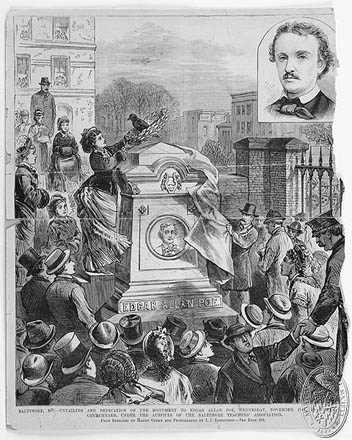
Rosalie eventually entered a shelter in Washington, D.C., where she died on July 21, 1874. Despite wanting to be buried near her brother (who would, one year later, be granted a substantial re-burying ceremony himself), she was instead buried in Washington in a plot belonging to the shelter. Her headstone oddly gives her year of birth as 1812 a year after her mother's death.

* Though there is a claim that no evidence exists for this date, it actually comes from the Mackenzie family Bible. However, even the Mackenzie's weren't entirely sure. They wrote: "Rosalie Mackenzie Poe... (is said) was born 20 Decr. 1810." The date has been supported, even with a question mark, by Poe scholars including Arthur Hobson Quinn and the two authors of The Poe Log.

Thursday, December 17, 2009

I was not his friend, nor he mine

Rufus Wilmot Griswold was the first major figure to express Poe's personality after the author's death in 1849. He took great liberties, embellishing Poe's bad habits or character flaws and even making a few up. It is not entirely clear what inspired Griswold, nicknamed "the Grand Turk," in what is now labeled a "character assassination." Conjecture says that his jealousy for the attention of Fanny Osgood had something to do with it; perhaps a rivalry began when the editorship of Graham's Magazine changed hands; Griswold may have never forgiven Poe for his lukewarm review of The Poets and Poetry of America; or, Griswold was still angry that Poe mocked him during a lecture tour. Likely all of those ideas are at least partially true. More importantly, however, is understanding what Griswold wrote on December 17, 1849 — two months after Poe's death.

Poe was not without his defenders, after all. One of the loudest voices on his behalf was Sarah Helen Whitman, the woman who almost became Poe's second wife. She was suspicious that Griswold was the author of the so-called "Ludwig article," the obituary which announced Poe's death in a less-than-sympathetic manner. Whitman herself had been quoted in the work of Rufus Griswold, allegedly for calling Poe "intemperate and dissolute." Responding to the claim, Whitman wrote that, regardless of Griswold's interpretation of Poe, he had never been that way in her experience. Griswold casually side-stepped the accusation that he was a liar, writing back in a letter dated December 17, 1849, simply that "I was not his friend, nor he mine."

That lack of friendship might be just enough for Griswold not to care much about the damage he was doing to Poe's posthumous reputation.

That same day, a poet named John Greenleaf Whittier turned 42 years old. Perpetually nicknamed "the Quaker Poet," Whittier was well-represented in Griswold's poetry anthology. Whittier, in fact, was likely one of the New England writers that Poe thought was over-represented in Griswold's book. Likely, Poe also disapproved of Whittier's poetry which, at the time, was almost exclusively abolitionist in nature.

The two poets rarely crossed paths and, ultimately, they would likely have admitted that they were not friends. Nevertheless, Whittier (who generally avoided the literary battles of the day) was one of Poe's targets in his "Chapter on Autography." Poe wrote he "is placed by his particular admirers in the very front rank of American poets. We are not disposed, however, to agree with their decision in every respect." Though Poe admitted Whittier was "a fine versifier" he lacked imagination. Likely referring to the anti-slavery works, Poe added succinctly: "His themes are never to our liking."

Whittier never took it personally. In fact, several years later, Whittier would contribute a few words in honor of the memorial to Poe which was dedicated in 1875.

Monday, November 30, 2009

Birth of Mark Twain

What a curious thing a "detective" story is. And was there ever one that the author needn't be ashamed of, except the "Murders in the Rue Morgue"?
So says Mark Twain (the pen name of Samuel L. Clemens). Twain was born on November 30, 1835. He never knew Poe (he was 13 when Poe died) but both writers were pursuing a national identity in American literature. Twain, however, thought Poe had failed miserably (he thought so about many authors). A day before Poe's centennial in 1909, he wrote to William Dean Howells and told his fellow novelist his opinion of the master of the macabre: "To me his prose is unreadable—like Jane Austen's. No, there is a difference. I could read his prose on salary, but not Jane's."

It's unclear what kind of salary Twain got for reading Poe or for writing an obscure short story called "The Facts Concerning the Recent Carnival of Crime in Connecticut." Scholar Robert Comeau identified this story by Twain as borrowing themes from Poe's "William Wilson," a character from "Hop-Frog," and a device from "The Raven."

Poet-turned-Poeist Daniel Hoffman wrote: "In Poe's own country the only thing like 'William Wilson' is by that other demon-haunted genius, Mark Twain. But where Poe's tale is taut with demonic intensity, there is a wonderful hilarity in 'The Facts Concerning A [sic] Recent Carnival of Crime In Connecticut.'" In the story, a character is tortured by his Calvinist conscience, but outwits his tormentor (e.g. his conscience) by murdering him. Suddenly conscience-free, the character goes on murdering, cheating, and generally indulging in mischief.

For a time, the character's conscience is perched on a bookshelf. According to Comeau, this serves as the same symbolism as the bust of Pallas in Poe's "The Raven."

Happy birthday, Samuel Clemens/Mark Twain.

Tuesday, November 3, 2009

Birth of William Cullen Bryant

Born on November 3, 1794, William Cullen Bryant became one of the most well-known poets of his generation. His earliest poems, including "Thanatopsis" and "To a Waterfowl" remain his most enduring works. Like Poe, Bryant took full-time jobs with the press to make ends meet. His longest run was with the Saturday Evening Post; his affiliation with that publication lasted 50 years.

Poe first reviewed Bryant's work for the Southern Literary Messenger in 1837. Shortly after, Poe attended the Booksellers Dinner in New York's City Hotel. The guest list that day included not only Bryant but also Charles Fenno Hoffman, Washington Irving, Fitz-Greene Halleck, James Kirke Paulding, George Pope Morris, and Lewis Gaylord Clark. Poe proposed a toast to "The Monthlies of Gotham" and their editors.

Years later, in 1841, Bryant was one of the many "heavy-hitters" that Poe solicited for contributions upon taking the editorial reins at Graham's Magazine. A year later, Bryant was one of the top five poets Rufus Griswold used in his frontispiece to better sell The Poets and Poetry of America (in his review, Poe noted that Bryant deserved more attention and representation in the book itself). Bryant's son-in-law Parke Godwin later recalled that Bryant and Poe met face to face in 1845 and "Poe approached him as some Grecian youth might be imagined to approach an image of Plato — with a look and attitude full of the profoundest reverence." This account is almost certainly exaggerated, considering Poe had already corresponded with Bryant — not to mention they probably already met at the Booksellers Dinner eight years earlier.

Poe admitted that Bryant was one of America's most important writers, but noted that his popularity was due to his narrow, "safe" topics which were designed to be accessible to a broad audience. "It will never do to claim for Bryant a genius of the loftiest order," Poe wrote. Referring to Bryant's poem "June," Poe notes "the rhythmical flow, here, is even voluptuous — nothing could be more melodious... The impression left is one of a pleasurable sadness."

As a side note, Bryant was also an active proponent of copyright protection for authors and even founded the Copyright Club.

Happy birthday, William Cullen Bryant.

Tuesday, September 15, 2009

Birth of James Fenimore Cooper

Novelist James Fenimore Cooper was born September 15, 1789.* By rights, he should be considered among the first man of letters in the United States, alongside Washington Irving, Charles Brockden Brown and others. Of course, few of these names are recognized today and, when they are, they're not always considered major players. Irving may still be read but many literary scholars show disdain for his work as being too silly or comical. Cooper is largely forgotten, despite his immense popularity in his lifetime for works like The Last of the Mohicans — which wasn't on the curriculum when I was in school (or in college, for that matter).

Poe solicited contributions from Cooper while the former was working for the Southern Literary Messenger. Even though Poe recognized Cooper's draw, he questioned his legitimacy as a writer (his request for contributions noted they were seeking Cooper's "name" to give the magazine weight). One review from Poe, published in 1840, attacked Cooper's characterization. "We did not look for character in it, for that is not Cooper's forte; nor did we expect that his heroine would be aught better than the inanimate thing she is." Of course, Cooper's depiction of female characters is still the subject of criticism today.

In a review in Graham's Magazine (November 1843) titled "Wyandotté, or The Hutted Knoll. A Tale, By the Author of 'The Pathfinder,' 'Deerslayer,' 'Last of the Mohicans,' 'Pioneers,' 'Prairie,' &c., &c.," Poe noted that Cooper's latest production was "precisely similar to the novels enumerated in the title" (a complaint which is still issued today). Interest in these works, Poe argues, is based on "first the nature of the theme; secondly, upon a Robinson Crusoe-like detail in its management; and thirdly, upon the frequently repeated portraiture of the half-civilized Indian." Having summarized the model for all of Cooper's works, Poe concludes: "It will be at once seen that there is nothing original in this story... It is even excessively commonplace."

Poe satirized Cooper in a short story called "The Literary Life of Thingum Bob, Esq." The briefly mentioned character Mr. Fatquack is considered a genius for his writing but his novel, Dish-Clout, only earns him a whopping 62 (and a half) cents. In a review of another writer, Poe notes the emergence of "native writers": "It is not because we have no Mr. Coopers but because it has been demonstrated that we might, at any moment, have as many Mr. Coopers as we please." Was Poe right? Was Cooper just another dime-a-dozen American prose writer who got more praise than he deserved? Is Cooper's falling reputation evidence of this? I'd love to hear thoughts on this.

*Incidentally, he died one day short of his 62nd birthday on September 14, 1851. Rufus Griswold was one of the many figures who organized a memorial to him in New York.

Saturday, August 29, 2009

Bicentennial of Dr. Holmes

Also celebrating his bicentennial in 2009 is Dr. Oliver Wendell Holmes, the doctor-writer who was born in Cambridge, Massachusetts on August 29, 1809.

Through Holmes's lengthy life and career (he was alive in every decade of the 19th century), he would be a doctor, professor, medical reformer, poet, author, essayist, lecturer... a true Renaissance Man. However, many of his major works were not published during Poe's lifetime. His Autocrat of the Breakfast-Table series far off, Holmes's early literary career hinged on only one poem: "Old Ironsides." It was an auspicious beginning; the poem's publication in 1830 is directly responsible for the preservation of the U.S.S. Constitution. At the time, it was in serious danger of being scrapped; today, because of Holmes, it remains the oldest commissioned ship in the United States Navy and the oldest afloat anywhere in the world. It was an early blossoming that Holmes had trouble living up to for a time.

Poe included Holmes in his "Autography" series and acknowledged a side of Holmes which would later become his legacy: his humor. Elsewhere, Poe offered substantial praise to Holmes — no small feat, considering the rarity of Poe's praise for New England writers. In fact, it's rare to find unqualified praise from Poe at all; most of the writers he lauded were also the on the receiving end of Poe criticism. Holmes, however, never seems to have earned any negative commentary from Poe.

In particular, Poe enjoyed Holmes's poem "The Last Leaf" (another admirer was Abraham Lincoln, who also celebrated his 200th birthday in 2009) — a seriocomic poem which mentions Thomas Melvill (grandfather of Herman Melville). Melvill was a remnant of the Revolutionary era and still wore 18th-century fashions, including a tricornered hat. Holmes found it comical to see the man so out of place but, somewhat romantically, mused would it would be like if he himself were the last of his own generation:

And if I should live to be
The last leaf upon the tree
In the spring,
Let them smile, as I do now,
At the old forsaken bough
Where I cling.

The poem turned out to be prophetic. Holmes outlived all of his writer-friends, including Longfellow, Lowell, Emerson, Hawthorne, and others. Holmes was, in fact, "The Last Leaf," just as he predicted. He died October 7, 1894 — exactly 45 years after the death of Edgar Poe, but not before contributing a poem for the dedication of a new Poe monument in Baltimore in 1875.

Not to worry, folks — Holmes is not being forgotten on his birthday. The city of his birth is hosting a pretty substantial birthday party for him this morning.

Friday, August 21, 2009

Birth of Aubrey Beardsley

English illustrator Aubrey Beardsley was born on August 21, 1872. I don't know much about him, but I know his illustrations of the works of Poe are brilliant. These black and white images uniquely capture Poe's vision: strangely dark, yet slightly exotic, each is simple, yet hauntingly beautiful. The examples below date to 1901, so far as I can tell.

"The Murders in the Rue Morgue"
"The Black Cat"
"The Masque of the Red Death"

Thursday, August 20, 2009

Lovecraft and Poe

Howard Phillips Lovecraft was born August 20, 1890. He went on to become an important writer of horror and science fiction. His name is rarely mentioned without immediately mentioning one of his important inspirations: Edgar Poe. Lovecraft invented in an entire world for his work and Poe's influence on him is unmistakable. In fact, Lovercraft even wrote a poem inspired by Poe:

“In a Sequester’d Providence Churchyard Where Once Poe Walk’d”

Eternal brood the shadows on this ground,
Dreaming of centuries that have gone before;
Great elms rise solemnly by slab and mound,
Arched high above a hidden world of yore.
Round all the scene a light of memory plays,
And dead leaves whisper of departed days,
Longing for sights and sounds that are no more.

Lonely and sad, a specter glides along
Aisles where of old his living footsteps fell;
No common glance discerns him, though his song
Peals down through time with a mysterious spell.
Only the few who sorcery’s secret know,
Espy amidst these tombs the shade of Poe.

The cemetery to which Lovecraft referred is possibly the same cemetery in Providence where Poe's one-time fiancee Sarah Helen Whitman is buried today. Lovecraft is buried nearby in another Providence cemetery (pictured above). I'm definitely not an expert (or fan) of Lovecraft, but I'm sure there are others out there who can make great connections between the two. I'd love to hear from those people — please add a comment below!

Happy birthday, H. P. Lovecraft.

Saturday, August 15, 2009

Birth of Virginia Clemm

Happy birthday to Virginia Eliza Clemm, who was born August 15, 1822.* She would have been 187 today.

What more can be said about Virginia that hasn't been said here already? I've wrote about the only surviving letter from Poe to his wife, their unusual marriage (and uncertain anniversary date), and the Valentine's poem she wrote to her husband — just to name a few. Today, I'd like to introduce the Poe work which is most inspired by Virginia. It is not "The Raven," nor is it "Annabel Lee." It is, in fact, the short story "Eleonora."

First published in the 1841 issue of The Gift, the story features an unnamed narrator who lives a life of isolation with his cousin and aunt. The setting is paradisaical, known as the Valley of the Many-Coloured Grass. Untrodden by strangers, the land is full of beautiful flowers and trees as well as a River of Silence. In this paradise, the narrator falls in love with his cousin — but she was sick, "made perfect in loveliness only to die." She worries that when she dies, her cousin will move on and fall in love with another. He promises that would never happen.

Her death, the narrator says, kicks off "the second era of my existence." This new life, however, is not as idyllic as it had been. The Valley of the Many-Coloured Grass does not survive after Eleonora's death:
The star-shaped flowers shrank into the stems of the trees, and appeared no more. The tints of the green carpet faded, and one by one the ruby-red asphodels withered away... And life departed from our paths; for the tall flamingo flaunted no longer his scarlet plumage before us, but flew sadly from the vale into the hills, with all the gay, glowing birds that had arrived in his company. And the golden and silver fish swam down through the gorge at the lower end of our domain, and bedecked the sweet river never again... And then, lastly, the voluminous cloud uprose, and abandoning the tops of the mountains to the dimness of old, fell back into the regions of Hesper, and took away all its manifold golden and gorgeous glories from the Valley of the Many-Coloured Grass.
The narrator leaves and moves to an unnamed city. There, he marries Ermengarde, not fearing the vow he had made. Eleonora appears to him and blesses his new union, saying "Thou art absolved... for reasons which shall be made known to thee in Heaven."

The story clearly references the idealism Poe had with his marriage (the biggest clue that this story is autobiographical is the inclusion of the aunt/mother-in-law character; she plays no clear role in the story but is a definite reference to Maria Clemm). Virginia was just beginning to show signs of tuberculosis — the illness which would kill her in five years. Poe was already feeling guilty that he might have to consider other women as potential second wives. Jumping the gun a bit? Maybe, but the more important aspect of the story is the idealism of the Valley of the Many-Coloured Grass, and how this paradise dies with the wife.

A couple lines from this story are often quoted, though it doesn't seem most know the origin of these quotes. This might sound familiar:
Men have called me mad; but the question is not yet settled,whether madness be or be not the loftier intelligence — whether much that is glorious — whether all that is profound — does not spring from disease of thought, from moods of mind exalted at the expense of the general intellect. They who dream by day are cognizant of many things which escape the dreamers by night.
Happy birthday, Virginia.

* I have found one source that lists her birthday as August 22. The majority of sources, however, use the August 15 date.

Thursday, August 6, 2009

Bicentennial of Tennyson

Speaking of bicentennials, today marks the 200th birthday of Alfred, Lord Tennyson. Born August 6, 1809, Tennyson went on to become an important canonical poet not only in his native England, which granted him the title of Poet Laureate, but also worldwide. Among his most well-known works are "The Charge of the Light Brigade," "Ulysses," the lengthy In Memoriam A.H.H., and Idylls of the King.

Poe praised Tennyson's work profusely. His final assessment in 1845 was that Tennyson was "a poet, who (in our own humble, but sincere opinion,) is the greatest that ever lived." Years later, friend Lambert A. Wilmer recalled, "I never knew him to speak in warm terms of admiration of any poetical writer, except Alfred Tennyson." Poe even accused other poets of plagiarizing from Tennyson, including Henry Wadsworth Longfellow. Perhaps ironically, a London critic in 1844 suggested Poe was the one trying to be like Tennyson: "Poe is a capital artist after the manner of Tennyson; and approaches the spirit of his original more closely than any of them."

In 1886, speculating on a trip to the United States, Tennyson mentioned to an interviewer a certain spot that he wanted to see. He said, "There is one spot in your country which I should like to visit — a spot, which as your poet, Fitz-Greene Halleck, finely expressed it, is hallowed ground, a pilgrim shrine, a mecca of the mind." The interviewer assumed he meant Mount Vernon, the home of American icon George Washington. "No," Tennyson responded. "I mean a long-neglected spot in the provincial town of Baltimore, where the greatest American genius lies buried. I mean the grave of Edgar Allan Poe." Years earlier, in 1875, Tennyson provided a poem to be read at the dedication of Poe's memorial monument:
Fate that once denied him,
And envy that once decried him,
And malice that belied him,
Now cenotaph his fame.
Happy 200th birthday, Lord Tennyson.

Saturday, August 1, 2009

A tale of two sailors

Herman Melville was born August 1, 1819 in New York City, just over ten years after Poe's birth. The two would never cross paths but they certainly have connections. Both were under-appreciated during their lifetime, especially for works they were particularly proud of (Moby-Dick for Melville, Eureka: A Prose Poem for Poe, for example). Both made substantial enemies, both literary and personal, and died relatively miserable. Most importantly, both were interested in the sea.

Melville's connection to the ocean is more obvious than Poe's; Melville served as a sailor and for a time lived amongst a cannibalistic tribe — an experience which would inspire his popular book Typee. That particular voyage left from New Bedford, Massachusetts in 1841 — three years after Poe published his own novel featuring a character named Arthur Gordon Pym who takes to the sea and later finds himself among a cannibalistic tribe. The literary connections between Melville and Poe don't end there. Though speculative, it's all but certain that Melville's white whale was largely inspired by the symbolism of the color white in The Narrative of Arthur Gordon Pym of Nantucket. Additionally, Poe and Melville were part of a subgenre of literature known as "Dark Romanticism" — a direct response to the Romantic movement's optimism and faith in the human experience (the third major Dark Romantic writer was Nathaniel Hawthorne, who easily connects to both Poe and Melville). I will be speaking about Poe's influence on Melville some time in September at New Bedford; date to be determined.

Perhaps ironically, August 1 has another interesting maritime connection. That date, in 1831, marked the death of William Henry Leonard Poe, the often-forgotten older brother of Edgar, who died of tuberculosis at age 24. In his short life, WHL Poe had traveled the world as a sailor. As a crewman aboard the frigate USS Macedonian, WHL Poe made it to South America, the West Indies, the Mediterranean, and Russia — all before the age of 20. When he returned to the United States, he became a writer (relatively unsuccessful; one notable work fictionalizes his younger brother's first true romance). After his death, WHL Poe was buried at Westminster Abbey in the Poe family plot (near where Edgar Poe was originally buried in 1849). Some say that the character of August Barnard in The Narrative of Arthur Gordon Pym might have been inspired by WHL Poe.

RIP, William Henry Leonard Poe... and happy birthday, Melville. Smooth sailing to you both.

Wednesday, July 8, 2009

The name of Halleck

"The name of Halleck is at least as well established in the poetical world as that of any American," Edgar A. Poe once wrote. At the time, the name "Halleck" needed no further introduction or definition. Today, however, that name has long since faded into obscurity.

Fitz-Greene Halleck was born in Guilford, Connecticut on July 8, 1790. He first received attention as a writer in 1819 (the same year Washington Irving's Sketch-book was published) when he and collaborator Joseph Rodman Drake anonymously published his humorous series of "The Croaker Papers." He continued writing, even while holding jobs at banks and libraries (even working directly for John Jacob Astor for a number of years). He earned the nickname "the American Byron" and his admirers included Charles Dickens, Abraham Lincoln, William Cullen Bryant, and others.

Poe wasn't as convinced. He wrote of Halleck's poetry: "to uncultivated ears... [it is] endurable, but to the practiced versifier it is little less than torture." Of Halleck's then-famous poem Fanny, Poe concluded that "there is really very little about this poem to be admired." Nevertheless, when Halleck's poetic output slowed to a crawl while he focused on other work, Poe lamented that Halleck "has nearly abandoned the Muses, much to the regret of his friends and to the neglect of his reputation."

Yet, Halleck's personal life deserves scrutiny. Even Poe, at the end of his entry on Halleck in The Literati of New York, made sure to point out: "He is unmarried." What an odd conclusion... Did he do the same for reviews of other writers? The answer may be this: Halleck was probably well-known as a homosexual. His relationship with Drake, before Drake's early death at age 25, was exceptionally close. Halleck's memorial poem to Drake noted that "none knew thee but to love thee" and, particularly, "I who woke each morrow to clasp thy hand in mine... shared thy joy and sorrow."

Did it diminish his popularity? Apparently not at all. When Halleck died in 1867, his friends and admirers (led by Bryant) immediately set about memorializing him. In 1877, a large bronze statue was erected in New York's Central Park — as I understand, Halleck remains the only American writer so immortalized. President Rutherford B. Hayes was present for the unveiling — as were some 10,000 others.

Poe also noted Halleck's character: "Personally, he is a man to be admired, respected, but more especially beloved." Certainly, in 2009, none of that seems true of Halleck any more (despite the efforts of some). Personally, I can't help but see irony here: for a poet so richly celebrated in the 19th-century, it turns out that Poe's questioning his talent (going against the grain) made a good point.

Nevertheless, happy birthday, Halleck. I'll conclude with a few of your lines which Poe thought belonged "to a very high order of poetry" and which he considered "gloriously imaginative... The passage is, I think, the noblest to be found in Halleck, and I would be at a loss to discover its parallel in all American poetry." These lines are from "Alnwick Castle":
Wild roses by the Abbey towers
Are gay in their young bud and bloom —
They were born of a race of funeral flowers
That garlanded, in long-gone hours,
A Templar's knightly tomb.

Saturday, July 4, 2009

Hawthorne, Poe, Brook Farm, and Ripley

Happy birthday to Nathaniel Hawthorne, who was born July 4, 1804. Poe and Hawthorne, I believe, were cut from the same chunk of marble. Both focused on perfecting the tale (until Hawthorne defected to novels) and attempted to make it big in the magazine industry (more or less). Both struggled financially for most of their lives (Hawthorne didn't buy a house until after Poe's death), and both were deeply in love with their wives.

Where they differed, however, was in the purpose of their writing. Though both presented the dark side of human nature — guilt, sin, evil — Hawthorne tried to teach lessons, something Poe called "the Heresy of The Didactic." Poe believed any piece of writing was a work of Art and need not be sullied by something like a moral message. Nevertheless, Poe encouraged Hawthorne early in his writing career. In his review of Twice-Told Tales, Poe writes of Hawthorne: "The style of Mr. Hawthorne is purity itself. His tone is singularly effective — wild, plaintive, thoughtful, and in full accordance with his themes... Upon the whole we look upon him as one of the few men of indisputable genius to whom our country has as yet given birth."

Poe would later soften his praise when Mosses from an Old Manse was published. Moving to the Old Manse in Concord, Massachusetts, connected Hawthorne with Ralph Waldo Emerson, and the Transcendentalists. Poe did not approve — though, in reality, neither did Hawthorne. He had grown weary with the movement fairly early after being a founding member of the Transcendental community at Brook Farm. Hawthorne quickly saw their idealism and optimism were misplaced. He quit and later sued to have his initial investment returned.

Coincidentally, today is the anniversary of the death of George Ripley, the Transcendental minister-turned-critic who founded Brook Farm. By his death in 1880, his attempts at creating a Utopia were pretty much forgotten. While the experiment was in full bloom, Poe at one point noted his "sincere respect" for Brook Farmers but noted that they "meant no harm." Really, Poe's was belittling them and noting that, at worst, they couldn't do much harm anyway.

Happy birthday to Hawthorne, and RIP to Ripley. As an aside, I just realized that this is my 100th post.

Thursday, June 18, 2009

Osgood and B-movies

Today, June 18, marks two interesting anniversaries.

Frances "Fanny" Osgood was born this day in 1811. An accomplished, well-known writer herself, she carried on a brief public flirtation with Poe — while both were still married. She was among the most popular women writers of her generation, dabbling both in poetry and in short prose. Her connection to Poe, though short-lived, became infamous. Her relationship with Poe's critical rival Rufus Griswold may have also led to friction between the two men, ultimately resulting in Griswold's character assassination of Poe beginning in 1849. Osgood herself died shortly after Poe's death; she had struggled with tuberculosis for years. In 1850, a posthumous edition of her works was published. One of the poems included in that collection was "Old Friends". It's an unusual one; much of her work is stereotypically feminine with particular emphasis on flowers. This one is about a dying man whose faithful dog clings to his side:
Cold blows the bleak wind around the long stranger,
Wild beat the snows in his thin waving hair,
One only true friend,—his old faithful Ranger,
Clings to his side in the wintry despair.

Sad and forsaken, his heart throbbing slowly,
His limbs numb'd and aching, his eyes dim with tears,
Back steals remembrance, with grief sweet and holy,
Back steals remembrance to happier years.

One only true friend, his old faithful Ranger,
Clings to his side in his wintry despair;
Wild blows the bleak wind around the lone stranger,
Drear drifts the snow in his thin waving hair.

Hunger and age, they have done their work drearily,
Yet is the forest tree grand in its fall;
Faith and affection, still gleaming out cheerily,
Like the sun, o'er the scene, halo it all.

Today also marks the anniversary of the world debut of Roger Corman's film House of Usher in 1960. A master of the B-movie, Corman took major advantage of Poe's name (much less than his actual works) to spit out a series of extremely loose adaptations of Poe's work beginning with House of Usher. Vincent Price made an appearance in all but one of them, including House of Usher. The one in which Price is conspicuously absent, The Premature Burial, is (coincidentally?) my personal favorite. Other Corman/Price collaborations include The Pit and the Pendulum and The Masque of the Red Death. All were very low budget but attracted decent audiences — and still do, to this day. Regardless of what you think of them, Poe's sudden surge in popularity in the 1960s is nothing to be ashamed of.

Monday, May 25, 2009

Emerson and his bee

Ralph Waldo Emerson was born May 25, 1803. He went on to become the leading voice in the Transcendental movement. Emerson and others believed that individuals could achieve perfection and work together to better society as a whole. In addition to his role as philosopher, Emerson was a lecturer, essayist, and a poet. Poe said the "transcendental vagabonds ... may all go to the devil together." Poe disagreed with the movement's idealism; they believed that pure reason and trust in the senses can lead to the absolute truth of nature, even without explicit external evidence. Poe's characters (most obviously the narrator in "The Tell-Tale Heart") make it clear that the senses cannot be trusted.

But forget the philosophy. What about Emerson's poetry? In March 1842, when Poe met Charles Dickens, we know they discussed the state of American poetry and Poe read Emerson's "To the Humble Bee" as an example. We don't know if Poe liked or disliked the poem; an extant letter merely states that he read it. Of course, who can forget such memorable lines:

Insect lover of the sun,
Joy of thy dominion!
Sailor of the atmosphere;
Swimmer through the waves of air;
Voyager of light and noon;
Epicurean of June;
Wait, I prithee, till I come
Within earshot of thy hum,—
All without is martyrdom.
He goes on to acknowledge the bee as "wiser far than human seer" and a "yellow-breeched philosopher." Clearly, Emerson's view of nature is one of worship, where he can see the inspirational philosophy of something as humble as a bee. The poem is dripping with sweetness and sentamentality, to the point of obnoxiousness, really. Rufus Griswold, that arbiter of what makes American poetry great, praised this poem profusely, and asked Emerson about it directly in a letter dated September 18, 1841.

But what is Poe's poetic view of nature? He didn't write about nature very often, certainly not in the same sense that Emerson did. For some reason, however, I can't help but compare "To the Humble Bee" to Poe's "The Conqueror Worm":
Lo! 'tis a gala night
Within the lonesome latter years!
An angel throng, bewinged, bedight
In veils, and drowned in tears,
Sit in a theatre, to see
A play of hopes and fears,
While the orchestra breathes fitfully
The music of the spheres.

Mimes, in the form of God on high,
Mutter and mumble low,
And hither and thither fly—
Mere puppets they, who come and go
At bidding of vast formless things
That shift the scenery to and fro,
Flapping from out their Condor wings
Invisible Woe!

That motley drama — oh, be sure
It shall not be forgot!
With its Phantom chased for evermore,
By a crowd that seize it not,
Through a circle that ever returneth in
To the self-same spot,
And much of Madness, and more of Sin,
And Horror the soul of the plot.

But see, amid the mimic rout
A crawling shape intrude!
A blood-red thing that writhes from out
The scenic solitude!
It writhes! — it writhes! — with mortal pangs
The mimes become its food,
And seraphs sob at vermin fangs
In human gore imbued.

Out — out are the lights — out all!
And, over each quivering form,
The curtain, a funeral pall,
Comes down with the rush of a storm,
While the angels, all pallid and wan,
Uprising, unveiling, affirm
That the play is the tragedy, "Man,"
And its hero the Conqueror Worm.
If Poe could be convinced of Emerson's theory that man could see the truth in nature, what truth would Poe see? Would he see the beautiful philosophy of something as humble as a bee? Or, would he see the tragedy that is man, whose only hero is the worm that eats his rotting flesh? No two men could be more dissimilar!

Nevertheless, happy birthday, Ralph Waldo Emerson!

Saturday, May 23, 2009

Margaret Fuller at 199

On May 23, 1810, Timothy and Margaret (Crane) Fuller welcomed their first (of eight) children. They named her Sarah Margaret Fuller — it would not be long after that the precocious child demanded she be referred to only as "Margaret." In fact, in her professional career — which spanned education, journalism, criticism, poetry, etc. — she went by that name, rather than the more conventional etiquette which would have her named "Miss Fuller."

The relationship between Poe and Fuller was, like many of Poe's interactions, complicated. Despite some comments against Fuller (he once called her an "old maid" and a "busybody") and her involvement in a strange personal interaction (involving Frances Osgood; I'll tell that tale another time), I believe Poe sincerely admired her work.

The earliest interaction I found was, oddly, over James Russell Lowell, who later became a sort of literary rival for both Fuller and Poe. A critic for the Daily Tribune in New York (presumed to be Fuller) strongly disagreed with Poe's review of Lowell. Charles Frederick Briggs wrote to his friend Lowell on January 17, 1845, about the disagreement: "Poe's criticism about your Conversations [on Some of the Old Poets] was extremely laudatory and discriminating; it was the female ass of the Tribune [e.g. Fuller] that misunderstood him."

The same month, Fuller noted Lowell's critical/biographical sketch of Poe. She noted that the article ("frank" and "earnest") introduced her to some of Poe's poetry which she never read before. She liked "The Haunted Palace" and "To Helen" enough to reprint them in the Tribune. The latter, she writes, is "of such distinguished beauty in thought, feeling, and expression, that we might expect the life unfolded from such a bud to have the sweetness and soft lustre of a rose." She was always very honest in her opinions of Poe. Later in 1845, she reviewed The Raven and Other Poems and suggested they were "all fragments" — suggesting that he was capable of better poetry, "with the exception of The Raven, which seems intended chiefly to show the writer's artistic skill." Nevertheless, she notes that the poems "breathe a passionate sadness, relieved sometimes by touches very lovely and tender" and show "a sweep of images, thronging and distant like a procession of moonlight clouds on the horizon."

Poe, in turn, acknowledged Fuller's "high genius." In 1846, he commended her daring review of Henry Wadsworth Longfellow. As he wrote, "it is one of the very few reviews of Longfellow's poems, ever published in America, of which the critics have not had abundant reason to be ashamed." When Fuller published Woman in the Nineteenth Century, her definitive work (regarded as the first major feminist work in the United States), Poe praised her fortitude. He called it "a book which few women in the country could have written, and no woman in the country would have published, with the exception of Miss Fuller." He particularly praised her for not manufacturing a false public persona. Instead, he wrote, her "personal character and her printed book are merely one and the same thing."

Happy 199th birthday to Margaret Fuller — a woman well ahead of her time! All the best for her bicentennial next year, in 2010!

Friday, May 22, 2009

Doyle/Holmes and Poe/Dupin

Today celebrates the 150th anniversary of the birth of Sir Arthur Conan Doyle, who was born May 22, 1859. The British author is today remembered as the creator of the well-known recurring character Sherlock Holmes. Holmes's first appearance was in the novel A Study in Scarlet (1887). The character was modeled after a former university professor under whom the author studied.

Nevertheless, the iconic fictional detective would not have existed but for Edgar A. Poe.

In 1841, Poe published "The Murders in the Rue Morgue," widely considered the first modern detective story. Poe's well-known recurring fictional "detective" character is C. August Dupin — a socially-awkward yet highly intelligent gentleman who relies on a combination of logic and imagination. With him, as always, is his nameless friend, who serves as both bumbling sidekick and the first-person narrator of Dupin's exploits.

Doyle, you might recall, introduced his fictional detective, Sherlock Holmes, as a socially-awkward yet highly intelligent gentleman as well, and all of his stories include his assistant Watson, who serves as both bumbling sidekick and the first-person narrator of Holmes's exploits. In other words, Poe created the model of fictional detectives which Doyle popularized (I won't say "perfected," as I'm not too familiar with his works).

Of course, Doyle does pay an homage of sorts to his source of inspiration. In the aforementioned A Study in Scarlet, the Watson character attempts to pay Holmes a "compliment" in chapter 2:
"It is simple enough as you explain it," I said, smiling. "You remind me of Edgar Allan Poe's Dupin. I had no idea that such individuals did exist outside of stories."

Sherlock Holmes rose and lit his pipe. "No doubt you think that you are complimenting me in comparing me to Dupin," he observed. "Now, in my opinion, Dupin was a very inferior fellow... He had some analytical genius, no doubt; but he was by no means such a phenomenon as Poe appeared to imagine."

Holmes's snide remarks aside, it is now generally understood that Doyle's work owes more than a little to Poe's. Incidentally, there are detractors who suggest that Poe was not the first to write a mystery story. This is true enough, yet Poe's model allows the mystery to be solved by a specific individual who makes it his role to deduce the answer. At the time "The Murders in the Rue Morgue" was published, there was not a single professional detective anywhere in the country — in fact, the word "detective" was not yet coined. Poe referred to the process Dupin uses not as "detection" but "ratiocination" — and it has part of the word "imagination" right there in it.

Oddly, Poe found writing these stories a little boring. As he wrote, "where is the ingenuity in unraveling a web which you yourself... have woven for the express purpose of unraveling?" Good question, coming from a guy who liked to play hoaxes on his audience. In fact, Poe even parodied the very genre he invented. The little-known tale "Thou Art the Man!" is Poe's burlesque of the modern detective story, before the genre was identified beyond "something in a new key."

Happy birthday to Sir Arthur Conan Doyle, whose Sherlock Holmes character is sure to entertain for generations to come.

Friday, April 10, 2009

Lippard: Supreme Washington

Today celebrates the anniversary of the birth of George Lippard, "Poe's Philadelphia friend." If I were still living in the Philadelphia area, it would be the perfect day to visit his grave - an impressive monument that has an interesting story. I hope it's not improper to talk about his death on his birthday...

Born on April 10, 1822, Lippard became a hugely successful novelist, part of the Philadelphia Gothic literary movement which presented a decaying urban environment of sin, hostility, and greed. He was also a journalist and owned his own newspaper. In the last years of his life, two of his children died, as did his wife. Suffering from tuberculosis, Lippard was working on an article protesting the Fugitive Slave Law when he died on February 9, 1854. His last words were to his physician: "Is this death?" He was 31 years old.

But, he would not be forgotten. In addition to his novels and journalism, Lippard was a labor organizer, among the first unions in the United States. The Brotherhood of the Union, as it was called, was based on Christian ideals - and heavy secrecy. Like any secret society, the Brotherhood had rituals and customs that seemed sensational, including Lippard's title as "Supreme Washington." In fact, George Washington often made appearances in Lippard's fiction (see the Boston 1775 blog for an idea) and the Brotherhood considered themselves a political entity which would do good for society as a whole, leading to decreased crime, the elimination of poverty and, of course, advancing Christian values.

It was the Brotherhood that gave Lippard his nearly 5-foot tall monument in 1886, years after he was buried at the Odd Fellows Cemetery in Philadelphia. The Brotherhood would have a near-worship of their founder in the coming years; as their numbers swelled to between 20,000 and 30,000 members, they began a semi-regular procession to his grave, where they sang hymns and read dedications. But Lippard would not stay at rest.

In 1951, Odd Fellows Cemetery was razed for a housing project. Lippard (and his monument) were moved to Lawnview Cemetery, just outside of northeast Philadelphia, hidden way in the back, where no processions come, and no hymns are read. In fact, when I first went to the grave (on his death anniversary, unknowingly - February 9, 2008), his burial records were not found on the computer. A staff member had to go into the bowels of the handwritten burial records which were never transferred over. She showed me the little index card, yellowed in the 50 years since it was first inscribed with pencil, which casually noted his plot number.

To get an idea of its extravagance (which matches Lippard's eccentricity), the front of the monument reads (in all capital letters):

The spirit of the Lord is upon me
because he hath anointed me to
preach the Gospel to the poor;
He hath sent me to heal the
brokenhearted to preach deliverance
to the captives, and recovering of
sight to the blind, to set at
liberty, them that are bruised,
to preach the acceptable
year of the Lord.

Happy birthday, George.

Wednesday, April 8, 2009

Charles Baudelaire: Kindred Spirit

Happy birthday to Charles Baudelaire, who was born April 9, 1821. Baudelaire, who went on to become an important poet in France, was also among the earliest to translate Poe's works into French. Poe remains a huge influence in France today and is, arguably, more respected there than anywhere in the world — including the United States.

Baudelaire first ran into the work of Poe in French translations of "The Black Cat" and "The Murders in the Rue Morgue" in the 1840s. Baudelaire was instantly smitten.

The (weak) biography of Poe by Jeffrey Meyers notes that the similarly oversized foreheads in both Baudelaire and Poe made their writings destined to be thematically-linked. I'm neither a phrenologist nor an aficionado of foreheads but Baudelaire certainly saw a kindred spirit in Poe. "The first time I opened one of his books," Baudelaire wrote, "I saw, to my amazement and delight, not simply certain subjects which I had dreamed of, but sentences which I had thought out, written by him twenty years before." He also notes, "believe me or not as you like." Perhaps shockingly, Baudelaire's works were so similar to Poe's that people were suspicious. "People accuse me of imitating Edgar Poe!"* he told painter Édouard Manet. "Do you know why I translate Poe so patiently? Because he resembled me."

And translate is what Baudelaire did. His first seems to be "Révélation magnetique" ("Mesmeric Revelation"), published in July 1848. Over 16 years, he translated enough of Poe's works into French that they make up some five books out of Baudelaire's 12-volume collected works. It is worth noting that Baudelaire did more than translate: he actually altered Poe's works. He simplified Poe's wording, removed some of the stereotypical decadence of 19th-century American writing, and left a stream-lined version which still resonates with French readers. Many of these translations are considered the definitive versions of Poe in Europe. As an aside, Baudelaire emphasized the entirety of Poe's ouvre, not just horror — I have learned firsthand that telling a Frenchman that Poe was "a horror writer" is considered confusing, if not insulting.

Yet, Baudelaire also contributed to the "myth of Poe" which emphasized the author as dark, depressed, disturbed — and nothing else. As a drinker, Baudelaire wrote, Poe "did not drink like an ordinary toper, but like a savage, with an altogether American energy and fear of wasting a minute, as though he was accomplishing an act of murder, as though there was something inside him that he had to kill." Baudelaire also helped in intermingling Poe's fiction with Poe's life story such that boundaries were not easily defined. As for Poe's death, Baudelaire wrote, it was "almost a suicide... a suicide prepared for a long time." I might argue that these assessments were more reflective of Baudelaire than of Poe.

Nevertheless, to Baudelaire, we owe something of the French fascination with our humble American writer. Happy birthday, Baudelaire — and thank you.

*Baudelaire's critics were quite right. He ripped off part of "The Fall of the House of Usher" in a story called "Spleen" and paraphrased part of "To Helen" in his poem "The Living Flame." He also rewrote a scene from Poe's The Narrative of Arthur Gordon Pym as a poem, "Voyage to Cythera." These should be considered homages, however, and not plagiarism.

Sunday, April 5, 2009

Happy B-Movie Birthday

Today celebrates the birthday of Roger Corman, B-movie-maker extraordinaire. Under his belt are several low-budget adaptations of stories by Poe - although few of them come close to the source material and at least one shares nothing in common with Poe beyond a title.

Regardless of what you might think of Corman's Poe movies, he certainly introduced them to a new audience in the 1960s. Many, of course, never went beyond the films, but I'm sure quite a few ran to their nearest book shop to buy their own collected works of Poe. I give Corman credit for that.

My favorite of all of Corman's loose adaptations is, perhaps ironically, the only one that does not star his frequent collaborator Vincent Price. Instead, The Premature Burial stars veteran actor Ray Milland. The film, I think, captures the original spirit of the story quite well, with ample amounts of the expected campiness thrown in. The trailer alone gives you a good idea of the camp:


Happy birthday, Roger Corman!