"A Succession of Sundays" was first printed in the November 27, 1841 issue of the Saturday Evening Post. The story, now known as "Three Sundays in a Week," depicts a grumpy Uncle Rumgudgeon who refuses to grant his nephew Bobby permission to marry his daughter and, therefore, inherit a portion of Rumgudgeon's estate. The uncle, being sly, says he would only offer his blessing when "three Sundays came together in one week."
Determined, with comedic effect, the traveling nephew finds a way to have three Sundays fall in one week. Two sea captains are confused by the date, both having come from different time zones and because of how they travel. One swears that yesterday was Sunday, while the other swears that's tomorrow. In fact, the day of their conversation was a Sunday. In other words, bringing these perceptions together, even Rumgudgeon admits these are "Three Sundays all in a row!"
Certainly not one of Poe's greatest, but it's another example of his humor. In this case, it's mixed in with a little of that version of science fiction that Poe plays with (to greater degrees of success) in more well-known works like "The Balloon-Hoax." It also shows a tiny bit of ratiocination, that imaginative problem-solving that refuses to dismiss the unusual. It calls to mind his essay on "Maelzel's Chess-Player," for example.
"Three Sundays in a Week" became the standard title when it was republished with that name in the May 10, 1845 issue of the Broadway Journal. It was translated into Spanish and published i February 1857 in Madrid's El Museo Universal. That publication is considered the first of Poe's works translated into Spanish. This light-hearted tale was almost certainly an influence on Around the World in 80 Days (1873) by Jules Verne — an admitted Poe fan. As in Poe's story, characters in Verne's novel lose a day by traveling west around the world or gain a day by going east.
Showing posts with label humor. Show all posts
Showing posts with label humor. Show all posts
Friday, November 27, 2009


Friday, November 13, 2009
For the love of God, Montresor!
 What, another Friday the 13th? Well, in that case, here's a story about bad luck.
"The thousand injuries of Fortunato I had borne as I best could, but when he ventured upon insult I vowed revenge." Thus begins Poe's November 1846 tale "The Cask of Amontillado." These "insults" are never specified, nor are the "thousand injuries." Poe makes us focus not on the reasons for revenge, but on the revenge itself.
The narrator, Monstresor, strikes at Carnival, while his friend/enemy is dressed as a jester. He knows that Fortunato has two weaknesses: pride and wine. He uses both.
I said to him — "My dear Fortunato, you are luckily met. How remarkably well you are looking to-day. But I have received a pipe* of what passes for Amontillado, and I have my doubts."Fortunato, being a wine expert, could help Montresor identify whether or not a good purchase was made. But, what really convinces Fortunato to help is when Montresor suggests he could just ask Luchresi, who knows just as much about wine as Fortunato. Well, of course, the jester-clad Fortunato is insulted — "Luchresi cannot tell Amontillado from Sherry."
Montresor tricks Fortunato into coming down into his wine cellar, which is also the family catacombs. Surrounded by the dead, Montresor enacts his plan to "not only punish but punish with impunity." At the end of the tale, we are told that Montresor's final act of cruelty has not been discovered for a half century.
There are two important ways to read this story. For one thing, it's based on true events. Poe really was punishing with impunity after a thousand injuries and an insult (or two). Thomas Dunn English inspired Poe's act of literary revenge and, like the story says, his final act of cruelty (replacing English with Fortunato) is not discovered for decades. Many of the odd elements (the strange hand signal Fortunato gives, the odd family crest Montresor describes) were direct references to English's novel 1844, or the Power of the S. F. Poe was a character in this novel and was depicted, well, not nicely. So English, in response, was buried alive in a vault wearing a jester's outfit.
But, just looking at the story itself, it's very, very complex. As is often the case with Poe, we should question everything that is presented to us. Did Fortunato really injure or insult Montresor? The two seem to carry on a very convivial relationship through the vaults. There are a couple moments when Fortunato questions Montresor's sincerity (and we should too). Fortunato is suspicious at how far down into these crypts he's going and, doubtless, wondering how Montresor so quickly bought the (100+ gallons of) Amontillado, rushed it down here and came all the way back, to find his wine expert. But, perhaps, that is the most pressing question of all: Was there a wine expert in this story?
Fortunato notes that his competitor, Luchresi, cannot tell Amontillado from Sherry. Well Amontillado is Sherry. Fortunato comes onto the scene already drunk — it's hard to appreciate fine wine when drunk. When we do see him drink, he does not seem like a connoisseur. Presented with De Grâve, an expensive French wine, he doesn't seem to savor it. Instead, "he emptied it at a breath. His eyes flashed with a fierce light. He laughed and threw the bottle upwards with a gesticulation I did not understand." So, is Fortunato truly an expert on wine, or just an expert on drinking, if you know what I mean?
All this leads up to one of the best parts of this story: its humor. For a revenge tale and a horror story, "The Cask of Amontillado" is funny, and not just from the irony of the "unfortunate" victim's name. When Fortunato is affected by the damp air in the vaults, Montresor expresses concern over his health. "The cough is a mere nothing," he says. "It will not kill me. I shall not die of a cough." Montresor knows this: "'True — true,' I replied." When Fortunato asks if Montresor is of the Masons, Montresor says yes, and produces a trowel to prove it — the trowel he will use to bury his enemy alive. Now, that's funny.
*A "pipe" is over 100 gallons. This is a huge purchase.
**The picture at the top is by Harry Clarke, creator of some of the greatest Poe illustrations, circa 1919.
Sunday, September 13, 2009
I don't care who the devil he is
My last post was about one of Poe's most famous horror stories published in September. To balance it out, I have to write about one of my absolute favorite Poe works. "Never Bet the Devil Your Head" was first published in the September 1841 issue of Graham's Magazine. The story is a comedy, and possibly one of Poe's most successful in that genre.
The narrator/author responds to critics who note that he has never written a moral tale (Poe, after all, despised didacticism). So, the narrator tells the story of Toby Dammit, a man of many vices prone to rhetorical bets introduced with the idiomatic, "I'll bet the devil my head..." One day, he and his companion come across a covered bridge with a turnstile in the middle. Dammit, looking for some fun, bets the devil his head that he can jump clear over that turnstile.
Besides the ironic humor, and the clear criticism of moral tales, "Never Bet the Devil Your Head" is also a satire on Transcendentalism. As Dammit approaches the bridge, his friend notes he is in an unusually happy mood and may, in fact, "be affected with the transcendentals," a disease.
After losing his head, the narrator notes "he did not long survive his terrible loss." After his death, the narrator sends a bill to the Transcendentalists but "the scoundrels refused to pay it." Instead, Toby Dammit's body was ground into dog's meat — perhaps a fitting fate for one who was afflicted with the disease of the transcendentals.
I think Poe here was responding to the Transcendental idea of communing directly with God or "the over-soul." If one can communicate with God, why can't he also communicate with the Devil? The result, of course, is disastrous (and hilarious). As a "moral tale," the story satirizes not only the Transcendentalists and their writings but also of popular writing in general. Poe, of course, called didacticism in literature a "heresy" which detracted from the inherent art of writing. But feel free to forget that stuff. Ultimately, "Never Bet the Devil Your Head" is simply a funny story — and very much worth reading. I've got one more post on my favorite of Poe's September stories coming soon.
For more on Poe's battles with Transcendentalism, mark your calendar for October 31. I'll be presenting a talk called "Poe vs. Transcendentalism" — in Concord, Massachusetts, of course.
The narrator/author responds to critics who note that he has never written a moral tale (Poe, after all, despised didacticism). So, the narrator tells the story of Toby Dammit, a man of many vices prone to rhetorical bets introduced with the idiomatic, "I'll bet the devil my head..." One day, he and his companion come across a covered bridge with a turnstile in the middle. Dammit, looking for some fun, bets the devil his head that he can jump clear over that turnstile.
He insisted upon leaping the stile, and said he could cut a pigeon-wing over it in the air. Now this, conscientiously speaking, I did not think he could do... I therefore told him, in so many words, that he was a braggadocio, and could not do what he said. For this I had reason to be sorry afterward;—for he straightway offered to bet the Devil his head that he could.Right on cue, a mysterious stranger arrests their attention when he clears his throat. He decides to take Dammit up on his bet — to the dismay of the narrator, who notes, "I don't care who the devil he is." Misgivings of his friend aside, Dammit gracefully jumps over the turnstile — though as he reaches the apex of his leap, things change: his body makes it over, but his head does not ("what might be claimed a serious injury," the narrator notes). The mysterious gentleman claims the head and walks off. It turns out that, directly above the turnstile, was a thin, razor-sharp metal bar. The moral of the story? "Never bet the devil your head."
Besides the ironic humor, and the clear criticism of moral tales, "Never Bet the Devil Your Head" is also a satire on Transcendentalism. As Dammit approaches the bridge, his friend notes he is in an unusually happy mood and may, in fact, "be affected with the transcendentals," a disease.
After losing his head, the narrator notes "he did not long survive his terrible loss." After his death, the narrator sends a bill to the Transcendentalists but "the scoundrels refused to pay it." Instead, Toby Dammit's body was ground into dog's meat — perhaps a fitting fate for one who was afflicted with the disease of the transcendentals.
I think Poe here was responding to the Transcendental idea of communing directly with God or "the over-soul." If one can communicate with God, why can't he also communicate with the Devil? The result, of course, is disastrous (and hilarious). As a "moral tale," the story satirizes not only the Transcendentalists and their writings but also of popular writing in general. Poe, of course, called didacticism in literature a "heresy" which detracted from the inherent art of writing. But feel free to forget that stuff. Ultimately, "Never Bet the Devil Your Head" is simply a funny story — and very much worth reading. I've got one more post on my favorite of Poe's September stories coming soon.
For more on Poe's battles with Transcendentalism, mark your calendar for October 31. I'll be presenting a talk called "Poe vs. Transcendentalism" — in Concord, Massachusetts, of course.
Tuesday, August 25, 2009
Great Astronomical Discoveries
GREAT ASTRONOMICAL DISCOVERIES
Lately Made
BY SIR JOHN HERSCHEL, L.L.D, F.R.S, &c.
At The Cape of Good Hope.
So read the headline in the August 25, 1835 issue of the New York Sun, supposedly a reprint from the Edinburgh Journal of Science. The article proudly reported that Sir John Herschel, the son of an astronomer who followed his father's footsteps, had built the most powerful telescope in the world. His discoveries were nothing less than amazing.
Throughout the series of six articles which ran daily through August 31, readers were told how Sir John aimed his powerful telescope at the moon. It was powerful enough, it was reported, that its view was "fully equal to that which the naked eye commands of terrestrial objects at the distance of a hundred yards." He saw there oceans, "treeless deserts" and forests.
In fact, he claimed that what he saw conclusively answered the question of whether or not the moon was inhabited. It was reported that "he classified nine species of mammalia, and five of ovipara," including a type of reindeer, elk, and a bipedal tail-less beaver which lived in huts and knew how to make fire. Most shocking was probably the bat-like creatures, as described in the fourth article:

We denominated them as Vespertilio-homo, or man-bat; and they are doubtless innocent and happy creatures, notwithstanding that some of their amusements would but ill comport with our terrestrial notions of decorum.The article also tantalizingly notes that the author of the article faithfully suppressed parts of Sir John's observations by request.
Later nicknamed "The Great Moon Hoax," this article may or may not have really fooled many people (a retraction was never issued). Though presented as an account by Sir John's assistant, the article's real author is assumed to be a journalist named Richard Locke (Sir John Herschel, by the way, was a real astronomer, who likely wasn't pleased by his inclusion).
The story was certainly an influence on Edgar Poe, who became a renowned hoaxster in his own right. An early one included its own "great astronomical discoveries" and its first installment was published two months before "The Great Moon Hoax." The story, "The Unparalleled Adventure of One Hans Pfaal," describes the title character's attempts to visit the moon in a balloon. Later, the same newspaper that published "The Great Moon Hoax," the New York Sun, published Poe's "The Balloon-Hoax" in 1844.
Friday, July 31, 2009
Silence like a sea that overwhelms
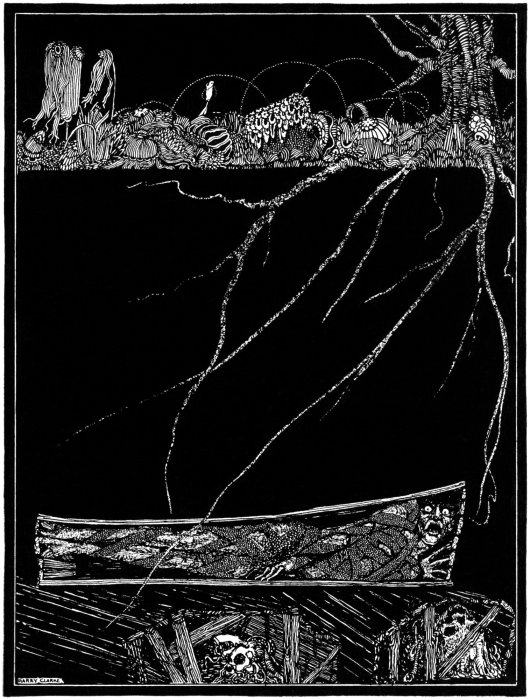 Perhaps the quintessential Poe short story that few have read, "The Premature Burial" was published for the first time in the July 31, 1844 issue of Philadelphia's Dollar Newspaper. Only a few of Poe's works feature the concept of being buried alive, yet, for some reason, I often read that Poe was obsessed that he would be buried prematurely. It's hard to say if this is true but I have yet to find any evidence at all that Poe was personally concerned with being buried alive.
Instead, Poe was responding to the popular concern about premature burial among his readers. Poe was, after all, a pop culture writer trying to appeal to a mass audience (the most obvious piece of evidence is that "The Premature Burial" was published in a cheap newspaper, not a high-end book). Even Poe's only novel was a direct response to the common interest of the masses.
I could argue that the reason American readers were suddenly interested in stories about premature burial is based on a general interest in death at the time. Concepts of death shifted from a Puritan "dirty death" point of view to a more romantic Victorian idealism. Medical science, however, was beginning to help define the moments where life and death meet at the same time that Spiritualism, galvanism, and similar movements were becoming popular. All of this created, I think, a sort of anxiety over death. Coffins in Poe's time could be affixed with bells and other emergency devices in case the "deceased" suddenly awoke after burial, organizations like the "Society for the Prevention of People Being Buried Alive" were formed, and it was reported that hundreds of people were mistakenly pronounced dead while, in fact, still living.
Can you blame Poe for writing a story like "The Premature Burial"? As Poe writes in this tale,
It may be asserted, without hesitation, that no event is so terribly well adapted to inspire the supremeness of bodily and of mental distress, as is burial before death. The unendurable oppression of the lungs — the stifling fumes from the damp earth — the clinging to the death garments — the rigid embrace of the narrow house — the blackness of the absolute Night — the silence like a sea that overwhelms — the unseen but palpable presence of the Conqueror Worm — these things, with thoughts of the air and grass above, with memory of dear friends who would fly to save us if but informed of our fate, and with consciousness that of this fate they can never be informed... We know of nothing so agonizing upon Earth — we can dream of nothing half so hideous in the realms of the nethermost Hell.In addition to being written specifically to appeal to popular tastes, what makes the story so quintessentially Poe? Well, its vaguely frightening storyline is not based on blood, guts, violence, or the supernatural. Instead, it's a psychological story that creeps you out more than scares you. And, also very Poe-like, the story turns out to be a comedy at the end. Who knew??
By the way, Poe's other stories which feature premature burial are "Berenice," "The Cask of Amontillado" and, most notably, "The Fall of the House of Usher."
*Above, "The Premature Burial," as illustrated by Harry Clarke, 1919.
Thursday, June 25, 2009
The night of the twenty-fifth of June
"I remember the buzz of curiosity which his advent excited within the college precincts on the night of the twenty-fifth of June." Thus says the narrator of Poe's obscure tale, "Mystification," originally published in June 1837 as "Von Jung, the Mystific." The comedic tale was the only major work which Poe published that year, amidst the backdrop of the Panic of 1837.
The community at the "University of G——n" was abuzz on June 25 that year, so says the story, because of the arrival of the Baron Ritzner Von Jung, a Hungarian nobleman who many described as "the most remarkable man in the universe." Ironic, perhaps, because our narrator notes he is "by no means a handsome man — perhaps rather the reverse." Of course, what makes him interesting is that he has made mystification his "scientific" pursuit. Though the narrator questions the Baron's ability, he admits that "we were chums."
Amidst conversation on June 25, a man nicknamed Hermann ("he was one of the greatest asses in all Christendom") took a sudden interest in the Baron's words about the traditional duello. Hermann takes issue. He says:
The narrator (curiously named "Mr. P—") serves as a go-between among the two men as they make a gentlemanly exchange airing their grievances. As it turns out, the Baron had planted a book on dueling for Hermann which was purposely mystifying and written in a way to confuse. Hermann, however, attempted to follow the instructions of the book without comprehending a word of it. In fact, it was "a horribly absurd account of a duel between two baboons." Rather than admitting his confusion, Hermann fell right into the "Mystific" trap.
The community at the "University of G——n" was abuzz on June 25 that year, so says the story, because of the arrival of the Baron Ritzner Von Jung, a Hungarian nobleman who many described as "the most remarkable man in the universe." Ironic, perhaps, because our narrator notes he is "by no means a handsome man — perhaps rather the reverse." Of course, what makes him interesting is that he has made mystification his "scientific" pursuit. Though the narrator questions the Baron's ability, he admits that "we were chums."
Amidst conversation on June 25, a man nicknamed Hermann ("he was one of the greatest asses in all Christendom") took a sudden interest in the Baron's words about the traditional duello. Hermann takes issue. He says:
"Your opinions, allow me to say, Baron Von Jung, although in the main correct,Uh-oh. Furious at being challenged, the Baron takes a moment to compose himself before trying to prove he is a true gentleman. Rather than venturing on violence for this insult, he says he will throw a bottle of wine at Hermann's reflection in the mirror, which he does, believing it proves him a true gentleman.
are in many nice points discreditable to yourself and to the University of which
you are a member. In a few respects they are even unworthy of serious
refutation. I would say more than this, Sir, were it not for the fear of giving
you offence, (here the speaker smiled blandly,) I would say, Sir, that your
opinions are not the opinions to be expected from a gentleman."
The narrator (curiously named "Mr. P—") serves as a go-between among the two men as they make a gentlemanly exchange airing their grievances. As it turns out, the Baron had planted a book on dueling for Hermann which was purposely mystifying and written in a way to confuse. Hermann, however, attempted to follow the instructions of the book without comprehending a word of it. In fact, it was "a horribly absurd account of a duel between two baboons." Rather than admitting his confusion, Hermann fell right into the "Mystific" trap.
Sunday, May 17, 2009
"Insufferable trash... one of the most delightful books"
On May 17, 1845, The Town, a New York weekly, poked fun at Edgar A. Poe, who was in town working at the Broadway Journal. It featured a mock review, found "Astray from the office of the Broadway Journal" of the (fictitious) book The Adventures, Life and Opinions of John Smith. The Poe-like reviewer notes the work "a mass of insufferable trash, without one redeeming quality." Nevertheless, it is "one of the most delightful books... printed in a beautiful arabesque style by Wiley & Putnam."
The hilarious little stab at Poe was noting how his reviews always seem to fall in both positive and negative categories: even as he praises a writer, he still damns them. It is, of course, quite a true observation, and it's one of the many details I point out to folks who think Poe simply "hated" or "loved" certain other writers. The reality is, he always found ways to both praise and criticize nearly everyone. Such is the case with Rufus Griswold's The Poets and Poetry of America in 1842, which many categorize as a negative review outright — in fact, Poe loved the anthology and thought it a major turning point in American poetry, though he noted a few errors in judgment on the part of its editor. The same is also true for Poe's reviews of Henry Wadsworth Longfellow, which people seem to take for granted as "Poe hated Longfellow." Again, it's much more complicated.
But, before you think that Poe was being hypocritical or noncommittal, keep in mind the context here. The world of American literary criticism was slow to develop and, in a sense, Poe was moving against the grain. Writers like Margaret Fuller noted "the mutual admiration society" — a climate where reviewers praised to the point of absurdity, without any mark of sincerity. Such reviews, many felt, were detrimental to the advancement of American letters. At a time when Europeans were asking "Who reads an American book?", people like Poe (and Fuller) were trying to encourage writers to work harder and not just idly assume that their writing was good enough (clearly, it wasn't!).
I haven't found much information about The Town, but the Poe Log refers to it as a weekly magazine devoted to satirizing the New York literati. It's first mention of Poe seems to be in February 1845, when it notes Poe's plans to start a new magazine (presumably The Stylus, which was a dream never to come true). The writer noted Poe was "the most interesting and original of Magazine writers, and a fearless critic." When Poe became affiliated with the Evening Mirror that same month, The Town reported that they "rejoice at the fact" — especially because his style of criticism would relieve "much of the Miss Nancyism of [N. P.] Willis" and add "a more manly vigor" to the reviews. They nevertheless note their disagreement with Poe's review of Edward Bulwer-Lytton. Poe had denied the poet's genius, suggesting he was instead merely a clever fellow. The Town suggested Poe "ought to hurry express haste to Washington and get out a patent right for his Discovery." The point is: Poe's negativity looked strange to people who were used to "puffing" (Griswold, by the way, once noted to James Thomas Fields that he "puffed," or gave empty praise to, all the books Fields published, regardless of quality).
By the way, the satire of Poe's criticism happens to use the name "John Smith" in the title of their fictitious book. "John Smith" is also a character in Poe's 1849 comedy story "X-ing a Paragrab" who eventually takes revenge on his newfound rival publisher.
Tuesday, May 5, 2009
"Txld yxu sx, yxu knxw!"
One of the many pieces published in the Flag of Our Union toward the end of Poe's life was the comedy "X-ing a Paragrab" — released on May 5, 1849, though the issue carried the cover date of May 12. "X-ing a Paragrab" is, quite simply, one of Poe's funniest works, and its humor easily stands the test of time after a century and a half.
The story follows a "wise man" from the east named Mr. Touch-and-go Bullet-head, whose intellect is easily proven by his being an editor. He also had a bit of a problem with stubbornness, which he considered his greatest strength. After moving to Alexander-the-Great-o-nopolis ("or some place of similar title") in the West, he established a newspaper called The Tea-Pot, assuming no other newspaper existed. He was wrong; the Alexander-the-Great-o-nopolis Gazette had been quite successful for years. Nevertheless, Bullet-head establishes his Tea-Pot offices right next door to the Gazette. As you can imagine, rivalry ensues. No matter how often I read it, Bullet-head's final editorial in The Tea-Pot always has me laughing out loud. Try it yourself. Seriously, read it!!
Poe was openly mocking a couple of things that make the humor even deeper. For one, he was clearly making fun of the "irascibility," "firmness" or, really, obstinacy of editors like Bullet-head. He also mocked the sort of rivalries which became common in the press during this period. Newspapers were battle-grounds; for example, many staunchly supported one political party over another, resulting in back-and-forth arguments printed between opposing party papers. Poe was stretching to ask what would happen if these rivals took their wars beyond the printed page (though, ultimately, the war stays within those printed pages anyway).
Poe's humor has had many, many critics, who suggest that Poe knew nothing about comedy and was only able to present dark, death-obsessed comedy. "X-ing a Paragrab" is either the exception or the proof that this generalization is untrue. There is no blood or gore in this story, even for humorous effect. This is, to put it simply, a cute comedy — and it really is funny.
I also use the story as an example to note Poe's understanding of the printing technology of the day. The humor relies on movable type. There is evidence that Poe was directly responsible for typesetting here and there throughout his career as a writer. As an aside, Walt Whitman knew about movable type as well and personally oversaw the type-setting for the first edition of Leaves of Grass, resulting in the poem's odd yet artistic spacing.
I will be speaking more in-depth on Poe's understanding of his contemporary publishing world, including its technology, a week from today at the Boston Public Library. The lecture, sponsored by the bibliophiles in The Ticknor Society, is called "Poe and Publishing." All are invited: May 12 at 6:00 p.m. in the orientation room of the McKim Building.
Tuesday, April 14, 2009
A Discovery Greater Than Gold
On April 14, 1849, the Flag of Our Union published Poe's tale "Von Kempelen and His Discovery." The timing is good because it continues the "hoax," the humor and, to a lesser extent, the science fiction aspects of the last post.
The tale begins by knocking down a Brunswick, Maine-based scientist who claims he made the same discovery before Von Kempelen. Poe doesn't believe it, saying that the newspaper reporting it probably made it up to "make a talk." After all, he says, it has an "amazingly moon-hoaxy-air" to it. That same hoaxiness is in the atmosphere of Poe's story too. As is typical, Poe adds just enough possible truth to it that it could be real — the original account of Von Kempelen's discovery was allegedly published in the Home Journal (a journal edited by Poe's friend Nathaniel Parker Willis) and Poe notes some possible errors in translation. In fact, the whole things sounds like a news piece (as intended), with the exception of being written in the first-person singular.
And Poe even seems to admit that he's writing another hoax! "There can be little question that most of the marvellous rumors afloat about this affair are pure inventions, entitled to about as much credit as the story of Aladdin's lamp." Yes, even this marvellous rumor that Poe is writing. He also notes (and a good Poeist catches this one easily) that Von Kempelen is related to a certain Maelzel.
In case you don't know, I don't want to hold you in suspense. What has Von Kempelen discovered? Why, he has been able to transmute lead into pure gold — "in fact, absolutely pure, virgin, without the slightest appreciable alloy!"
Sure, it seems silly today. But remember the story was published in 1849 — amidst the California Gold Rush. Poe was making fun of this sudden lust for gold (he'll note it in a more serious work, the excellent poem "Eldorado," as well). By the end of the story, we learn that Von Kempelen has been arrested and they are trying to force the secret out of him. In fact, people are so convinced that some day the ability to change lead into gold, that Europe already has seen "a rise of two hundred percent in the price of lead." This is comedy gold, certainly, as Poe notes that we choose what is valuable somewhat arbitrarily.
Monday, April 13, 2009
Astounding news!
ASTOUNDING NEWS!
BY EXPRESS VIA NORFOLK:
THE ATLANTIC CROSSED
IN THREE DAYS!
SIGNAL TRIUMPH OF
MR. MONCK MASON'S
FLYING MACHINE!!!
This was the headline on the front page of the New York Sun on April 13, 1844. The article below it described, in great detail, an amazing variation on a hot-air balloon invented by the well-known balloonist Monck Mason. Using a propeller, Mason was able to lead his balloon, full of riders, across the Atlantic Ocean in an impressively-fast 75 hours. This discovery would have marked an epic moment in trans-Atlantic flight, which suddenly made the world seem a little smaller and a little more accessible... as the article states: "The air, as well as the earth and the ocean, has been subdued by science." The article sums up:
This is unquestionably the most stupendous, the most interesting, and the most important undertaking, ever accomplished or even attempted by man. What magnificent events may ensue, it would be useless now to think of determining.
...If only the story were true.
 Known today as "The Balloon-Hoax," Edgar A. Poe made quite a sensation with his "news" story, only a few months after his relocation to New York. Excited readers in the city demanded to know more, and copies of the newspaper quickly sold out. In fact, those who didn't get a copy "besieged" the newspaper offices and demanded more be printed. "I never witnessed more intense excitement to get possession of a newspaper," Poe wrote. His hoax had certainly made a hit.
That's not to say everyone was taken in by the hoax. It was spoofed only a day later in the Mercury, under the headline "Astounding Intelligence from the Man on the Moon." Some critics pointed out how suspicious it was to already have an image of the balloon in New York — that's some quick turn-over time in making an engraving, if the balloon had only landed in Charleston, South Carolina, just four days before publication. Poe was sure to let readers know it was all a fake within a couple of days. But Poe proved something important: he was capable of writing impossible ideas with perfect plausibility. Scholars and critics today think "The Balloon-Hoax" falls under the category of "tales of ratiocination," the early form of detective fiction which Poe invented. More importantly, however, the story is an early form of what would become known as "modern science fiction."
Early forms of sci-fi prior to Poe were not interested in presenting plausible stories. Read Frankenstein (1818), for example, and you are not given a recipe for creating a living creature out of dead people — quite the opposite, in fact. In Poe's story, however, he gives you all the details: he gave the names of everyone involved (some were real people, including novelist William Harrison Ainsworth), the balloon's exact size (13' 6" x 6' 8", filled with 320 cubic feet of gas), the materials which were used to build it, and even included snippets of the journal which Mason kept during the travel.
What denotes Poe's science fiction, then, is its emphasis on science rather than fiction. Other sci-fi works by Poe (which you've probably never read!) include "The Unparalleled Adventure of One Hans Pfaall" (1835), "Mellonta Tauta" (1840), "Mesmeric Revelation" (1844), and "The Facts in the Case of M. Valdemar" (1845). Arguments have been made for several others, including "A Descent into the Maelstrom" (1841) and, of course, Eureka: A Prose Poem (1848). Another example that Poe is much more than a writer of scary stories!
Wednesday, February 25, 2009
A regular business man
One of Edgar A. Poe's more enduring comedy stories, "The Business Man" was first published in the February 1840 issue of Burton's Gentleman's Magazine in Philadelphia. Poe, of course, wrote a substantial number of comedies and satires (and, really, started his prose career with them) but many have lost their humor after 150 years. "The Business Man," however, is still funny — especially in the context of today's economy!
Poe makes fun of the "typical" businessman (people like John Allan?) who profits through ruthlessness and questionable ethics. The businessman of the story, Peter Pendulum (later renamed to "Peter Proffit"), describes himself:
I am a business man. I am a methodical man. Method is the thing, after all. But there are no people I more heartily despise than our eccentric fools who prate about method without understanding it; attending strictly to its letter, and violating its spirit. These fellow are always doing the most out-of-the-way things in what they call an orderly manner. Now here, I conceive is a positive paradox. The true method appertains to the ordinary and the obvious alone, and cannot be applied to the outre.
Pendulum's "method" is simple: make money, no matter how. Presumably he never violates the spirit of being a businessman throughout his many business ventures. Through the course of the story, he has many careers. For one, he joins the "Eye-Sore" business: purposely building ugly homes and structures adjacent to beautiful new buildings, and asking for 500% of the value to tear it down. He also joins the "Assault-and-Battery" business by provoking people on the street into fights, then suing them for attacking him. He also becomes a "Mud-Dabbler" and asks people to pay him not to splash mud on them as they walk by. Later, he makes his money as a "Cat-Grower": raising cats and selling their tails ("tales"? Could this be an indictment of the businessmen in the publishing industry??).
"The Business Man" is still funny 169 years after its publication — if you don't mind the absolute ridiculousness of it, of course. But, to sum up, here is Poe's version of the great businessman, in the words of Pendulum:
If there is any thing on earth I hate, it is a genius. Your geniuses are all arrant asses—the greater the genius the greater the ass—and to this rule there is no exception whatever. Especially, you cannot make a man of business out of a genius... The creatures are always going off at a tangent into some fantastic employment, or ridiculous speculation, entirely at variance with the "fitness of things," and having no business whatever to be considered as a business at all. Thus you may tell these characters immediately by the nature of their occupations... Now I am not in any respect a genius, but a regular business man.
It's important to remember that Poe was a business owner for a while too, albeit years after this story was printed. Read more about The Broadway Journal in previous blog posts.
After Poe's death, his infamous literary executor Rufus W. Griswold collected his works into a multi-volume edition in 1850. Griswold excluded "The Business Man" from this collection, either because he didn't know about it, or because he considered all of Poe's comedies to be miserable failures. Griswold is at least partially responsible for burying Poe's humor works — and that influence remains to this day. Who out there thinks of Poe as a comic writer?
Subscribe to:
Posts (Atom)
