On December 3, 1844, the Paris, France-based newspaper La Quotidienne began publishing installments of "James Dixon, ou la funeste resemblance" (which translates to "James Dixon, or the fatal resemblance"). Though it included a byline of Gustave Brunet, the story was, in fact, an adaptation of Poe's doppelganger story "William Wilson." This was two years before Charles Beaudelaire began his translations of Poe. The same Paris newspaper would soon publish a controversial translation of "The Murders in the Rue Morgue."
As I've noted elsewhere, French readers have long been devoted followers of Poe. I would say that their appreciation for Poe could never be overstated. An entire book has been written about it, so I could never do it justice here. But, to get an idea, besides the admiration of Charles Baudelaire, Poe is credited as the main inspiration for the Symbolist poetry movement that took hold in France, particularly the work of Stephane Mallarmé. This "James Dixon" is the first known translation of Poe's work into French so, in a sense, this one started it all.
More than that, however, the publication of "James Dixon, ou la funeste resemblance" is the first known version of the work of Poe in any language other than English. Even during his lifetime, Poe was becoming a figure of world literature. Some foreigners find it ironic (or, in the case of Baudelaire, unconscionable) that Poe earned greater respect outside of his native country. I would argue that he has come to be much better appreciated here in the United States since then, but that most Americans make their assessment of him based on a very narrow selection of his works. Many readers in countries like France, Spain, England, the Czech Republic, Russia, and scores of others in Europe and South America in particular do not consider Poe a horror writer. They embrace the full span of his various works, including science fiction, comedy, and romantic poetry. I've been particularly surprised to see how much non-American readers have come to love strange works like Eureka and The Narrative of Arthur Gordon Pym of Nantucket.
I have two questions: If you are an American, when do you think we will come to know Poe beyond his horror works? If you are from elsewhere, what has been your experience with Poe?
Showing posts with label Poe media. Show all posts
Showing posts with label Poe media. Show all posts
Thursday, December 3, 2009


Tuesday, November 17, 2009
Fate that once denied him
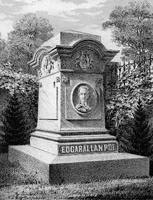
After over two decades buried in an unmarked corner of the cemetery at Baltimore's Westminster Church, Poe’s body was re-buried where people could see it from the street. A new memorial marker was dedicated on November 17, 1875.
 The monument was substantial. Money for it was raised by several parties, including a Baltimore schoolteacher named Sara Sigourney Rice. Rice kicked off a "pennies for Poe" campaign and even asked her students to perform public speeches to raise funds. The final $650 came from Philadelphian George William Childs. The design came from architect George A. Frederick, built by Colonel Hugh Sisson, with a stone medallion of Poe by artist Adalbert Volck (later replaced). The total cost of the new monument was equal today to over $28,000.
Despite all the hard work on the monument, Poe's birthday was incorrectly chiseled as January 20 instead of January 19. It has never been corrected. On his birthday ten years after his reburial, Poe's long-dead wife Virginia Poe was buried with him. Maria Clemm was buried there too, bringing the family trio together for their eternal rest.
The ceremony to dedicate the new monument included speeches from Neilson Poe, Poe's oft-maligned cousin. Several famous poets were invited to attend. The only one that made it was Walt Whitman, then age 56, who was still recovering from a stroke.
Letters, poems and remembrances were contributed his one-time fiancee Sarah Helen Whitman and his occasional enemy James Russell Lowell. Other acknowledgments came from John Greenleaf Whittier ("The extraordinary genius of Edgar Poe is now acknowledged the world over"), William Cullen Bryant (Poe is "distinguished alike for originality in the conception, skill in word-painting, and power over the mind of the reader") and even Henry Wadsworth Longfellow (who noted: "The fever called Living is conquered at last"). Some of the greatest lines in honor of Poe came from fellow 2009 bicentennial poets Alfred Lord Tennyson, who later said that "neglected spot" would be the first place he would visit on a trip to the United States, and Oliver Wendell Holmes. As Dr. Holmes wrote:
 The monument was substantial. Money for it was raised by several parties, including a Baltimore schoolteacher named Sara Sigourney Rice. Rice kicked off a "pennies for Poe" campaign and even asked her students to perform public speeches to raise funds. The final $650 came from Philadelphian George William Childs. The design came from architect George A. Frederick, built by Colonel Hugh Sisson, with a stone medallion of Poe by artist Adalbert Volck (later replaced). The total cost of the new monument was equal today to over $28,000.
Despite all the hard work on the monument, Poe's birthday was incorrectly chiseled as January 20 instead of January 19. It has never been corrected. On his birthday ten years after his reburial, Poe's long-dead wife Virginia Poe was buried with him. Maria Clemm was buried there too, bringing the family trio together for their eternal rest.
The ceremony to dedicate the new monument included speeches from Neilson Poe, Poe's oft-maligned cousin. Several famous poets were invited to attend. The only one that made it was Walt Whitman, then age 56, who was still recovering from a stroke.
Letters, poems and remembrances were contributed his one-time fiancee Sarah Helen Whitman and his occasional enemy James Russell Lowell. Other acknowledgments came from John Greenleaf Whittier ("The extraordinary genius of Edgar Poe is now acknowledged the world over"), William Cullen Bryant (Poe is "distinguished alike for originality in the conception, skill in word-painting, and power over the mind of the reader") and even Henry Wadsworth Longfellow (who noted: "The fever called Living is conquered at last"). Some of the greatest lines in honor of Poe came from fellow 2009 bicentennial poets Alfred Lord Tennyson, who later said that "neglected spot" would be the first place he would visit on a trip to the United States, and Oliver Wendell Holmes. As Dr. Holmes wrote:
His monument shall be his gentle verse,* People still leave "pennies for Poe" at this memorial today. This has become a tradition at the graves of famous figures, particularly writers. Poe did not originate the tradition, however.
Which eyes not yet created shall o'er read.
And tongues to be his being shall rehearse,
When all the breathers of this world are dead.
Tuesday, November 10, 2009
Poe preserved by the National Park Service
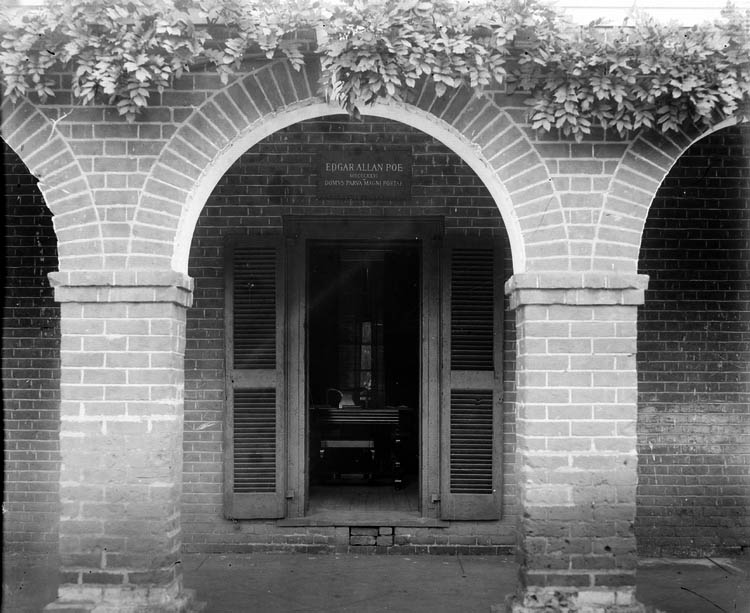
Though Poe lived in many parts of the United States (born in Boston; raised in Richmond, schooled in England and Charlottesville, VA; stationed in South Carolina; lived and worked in Baltimore, New York City, Philadelphia, The Bronx, etc.) there is only one federally-recognized, federally-funded site dedicated to his memory, and it is in Philadelphia.
 The Edgar Allan Poe National Historic Site was dedicated as part of the National Park Service on November 10, 1978. It remains one of only five literary landmarks funded by the federal government and overseen by the National Park Service.*
Poe's most productive (and, likely, most sober) years were spent in Philadelphia. He lived at this house near the corner of 7th and Spring Garden Streets for less than a year; none of his other Philadelphia homes (and there were many) are still standing. Nevertheless, in this city, Poe published iconic works like "The Tell-Tale Heart," "The Black Cat," "The Balloon-Hoax," and the world-changing "The Murders in the Rue Morgue." It was also during his time in Philadelphia that Poe met Charles Dickens and reviewed his work.
 The home's extant status is thanks to Richard Gimbel, who became a collector of Poe. He purchased Poe's former home in 1933, making it the centerpiece of his collection. He claimed that Poe began writing "The Raven" here, though it's not likely. Upon Gimbel's death, the home was donated and became the "official" shrine to Poe. However, none of Poe's furniture survived and, lacking clear information on how the interior of the home looked in Poe's time, the house remains empty under the NPS. They refused to "fake it" and install representative period furniture. The result is a creepy, unfurnished, empty house — complete with decaying walls and decrepit fireplaces.
The home remains open to the public after a renovation to its visitor center (completed just in time for the bicentennial) and is open year-round — and admission is always free.
Other sites related to Poe include the Baltimore Poe House and Museum, the Poe Cottage in the Bronx, Poe's preserved dorm-room at the University of Virginia, and the Richmond Poe Museum.
Happy anniversary to the Poe National Historic Site.
*The other four are: The Wayside in Concord, MA; Longfellow National Historic Site in Cambridge, MA; Carl Sandburg National Historic Site in North Carolina; Eugene O'Neill National Historic Site in California.
 The Edgar Allan Poe National Historic Site was dedicated as part of the National Park Service on November 10, 1978. It remains one of only five literary landmarks funded by the federal government and overseen by the National Park Service.*
Poe's most productive (and, likely, most sober) years were spent in Philadelphia. He lived at this house near the corner of 7th and Spring Garden Streets for less than a year; none of his other Philadelphia homes (and there were many) are still standing. Nevertheless, in this city, Poe published iconic works like "The Tell-Tale Heart," "The Black Cat," "The Balloon-Hoax," and the world-changing "The Murders in the Rue Morgue." It was also during his time in Philadelphia that Poe met Charles Dickens and reviewed his work.
 The home's extant status is thanks to Richard Gimbel, who became a collector of Poe. He purchased Poe's former home in 1933, making it the centerpiece of his collection. He claimed that Poe began writing "The Raven" here, though it's not likely. Upon Gimbel's death, the home was donated and became the "official" shrine to Poe. However, none of Poe's furniture survived and, lacking clear information on how the interior of the home looked in Poe's time, the house remains empty under the NPS. They refused to "fake it" and install representative period furniture. The result is a creepy, unfurnished, empty house — complete with decaying walls and decrepit fireplaces.
The home remains open to the public after a renovation to its visitor center (completed just in time for the bicentennial) and is open year-round — and admission is always free.
Other sites related to Poe include the Baltimore Poe House and Museum, the Poe Cottage in the Bronx, Poe's preserved dorm-room at the University of Virginia, and the Richmond Poe Museum.
Happy anniversary to the Poe National Historic Site.
*The other four are: The Wayside in Concord, MA; Longfellow National Historic Site in Cambridge, MA; Carl Sandburg National Historic Site in North Carolina; Eugene O'Neill National Historic Site in California.
Friday, November 6, 2009
A football interlude
 Way back in 1995, the ill-fated NFL franchise the Cleveland Browns was struggling (what else is new?). The controversial owner, Art Modell, was frequently criticized for his leadership. But, Cleveland is a football town, and the city discussed the possibility of spending a substantial amount of money to upgrade their stadium, all for the benefit of the Browns (and their fans).
Amid discussions of improving the stadium, however, Modell was secretly in talks with the state of Maryland about their desire for a football team (they were without a team since the Colts moved to Indianapolis in the 1980s). Just days short of the city's announcement that it would upgrade the stadium, on November 5, 1995, Art Modell announced that he was taking his team on the road — permanently. Reaction was quick and harsh, and critics said Modell purposely got ahead of the bill to improve the stadium so he had one more excuse why the Cleveland Browns needed to leave Cleveland. The city sued the Browns and its leadership. The agreement was to shut down the team entirely for a three-year period, suspending the creation of a Maryland football team until 1999, and requiring that the team's brand (name, colors, etc.) never make it out of Ohio.
The good news was that the NFL approved an expansion team to be named "Cleveland Browns." So, football stayed in Cleveland.
Back in Maryland, in preparation for their new team, to be housed in Baltimore, a local poll asked for help in determining their team name and mascot.
What does this have to do with Edgar A. Poe?
The city of Baltimore, in naming their relocated football team, chose to honor their greatest writer, their adopted son, by naming the team the Baltimore Ravens. Their mascot was named in his honor (originally Edgar, Allan, and Poe; now just Poe). In their second season, the team won their first (and only) SuperBowl. So far as I know, the Baltimore Ravens remain the only professional sports team named after a poem.
Tuesday, September 1, 2009
A Poe romance
September 1, 1827 saw the third and final installment of Merlin, a play in verse by Maryland writer Lambert A. Wilmer. Published in the North American, the three-act play followed a heroine named Elmira and her despondent pursuer Alphonse. The drama was based on the true story of a young Edgar Poe — the first in what would be a long series of fictionalized stories about Poe over several decades.*
As a young man, Poe pursued a neighboring Richmond woman named Sarah Elmira Royster. The relationship seemed strong enough and the couple apparently made some kind of agreement to get married. Poe then left Richmond to attend the University of Virginia and, somehow, the relationship ended. Poe wrote her often, imploring for a response. Miserable at college, quickly running out of money (due to insufficient support from his guardian John Allan) and, now, nursing a broken heart, the seventeen-year old Poe eventually gave up on his studies and never graduated. Royster, he assumed, had forgotten him, perhaps fallen in love with another man.
As it turns out, the villain of this real-life story was none other than Royster's father, who carefully intercepted each of Poe's letters before his daughter saw them. After months of hearing nothing from her husband-to-be, she gave up on him. By the time Poe returned home from his unsuccessful stint at the University, Poe realized Royster was no longer available. One story says that Poe went to see her at her family home and was surprised to find a party being hosted there — it turned out to be Royster's engagement party.
Whether that story is true or not, Poe and Royster lost their opportunity to live happily ever after — for now. The star-crossed lovers whose relationship inspired a play would rekindle their relationship many years later, when both were widows. That story will be told later this month.
* Though modern works like Matthew Pearl's The Poe Shadow or Louis Bayard's The Pale Blue Eye come to mind first and foremost, this post shows that neither author was doing anything particularly new or innovative. Literally scores of works based on Poe have been produced over the years, including short stories, novels, video games, and films.
As a young man, Poe pursued a neighboring Richmond woman named Sarah Elmira Royster. The relationship seemed strong enough and the couple apparently made some kind of agreement to get married. Poe then left Richmond to attend the University of Virginia and, somehow, the relationship ended. Poe wrote her often, imploring for a response. Miserable at college, quickly running out of money (due to insufficient support from his guardian John Allan) and, now, nursing a broken heart, the seventeen-year old Poe eventually gave up on his studies and never graduated. Royster, he assumed, had forgotten him, perhaps fallen in love with another man.
As it turns out, the villain of this real-life story was none other than Royster's father, who carefully intercepted each of Poe's letters before his daughter saw them. After months of hearing nothing from her husband-to-be, she gave up on him. By the time Poe returned home from his unsuccessful stint at the University, Poe realized Royster was no longer available. One story says that Poe went to see her at her family home and was surprised to find a party being hosted there — it turned out to be Royster's engagement party.
Whether that story is true or not, Poe and Royster lost their opportunity to live happily ever after — for now. The star-crossed lovers whose relationship inspired a play would rekindle their relationship many years later, when both were widows. That story will be told later this month.
* Though modern works like Matthew Pearl's The Poe Shadow or Louis Bayard's The Pale Blue Eye come to mind first and foremost, this post shows that neither author was doing anything particularly new or innovative. Literally scores of works based on Poe have been produced over the years, including short stories, novels, video games, and films.
Friday, August 21, 2009
Birth of Aubrey Beardsley
English illustrator Aubrey Beardsley was born on August 21, 1872. I don't know much about him, but I know his illustrations of the works of Poe are brilliant. These black and white images uniquely capture Poe's vision: strangely dark, yet slightly exotic, each is simple, yet hauntingly beautiful. The examples below date to 1901, so far as I can tell.
 "The Murders in the Rue Morgue"
 "The Black Cat"
 "The Masque of the Red Death"
 "The Murders in the Rue Morgue"
 "The Black Cat"
 "The Masque of the Red Death"
Thursday, June 18, 2009
Osgood and B-movies
Today, June 18, marks two interesting anniversaries.
 Frances "Fanny" Osgood was born this day in 1811. An accomplished, well-known writer herself, she carried on a brief public flirtation with Poe — while both were still married. She was among the most popular women writers of her generation, dabbling both in poetry and in short prose. Her connection to Poe, though short-lived, became infamous. Her relationship with Poe's critical rival Rufus Griswold may have also led to friction between the two men, ultimately resulting in Griswold's character assassination of Poe beginning in 1849. Osgood herself died shortly after Poe's death; she had struggled with tuberculosis for years. In 1850, a posthumous edition of her works was published. One of the poems included in that collection was "Old Friends". It's an unusual one; much of her work is stereotypically feminine with particular emphasis on flowers. This one is about a dying man whose faithful dog clings to his side:
Today also marks the anniversary of the world debut of Roger Corman's film House of Usher in 1960. A master of the B-movie, Corman took major advantage of Poe's name (much less than his actual works) to spit out a series of extremely loose adaptations of Poe's work beginning with House of Usher. Vincent Price made an appearance in all but one of them, including House of Usher. The one in which Price is conspicuously absent, The Premature Burial, is (coincidentally?) my personal favorite. Other Corman/Price collaborations include The Pit and the Pendulum and The Masque of the Red Death. All were very low budget but attracted decent audiences — and still do, to this day. Regardless of what you think of them, Poe's sudden surge in popularity in the 1960s is nothing to be ashamed of.
 Frances "Fanny" Osgood was born this day in 1811. An accomplished, well-known writer herself, she carried on a brief public flirtation with Poe — while both were still married. She was among the most popular women writers of her generation, dabbling both in poetry and in short prose. Her connection to Poe, though short-lived, became infamous. Her relationship with Poe's critical rival Rufus Griswold may have also led to friction between the two men, ultimately resulting in Griswold's character assassination of Poe beginning in 1849. Osgood herself died shortly after Poe's death; she had struggled with tuberculosis for years. In 1850, a posthumous edition of her works was published. One of the poems included in that collection was "Old Friends". It's an unusual one; much of her work is stereotypically feminine with particular emphasis on flowers. This one is about a dying man whose faithful dog clings to his side:
Cold blows the bleak wind around the long stranger,
Wild beat the snows in his thin waving hair,
One only true friend,—his old faithful Ranger,
Clings to his side in the wintry despair.
Sad and forsaken, his heart throbbing slowly,
His limbs numb'd and aching, his eyes dim with tears,
Back steals remembrance, with grief sweet and holy,
Back steals remembrance to happier years.
One only true friend, his old faithful Ranger,
Clings to his side in his wintry despair;
Wild blows the bleak wind around the lone stranger,
Drear drifts the snow in his thin waving hair.
Hunger and age, they have done their work drearily,
Yet is the forest tree grand in its fall;
Faith and affection, still gleaming out cheerily,
Like the sun, o'er the scene, halo it all.
Today also marks the anniversary of the world debut of Roger Corman's film House of Usher in 1960. A master of the B-movie, Corman took major advantage of Poe's name (much less than his actual works) to spit out a series of extremely loose adaptations of Poe's work beginning with House of Usher. Vincent Price made an appearance in all but one of them, including House of Usher. The one in which Price is conspicuously absent, The Premature Burial, is (coincidentally?) my personal favorite. Other Corman/Price collaborations include The Pit and the Pendulum and The Masque of the Red Death. All were very low budget but attracted decent audiences — and still do, to this day. Regardless of what you think of them, Poe's sudden surge in popularity in the 1960s is nothing to be ashamed of.
Sunday, April 5, 2009
Happy B-Movie Birthday
Today celebrates the birthday of Roger Corman, B-movie-maker extraordinaire. Under his belt are several low-budget adaptations of stories by Poe - although few of them come close to the source material and at least one shares nothing in common with Poe beyond a title.
Regardless of what you might think of Corman's Poe movies, he certainly introduced them to a new audience in the 1960s. Many, of course, never went beyond the films, but I'm sure quite a few ran to their nearest book shop to buy their own collected works of Poe. I give Corman credit for that.
My favorite of all of Corman's loose adaptations is, perhaps ironically, the only one that does not star his frequent collaborator Vincent Price. Instead, The Premature Burial stars veteran actor Ray Milland. The film, I think, captures the original spirit of the story quite well, with ample amounts of the expected campiness thrown in. The trailer alone gives you a good idea of the camp:
Happy birthday, Roger Corman!
Regardless of what you might think of Corman's Poe movies, he certainly introduced them to a new audience in the 1960s. Many, of course, never went beyond the films, but I'm sure quite a few ran to their nearest book shop to buy their own collected works of Poe. I give Corman credit for that.
My favorite of all of Corman's loose adaptations is, perhaps ironically, the only one that does not star his frequent collaborator Vincent Price. Instead, The Premature Burial stars veteran actor Ray Milland. The film, I think, captures the original spirit of the story quite well, with ample amounts of the expected campiness thrown in. The trailer alone gives you a good idea of the camp:
Happy birthday, Roger Corman!
Subscribe to:
Posts (Atom)