Showing posts with label Charles Dickens. Show all posts

Tuesday, November 10, 2009

Poe preserved by the National Park Service

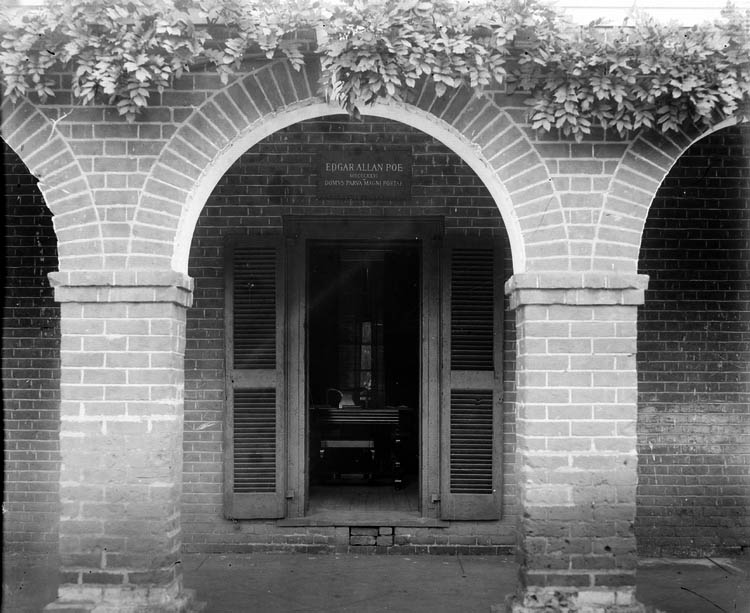
Though Poe lived in many parts of the United States (born in Boston; raised in Richmond, schooled in England and Charlottesville, VA; stationed in South Carolina; lived and worked in Baltimore, New York City, Philadelphia, The Bronx, etc.) there is only one federally-recognized, federally-funded site dedicated to his memory, and it is in Philadelphia.

The Edgar Allan Poe National Historic Site was dedicated as part of the National Park Service on November 10, 1978. It remains one of only five literary landmarks funded by the federal government and overseen by the National Park Service.*

Poe's most productive (and, likely, most sober) years were spent in Philadelphia. He lived at this house near the corner of 7th and Spring Garden Streets for less than a year; none of his other Philadelphia homes (and there were many) are still standing. Nevertheless, in this city, Poe published iconic works like "The Tell-Tale Heart," "The Black Cat," "The Balloon-Hoax," and the world-changing "The Murders in the Rue Morgue." It was also during his time in Philadelphia that Poe met Charles Dickens and reviewed his work.

The home's extant status is thanks to Richard Gimbel, who became a collector of Poe. He purchased Poe's former home in 1933, making it the centerpiece of his collection. He claimed that Poe began writing "The Raven" here, though it's not likely. Upon Gimbel's death, the home was donated and became the "official" shrine to Poe. However, none of Poe's furniture survived and, lacking clear information on how the interior of the home looked in Poe's time, the house remains empty under the NPS. They refused to "fake it" and install representative period furniture. The result is a creepy, unfurnished, empty house — complete with decaying walls and decrepit fireplaces.

The home remains open to the public after a renovation to its visitor center (completed just in time for the bicentennial) and is open year-round — and admission is always free.

Other sites related to Poe include the Baltimore Poe House and Museum, the Poe Cottage in the Bronx, Poe's preserved dorm-room at the University of Virginia, and the Richmond Poe Museum.

Happy anniversary to the Poe National Historic Site.

*The other four are: The Wayside in Concord, MA; Longfellow National Historic Site in Cambridge, MA; Carl Sandburg National Historic Site in North Carolina; Eugene O'Neill National Historic Site in California.

Wednesday, July 8, 2009

The name of Halleck

"The name of Halleck is at least as well established in the poetical world as that of any American," Edgar A. Poe once wrote. At the time, the name "Halleck" needed no further introduction or definition. Today, however, that name has long since faded into obscurity.

Fitz-Greene Halleck was born in Guilford, Connecticut on July 8, 1790. He first received attention as a writer in 1819 (the same year Washington Irving's Sketch-book was published) when he and collaborator Joseph Rodman Drake anonymously published his humorous series of "The Croaker Papers." He continued writing, even while holding jobs at banks and libraries (even working directly for John Jacob Astor for a number of years). He earned the nickname "the American Byron" and his admirers included Charles Dickens, Abraham Lincoln, William Cullen Bryant, and others.

Poe wasn't as convinced. He wrote of Halleck's poetry: "to uncultivated ears... [it is] endurable, but to the practiced versifier it is little less than torture." Of Halleck's then-famous poem Fanny, Poe concluded that "there is really very little about this poem to be admired." Nevertheless, when Halleck's poetic output slowed to a crawl while he focused on other work, Poe lamented that Halleck "has nearly abandoned the Muses, much to the regret of his friends and to the neglect of his reputation."

Yet, Halleck's personal life deserves scrutiny. Even Poe, at the end of his entry on Halleck in The Literati of New York, made sure to point out: "He is unmarried." What an odd conclusion... Did he do the same for reviews of other writers? The answer may be this: Halleck was probably well-known as a homosexual. His relationship with Drake, before Drake's early death at age 25, was exceptionally close. Halleck's memorial poem to Drake noted that "none knew thee but to love thee" and, particularly, "I who woke each morrow to clasp thy hand in mine... shared thy joy and sorrow."

Did it diminish his popularity? Apparently not at all. When Halleck died in 1867, his friends and admirers (led by Bryant) immediately set about memorializing him. In 1877, a large bronze statue was erected in New York's Central Park — as I understand, Halleck remains the only American writer so immortalized. President Rutherford B. Hayes was present for the unveiling — as were some 10,000 others.

Poe also noted Halleck's character: "Personally, he is a man to be admired, respected, but more especially beloved." Certainly, in 2009, none of that seems true of Halleck any more (despite the efforts of some). Personally, I can't help but see irony here: for a poet so richly celebrated in the 19th-century, it turns out that Poe's questioning his talent (going against the grain) made a good point.

Nevertheless, happy birthday, Halleck. I'll conclude with a few of your lines which Poe thought belonged "to a very high order of poetry" and which he considered "gloriously imaginative... The passage is, I think, the noblest to be found in Halleck, and I would be at a loss to discover its parallel in all American poetry." These lines are from "Alnwick Castle":
Wild roses by the Abbey towers
Are gay in their young bud and bloom —
They were born of a race of funeral flowers
That garlanded, in long-gone hours,
A Templar's knightly tomb.

Monday, April 27, 2009

Emerson, Transcendentalism, and Poe

Ralph Waldo Emerson has become the figurehead of American Transcendentalism. Even in his lifetime, he was the face of the movement, even though several others were important participants; many of those names are not commonly known today (anyone remember Orestes Brownson, Christopher Pearse Cranch, Frederick Henry Hedge, Sylvester Judd, Jones Very...?). Emerson was considered to be one of the greatest minds of the 19th century. However, when he died on April 27, 1882, not much of that mind was left.

Emerson suffered from some form of dementia, speculated by some to be Alzheimer's. He certainly had aphasia — his memory could no longer find the words for simple objects and concepts. When he attended the funeral of his good friend Henry Wadsworth Longfellow only a month before his own death, Emerson reportedly said something to the effect of: "Today we bury a great man. I do not remember his name." Emerson was also forgetting his own name. When asked how he felt around this time, he once answered: ""Quite well; I have lost my mental faculties, but am perfectly well."

These final years of Emerson aren't often discussed.* Of course, Edgar A. Poe never knew Emerson at this late stage in his life. Poe knew of Emerson when he was in his prime. Poe, just like people today, saw Emerson as the icon of Transcendentalism - and that made him a target.

Poe's utter dislike of Transcendentalism was no secret (he once took a swipe at Nathaniel Hawthorne, who he otherwise respected, simply for living in Concord, Massachusetts — the seat of the movement), and his particular disgust with Emerson was equally well-known. Poe chided the Concord Sage for writing that was purposely difficult to understand — "mysticism for mysticism's sake," as Poe referred to it. Poe also identified (and he was a bit right) that Emerson was "little more than a respectful imitation of [Thomas] Carlyle."

Overall, Transcendentalism and its avowed idealism didn't make sense to Poe (nor does it make sense to most high schoolers introduced to it). As he wrote, "They could not define their own position & cannot be expected that I can define them exactly." However, he noted that their philosophy wasn't inherently bad. "You mistake me in supposing I dislike the transcendentalists," he wrote to friend Thomas Holley Chivers. "It is only the pretenders and sophists among them." When the Transcendental community at Brook Farm began publishing their journal, The Harbinger, to promote their worldview, Poe wrote it was "conducted by an assemblage of well-read persons who mean no harm—and who, perhaps, can do no less." True enough.

Eventually, Poe looped all of the Boston area with Transcendentalism (and a general Longfellow-like lack of originality). So, feel free to blame Emerson for at least part of Poe's distaste for Boston in his adult years. Next month (May 25), I'll follow up with a battle of poetry, Emerson vs. Poe.

Perhaps ironically, today, the City of Boston dedicates "Edgar Allan Poe Square" at the intersection of Charles St. and Boylston St. near his original birthplace, directly across from the Boston Common. I'm sure the ceremony was scheduled on the anniversary of Emerson's death by mere coincidence.

*I am of the opinion that Emersonians have, for years, been cleaning up his image. Hiding his struggle with dimentia - or the fact that he was not perfect - does not help him. It would be better to humanize him, rather than try to deify him.

Saturday, March 7, 2009

Dickens and Poe in Philadelphia

The date is uncertain, but Charles Dickens and Edgar A. Poe met some time in March 1842, likely March 7.

As part of his tour of the United States, Dickens arrived in Philadelphia on March 5 and lodged at the United States Hotel on Chestnut Street above Fourth Street. By this time, Dickens had published a handful of works, including Oliver Twist, The Life and Adventures of Nicholas Nickleby, and Barnaby Rudge: A Tale of the Riots of 'Eighty (his A Christmas Carol would be published in 1843). Poe saw a great opportunity to rub elbows with an admired literary figure and wrote him a letter requesting an interview. Dickens responded with his own letter, dated March 6, 1842:

I shall be very glad to see you, whenever you will do me the favor to call... I have glanced over the books [apparently a copy of Tales of the Grotesque and the Arabesque] you have been so kind as to send to me; and more particularly at the papers to which you called my attention [Poe's review of Barnaby Rudge] . I have the greater pleasure in expressing a desire to see you, on their account.

Presumably, the two writers met on March 7, likely at the United States Hotel where Dickens was staying. The major topic of discussion was the state of American poetry. Poe read to Dickens a poem called "A Humble Bee" by Ralph Waldo Emerson. Dickens, apparently a sincere admirer of Poe's works which he "glanced over," offered to find an English publisher for Tales of the Grotesque and Arabesque (he never did). And Poe, always thinking like an editor, tried to convince Dickens to write for Graham's Magazine - Dickens slyly responded that he would, if he contributed to any American magazine.

By March 9, Dickens left Philadelphia and made his way to Washington, D.C., the next leg of his United States visit.

For more on the connection between Poe and Dickens, please read my prior post on "Charles Dickens with his raven."

Saturday, February 7, 2009

Charles Dickens with his raven


A special birthday tribute to a writer from across the pond, Charles Dickens (who still has a few years yet before he turns 200). I like to use Dickens as an example of what was happening in American literature because, though he wasn't American, he was the best-selling novelist in the United States for a time. American literature (and especially the American novel) had a slow start, and Americans were looking to mother England and its long-standing tradition of literature. Of course, there's also the whole international copyright issue, which meant that much of Dickens's work was published in the United States without legal permission. Ah well.

Our own Edgar Poe connects with Dickens in a couple of ways and I'm sure I'll mention the others throughout the year. Today, however, I'd like to connect one of Dickens's lesser-known novels with Poe's most famous poem.

Barnaby Rudge: A Tale of the Riots of 'Eighty, like most of Dickens's works, originally was printed in serialized form, in this case between 1840 and 1841. Poe was working in Philadelphia for Graham's Magazine at the time and reviewed Dickens's work in the February 1842 issue (of which I happen to have a first printing). The long review — nearly 12 columns — applauds Dickens's efforts, with an occasional negative criticism peppered throughout ("Mr Dickens fails peculiarly in pure narration").

The majority of Poe's praise is directed towards Dickens's ability to present dramatis personae — dramatic characters. Such skill "sustain[s] the high fame of Mr. Dickens as a delineator of character... Their traits are founded in acute observation of nature, but are exaggerated to the utmost admissible extent." He does find a flaw or two, and one particular one which he emphasizes: Dickens included as a character a talking raven. He wrote:
The raven, too, intensely amusing as it is, might have been made, more than we now see it, a portion of the conception of the fantastic Barnaby. Its croakings might have been prophetically heard in the course of the drama.
And thus, the concept of a talking raven that serves as a prophet was first crafted by Poe — and, by the way, those are Poe's italics, not mine.

In this review, we see another connection that Poe will make between Barnaby Rudge and his own poem "The Raven" in just a couple years. Poe questions that "no work of fiction can fully suit, at the same time, the critical and the popular taste". He would challenge this assertion very specifically in "The Raven", as he explains in its companion essay "The Philosophy of Composition" using nearly those exact same words.

Poe didn't deny Dickens's inspiration, either. He mentioned Barnaby Rudge in "The Philosophy of Composition" and many other writers knew it too. James Russell Lowell, for example, famously referred to Poe in A Fable for Critics (1848) as coming "with his Raven, like Barnaby Rudge."

Dickens, by the way, was inspired to include a raven character because he himself owned a pet raven named Grip. After Grip's death, Dickens had him stuffed and mounted in a glass case. The connection between Dickens's raven and Poe's was strong enough that Poe collector Richard Gimbel purchased the stuffed Grip and added it to his collection (now preserved at the Philadelphia Free Library). I had the good fortune of seeing Grip, in his current form, in January and was proud to think that it was from this little guy (actually, he's quite large!) that we eventually had "Once upon a midnight dreary..."

Happy birthday, Mr. Dickens.

Thursday, January 29, 2009

Once upon a midnight dreary...

"The Raven" was likely already in print when the Evening Mirror published it on January 29, 1845. The American Review was authorized to print it in its February issue, which was likely already out by January 29. The American Review, however, did not print the poet's name, and instead attributed the poem to the curious pseudonym "Quarles." Whether the American Review or the Evening Mirror printed it first, both had permission to legitimately print it and, either way, "The Raven" was first published some time in January 1845, and one of those early editions came out today, January 29 — the first time Poe's name was attached to "The Raven."

In thinking about where I wanted to go with this blog post, I debated on several options. "The Raven" by itself merits some discussion as Poe's most famous, most popular, and most successful poem. The story of its composition (which necessitates a discussion of Poe's theme of "the death of a beautiful woman" as "the most poetical topic in the world") and its publication (supposedly after George Rex Graham turned it down!) is fascinating. Nonetheless, I'll focus more on the importance of the January 29, 1845 date and introduce Nathaniel Parker Willis to this blog.

Willis was the editor of the Evening Mirror when it printed "The Raven." He introduced the poem with his now-famous note:

We are permitted to copy (in advance of publication) from the 2d No. of the American Review, the following remarkable poem by EDGAR POE. In our opinion, it is the most effective single example of "fugitive poetry" ever published in this country; and unsurpassed in English poetry for subtle conception, masterly ingenuity of versification, and consistent, sustaining of imaginative lift and "pokerishness." It is one of these "dainties bred in a book" which we feed on. It will stick to the memory of everybody who reads it.
Willis was a very important character in the story of Poe — not to mention the story of the development of American literature. He knew everyone, and counted among his friends Henry Wadsworth Longfellow, Washington Irving, Charles Dickens, and countless other literary and public figures. He was the highest-paid magazine writer of his day (he was the success story that Poe would have envied), earning the equivalent of over $300,000 a year, though his writing was cheap, frilly, and today is (rightfully) forgotten.

To understand Willis's writing, you must understand his personality; the two were intrinsically linked. A typically Willis essay took you, the reader, into his study, where he described to you his elaborate desk, the pen he held, the view from out his window to the wooded glen in his back yard by the Hudson River. He would tell you, the reader, that his wealth was not inherited like kings and princes — he was an American, and it was democracy and capitalism that made him successful. He was, after all, a regular fellow who happened to make it big — and you, the reader, could some day have the same luck.

In reality, Willis's success came from his over-the-top personality; his arsenal included a conviviality that did not allow exceptions to his offers of friendship, a wit and humor that made all others laugh, and a handsome face with wispy, innocent curls hanging by his temples (at least as a younger man; as the beard became fashionable, Willis adopted the popular haggled, sort of unkempt look that Longfellow, James Russell Lowell, and others adopted). This personality, of course, was chosen, rather than his natural personality — chosen because Willis knew it would lead him far. It meant he made friends with publishers, writers, and politicians (including Mary Todd Lincoln), and it meant that even readers who never met him would say, "What a great guy! I should read his poetry!" Some, however, saw through this, including Longfellow, a fellow Portland-born poet who spent an evening with Willis at the Astor House in New York. After their meal, Longfellow noted how fake Willis was and admitted he suddenly liked his poetry a lot less.

But, Willis was a huge friend to Poe, and that relationship didn't seem fake. Willis had suffered nearly as much tragedy in his life as Poe — his own wife Mary Stace had died in childbirth in 1845 just as Poe's wife Virginia was in the final stages of tuberculosis. Willis published an ad in his Home Journal (the periodical he helped found for which he was editor is now known as Town & Country Magazine) asking for financial support to his friend Poe and his dying wife — unsolicited by Poe, by the way. Willis sent financial assistance, offers of work, and requests for writing to Poe throughout his life.

Willis also, of course, played an important role after Poe's death. Ultimately, it's hard to determine, however, if Willis can be labeled a "friend" of Poe. After Poe's death, Willis — in his unending battle to become everyone's friend — built up a convivial relationship with someone with whom he should have sparred over Poe: Rufus Wilmot Griswold. But, more on him later.

I'll conclude with what has likely become the most famous word ever written by Poe, in celebration of today's anniversary: "Nevermore."