Showing posts with label Poe family. Show all posts

Saturday, December 26, 2009

The Richmond Theatre Fire

72 people died on December 26, 1811, when the Broad Street Theatre in Richmond, Virginia burned down. Eliza Poe was not one of them.

Though Eliza Poe, mother of Edgar Poe, had performed there and, in fact, gave her last performance there, she was already dead when the building caught fire. Years later, Poe would claim his mother was one of the many victims of that tragedy.

In fact, Eliza Poe had died about two weeks earlier, presumably from tuberculosis. Things moved very quickly from there. Young Edgar may have been taken in by John and Frances Allan as a foster child as early as the same day as Eliza's death. On about December 11, the Allans had him baptized (using the unofficial name "Edgar Allan Poe"). When the fire occurred, the Allan family, including young Edgar, was celebrating the Christmas holiday at Turkey Island, Virginia, southeast of Richmond on the James River. A letter to John Allan dated January 7, 1812, notes: "How fortunate that yourself & family were out of town" when the fire occurred.

A couple years later, a memorial church was built on the former site of the theatre. John Allan purchased one of the pews, number 80, for $340 as the family pew in April 1814.

Poe used the fire for sympathy points in 1829. Seeking to leave the Army and earn an appointment at West Point, he had a colonel named James House write to the general E. P. Gaines: "The said Perry [Poe's Army alias], is one of a family of orphans whose unfortunate parents were the victims of the conflagration of the Richmond theatre." The same letter also incorrectly notes that Allan had adopted Poe as "his son & heir" (neither claim was true).

Poe may have tried to cast his acting parents in a more noble light, considering that most actors were not considered noble by the public at the time (one historian noted that, though audiences loved drama, they did not respect those that performed it). Perhaps not coincidentally, Poe's loving foster-mother Frances Valentine Allan had died just before the claim was made that Eliza Poe died in the fire.

Interestingly enough, the theatre where Eliza Poe performed for the last time in Boston — the city where her two sons were born — also caught fire. Its stage, however, was preserved. Years later, Poe also "performed" on that same stage in Boston in what has been called the Boston Lyceum "incident." Poe likely did not realize the coincidence.

* The illustration above is from Richmond Then and Now.

Sunday, December 20, 2009

The mystery of Rosalie Poe

Rosalie Poe, the youngest of the three children of David Poe and Eliza Arnold, was born on December 20, 1811.* Her birth was in Norfolk, Virginia the same town where her parents met. Well, presumably. Ultimately, Rosalie Mackenzie Poe's story is one of rumors and more rumors.

The date, of course, is questionable (see the note below). Even Edgar Poe made things more confusing when he once claimed Rosalie was actually his older sister.

Rumors persist that Rosalie Poe was not the daughter of David Poe. Evidence for when his estrangement begins is unclear but his wife having affair could certainly have inspired it, in theory. Even in Rosalie's lifetime accusations were implied. John Allan, for example, wrote to William Henry Leonard Poe (the oldest of the three children) in November 1824:
God may yet bless him [i.e. young Edgar] & you & that Success may crown all your endeavors & between you your poor Sister Rosalie may not suffer. At least She is half your Sister & God forbid my dear Henry that We should visit upon the living the Errors & frailties of the dead.
The "Errors & frailties of the dead" would imply an affair that Eliza Poe had. How John Allan would have known about this is difficult to say though we might speculate that Eliza, a well-known and well-respected actress in Virginia, would easily fall prey to the gossip mill whether rumors were true or not.

Allan also implies that Henry and Edgar need to care for Rosalie. Though she was (legally) adopted into the very loving Mackenzie family of Richmond, the story goes that she had some sort of mental deficiency. Some called her dull, others referred to her as "backward." These rumors contrast with stories that she made a modest living as a schoolteacher and enjoyed playing the piano and writing songs. Evidence for both versions of the story is unclear.

Rosalie likely was not too close with her brother Edgar, judging by their lack of substantial surviving correspondence. One letter from Edgar from sometime in early 1843 is addressed to one of the Mackenzies and notes, "Tell Rose I hope to see her before long, and that I will write to her soon." After Edgar's death, she continued to live with the Mackenzies, never marrying. The Civil War, however, "impoverished and broke up the family," writes Poe biographer Kenneth Silverman. Rosalie herself wrote she was forced "on the charities of this cold uncharitable world Homeless & Friendless."

She made her way to Baltimore, where she was rejected by Neilson Poe. Rumors suggest she walked the streets, hysterical and shrieking. She made money by selling postcards of her now famous brother and often appended signatures of her name with "Sister of Edgar A. Poe."

Rosalie eventually entered a shelter in Washington, D.C., where she died on July 21, 1874. Despite wanting to be buried near her brother (who would, one year later, be granted a substantial re-burying ceremony himself), she was instead buried in Washington in a plot belonging to the shelter. Her headstone oddly gives her year of birth as 1812 a year after her mother's death.

* Though there is a claim that no evidence exists for this date, it actually comes from the Mackenzie family Bible. However, even the Mackenzie's weren't entirely sure. They wrote: "Rosalie Mackenzie Poe... (is said) was born 20 Decr. 1810." The date has been supported, even with a question mark, by Poe scholars including Arthur Hobson Quinn and the two authors of The Poe Log.

Friday, December 11, 2009

The mystery of David Poe, Jr.

Having already dedicated a post to Poe's mother, it is only fitting to follow it up with one about his father. Perhaps appropriate to the inventor of the modern detective story, however, Edgar Poe's father is a bit of a mystery.

David Poe, Jr. was born in Baltimore in 1784. His father, the original David Poe, was known for his patriotic self-sacrifice during the American Revolution. He was such a strong patriot, in fact, friends called him "General," despite not having such a title. One of those friends was the Marquis de La Fayette (who young Edgar Poe met years later).

David Poe, Jr.'s family was not well-off and they expected him to become a lawyer. He began studying law but, at the age of 22, was in Norfolk, Virginia, when he first laid eyes on the young widow Eliza Arnold Hopkins. Whether he was smitten by her or her acting performance is uncertain, but David decided to become an actor himself, to the dismay of his family. Eliza's first husband, Charles Hopkins, had been dead only six months when she and David married in 1806. Nine months later, their first son (William Henry Leonard Poe) was born. Two years later came baby Edgar. The parents weren't able to take care of their children and relied on David's Baltimore family to take care of them while they traveled and performed.

In fact, David did not excel as an actor. Over six years, he played 137 roles, 19 of them in Shakespeare works. Despite his attractive face, he just couldn't act. One critic noticed Mr. and Mrs. Poe: "the lady was young and pretty, and evinced both talent both as a singer and actress; the gentleman was literally nothing." Another wrote, "This man was never destined for the high walks of the drama; — a footman is the extent of what he ought to attempt." Puns on "Poe" and "p'oh" or "poo" were abundant.

The hard-tempered and sensitive David may have, in fact, suffered from stage fright. He turned to drinking. When Edgar was born, he realized his family was in a financial crisis. Rather than ask his famous father for help, he turned to a cousin in Stockertown, Pennsylvania named George Poe. Arriving at night unannounced, he was asked to come back the next day. Instead, he wrote a note — the only surviving letter from Edgar Poe's father — begging for money, with an all-to-insistent promise to pay him back. Edgar would write several similar notes.

David Poe appeared on stage in October 1809 — apparently his last. By July 1811, David had abandoned his family, quite literally disappearing off the map. It may have been due to his drinking, his lackluster performances, his jealousy of his wife, his frustration over his financial woes, or maybe he was dismissed from the troupe for his bad behavior and attitude (and bad acting skills). Or, perhaps, if we believe rumors suggested by both John Allan and Elizabeth Ellet, he left when his wife became pregnant with a third child — one which was not his.

David Poe, Jr. may have died on December 11, 1811* — three days after Eliza's death — in Norfolk, Virginia — the same town where he met his wife. Poe may or may not have known the circumstances. Known for making up his own autobiographical details, he did once acknowledge that his father outlived his mother, but by "a few weeks." David's burial place is unknown, and no image of him is known to exist.

*This date seems to have come from Susan Archer Talley Weiss, a minor poetess from Richmond who claimed to have known Poe intimately. Her claims should always be considered questionable. Nevertheless, I've seen this date listed in two other Poe sources. Go figure.

Tuesday, December 8, 2009

In Memoriam: Eliza Poe

Elizabeth Arnold Hopkins Poe, known today mostly as "Eliza Poe," died on December 8, 1811 in Richmond, VA. She was 24 years old and left behind three children.

Eliza Arnold was born in London, England in 1787. After her father's death, she sailed with her mother, an actress, to Boston in 1795. There, a nine-year-old Eliza debuted on stage, playing a character named Biddy Blair. That year, her mother re-married and the couple became founding members of a new acting troupe. Though her mother died in 1798, Eliza stayed with the group of traveling actors. Throughout her stage career, Eliza played over 300 characters, including a few singing roles.

In the summer of 1802, at age 15, Eliza married Charles Hopkins, though he died three years later. An 18-year old widow and orphan, she soon met David Poe, Jr. in Virginia. He joined the acting troupe, despite his family's intentions for him to become a lawyer. Eliza and David married in 1806. As it turned out, he was a poor actor, and soon turned to drinking.

Nine months into marriage, the couple's first son was born in Boston. They named him William Henry Leonard Poe. Two years later, their second son was born in that same city (Eliza performed up until 10 days before his birth), on January 19, 1809. They named him Edgar Poe.

David Poe disappeared before Eliza's third child, a daughter named Rosalie, was born. Abandoned by her husband, Eliza did her best to support the small, struggling family. In 1811, however, while in Richmond, she began spitting blood. She performed for the last time on October 11 of that year. Shortly after, advertisements were printed about a benefit performance on Eliza's behalf.

Surrounded by her children, Eliza died (likely of tuberculosis) on December 8, 1811. Her three orphaned children were split up. She was buried in an unmarked grave at St. John's Episcopal Church in Richmond (the same church where Patrick Henry had once asked, "Give me liberty, or give me death!"). Years later, a memorial marker was placed there in her honor (seen at right).

The only likeness of Eliza Poe was a small, watercolor miniature that eventually came into the possession of Edgar, who likely remembered little of his mother. She also left him a watercolor painting of Boston Harbor. On the back, she asked Edgar to "always remember Boston," the city of his birth.

RIP, Eliza.

Sunday, November 29, 2009

An appeal to the humane heart

TO THE HUMANE HEART
On this night, Mrs. Poe, lingering on the bed of disease and surrounded by her children, asks your assistance, and asks it perhaps for the last time. — The generosity of a Richmond Audience can need no other appeal.

This appeal, printed in the Richmond Inquirer on November 29, 1811, advertised that evening's benefit performance for Mrs. Elizabeth Arnold Hopkins Poe. She was an acclaimed British-born actress, playing such roles as Shakespeare's Ophelia and Juliet Capulet. She outlived her first husband and her second, David Poe, seems to have abandoned not only his wife but his three children as well. Now, without adult family, Eliza Poe (as she was called) was on her deathbed, dying of tuberculosis.

To get an idea for how much Eliza Poe was respected in the theatrical world, especially in Richmond, here's an excerpt on the article on this benefit performance from the Virginia Patriot:
In consequence of the serious and long continued indisposition of Mrs. Poe, and in compliance with the advice and solicitation of many of the most respectable families, the managers have been inducted to appropriate another night for her benefit — Taking into consideration the state of her health, and the probability of this being the last time she will ever receive the patronage of the public, the appropriation of another night for her assistance will certainly be grateful to their feelings, as it will give them an opportunity to display their benevolent remembrance.
The staff at the Richmond Theater hoped a benefit performance would bring in money to assist in Eliza's medical bills but, certainly, they must have also hoped to offer money for the children just in case she didn't survive. In fact, Mrs. Eliza Poe would die less than two weeks later, leaving behind her children William Henry Leonard, Rosalie, and, of course, her middle child Edgar — who was then less than three years old.

Tuesday, November 17, 2009

Fate that once denied him

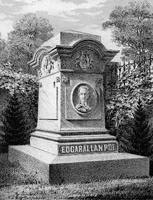
After over two decades buried in an unmarked corner of the cemetery at Baltimore's Westminster Church, Poe’s body was re-buried where people could see it from the street. A new memorial marker was dedicated on November 17, 1875.

The monument was substantial. Money for it was raised by several parties, including a Baltimore schoolteacher named Sara Sigourney Rice. Rice kicked off a "pennies for Poe" campaign and even asked her students to perform public speeches to raise funds. The final $650 came from Philadelphian George William Childs. The design came from architect George A. Frederick, built by Colonel Hugh Sisson, with a stone medallion of Poe by artist Adalbert Volck (later replaced). The total cost of the new monument was equal today to over $28,000.

Despite all the hard work on the monument, Poe's birthday was incorrectly chiseled as January 20 instead of January 19. It has never been corrected. On his birthday ten years after his reburial, Poe's long-dead wife Virginia Poe was buried with him. Maria Clemm was buried there too, bringing the family trio together for their eternal rest.

The ceremony to dedicate the new monument included speeches from Neilson Poe, Poe's oft-maligned cousin. Several famous poets were invited to attend. The only one that made it was Walt Whitman, then age 56, who was still recovering from a stroke.

Letters, poems and remembrances were contributed his one-time fiancee Sarah Helen Whitman and his occasional enemy James Russell Lowell. Other acknowledgments came from John Greenleaf Whittier ("The extraordinary genius of Edgar Poe is now acknowledged the world over"), William Cullen Bryant (Poe is "distinguished alike for originality in the conception, skill in word-painting, and power over the mind of the reader") and even Henry Wadsworth Longfellow (who noted: "The fever called Living is conquered at last"). Some of the greatest lines in honor of Poe came from fellow 2009 bicentennial poets Alfred Lord Tennyson, who later said that "neglected spot" would be the first place he would visit on a trip to the United States, and Oliver Wendell Holmes. As Dr. Holmes wrote:
His monument shall be his gentle verse,
Which eyes not yet created shall o'er read.
And tongues to be his being shall rehearse,
When all the breathers of this world are dead.
* People still leave "pennies for Poe" at this memorial today. This has become a tradition at the graves of famous figures, particularly writers. Poe did not originate the tradition, however.

Wednesday, October 28, 2009

Young Poe and Lafayette

Here's another story of Poe's teen years. At the age of 15, a young Edgar Poe served as a lieutenant (in fact, second-in-command) for the Richmond Junior Volunteers, a group of teenaged riflemen-in-training. This role put him in the direct path of the Marquis de La Fayette, one of the most celebrated generals of the American Revolution.

La Fayette, on his tour of the United States nearly a half-decade after the Revolution, included a three-day tour of Richmond. During a parade, Poe's group of Junior Volunteers were chosen to accompany General La Fayette's carriage.

We don't know for sure if Poe and La Fayette had a conversation, shook hands, or anything like that (though, allegedly, La Fayette himself inspected all his young bodyguards to make sure they were in full uniform). However, we know that Poe was particularly proud of his role that day. Years later, Thomas Ellis (son of Charles Ellis, business partner of Poe's foster-father John Allan) wrote: "But never was I more proud of [Poe] than when, dressed in the uniform... he walked up and down in front of the marquee erected on the Capitol Square, under which the old general held a grand reception." Poe's pride in this uniformed group may have inspired his attempts at joining the military. At one point, he even considers soliciting La Fayette himself to earn an appointment to the Polish Army.

Three weeks after the parade, Poe partnered with another boy, "Captain" John Lyle, in writing a letter to the governor of the Commonwealth of Virginia. They asked for permission "to retain the arms which they lately were permitted to draw from the Armory." A couple days later, the two boys met with a member of the Virginia State Council to further discuss the proposition.

During the same trip to the United States, the Marquis de La Fayette visited Baltimore. The young Edgar probably didn't know that the only person La Fayette asked about in Baltimore was his good friend "General" David Poe, Poe's paternal grandfather. Distressed to hear of his death, La Fayette went to visit his grave at Westminster Burying Ground — next to the plot where Poe would be (first) buried only 25 years later. There, he said, Ici repose un coeur noble ("Here rests a noble heart").

*The image above is of La Fayette circa 1825, shortly after his Richmond trip. The artist is believed to be Matthew Harris Jouett. It is now part of the National Portrait Gallery.

Tuesday, October 27, 2009

Poe's brother, The Pirate

The Baltimore North American Review published a short story titled “The Pirate” by William Henry Leonard Poe, Edgar’s older brother, on October 27, 1827. The story was based on Edgar’s young, tragic romance with Sarah Elmira Royster. Henry, as he called himself, published several poems in his short life and even occasionally submitted the poetry of his younger brother — though they were often credited to the wrong Poe. There has been some debate about some of the Poes' early poetry, as far as who wrote which.

Less than four years after the publication of "The Pirate," William Henry Leonard Poe died. He was 24 years old.

Henry had served as a sailor for a time but his life was cut short due to tuberculosis, but most biographers are quick to point out that his illness was exacerbated by alcoholism. In fact, the little we are told about Henry is almost always used as a way to better understand Edgar Poe.

Admiring his brother's exploits, Poe later made claims that he traveled to exotic lands (just like Henry). He set many of his prose works at sea, including his only complete novel The Narrative of Arthur Gordon Pym of Nantucket. Poe was deeply affected by the various tuberculoid figures in his life, including his brother. And, like his brother, he turned to drinking when times were tough.

Edgar once wrote: "there can be no tie more strong than that of brother for brother — it is not so much that they love one another as that they both love the same parent." For a time, Edgar used the alias "Henri Le Rennet," incorporating a French version of his older brother's first name. The strangest speculation comes from biographer Jeffrey Meyers, who says the name "Lenore" was a transformation of "William Henry Leonard."

It's all very poetic. But it's also making speculative leaps to connect the dots. How much do we really know about William Henry Leonard Poe? We don't even know what he looked like; no image of him has been identified.

Thursday, September 3, 2009

Rosalie Mackenzie Poe

Poe's younger sister was christened "Rosalie Mackenzie Poe" in Richmond on September 3, 1812. I've discussed Poe's older brother here before, but this is the first (and, likely, the only) post on his sister.

Rosalie is a bit of an enigma; even her birth is unknown (believed to be about December 20, 1810). Rumors persist that she was mentally deficient in some way, though it's unclear if these reports are just another attempt at slandering Poe.* Rumors also suggest that she was not the daughter of David Poe, Jr., father of Edgar and William Henry Leonard Poe, but that she was a bastard child, born after mother Eliza Poe had an affair with another man (inspiring David to abandon her).** While Eliza was on her deathbed, her children, including Rosalie, were tended to by fellow actors with the last name of Usher. After Eliza's death, the Mackenzie family of Richmond took in her youngest daughter and legally adopted her (something that the Allan family never did for Poe).

When William and Jane (Scott) Mackenzie took little Rosalie in, they already had two children (a third, the first-born, died within his first year). They eventually would have ten children in addition to the little one they adopted. Only a couple days after her christening, a woman reported to Frances Allan (Poe's foster-mother) that "Rosalie is not expected to live." Despite the pessimistic outlook, Rosalie survived that illness and, in fact, went on to outlive her brother by 25 years.

Rosalie attended a girls' school in Richmond run by Miss Jane Mackenzie, sister of adoptive father William Mackenzie. Although they grew up in the same town, it is unclear if Poe saw his sister often in his early years (though the Allan family and the Mackenzie family did correspond). In 1842, she traveled to Philadelphia to spend a week with her blood brother (he called her "Rose")e. They corresponded from then on, Poe giving her updates on his wife Virginia's health and she requesting autographs for friends. In 1843, the Mackenzies built a home they named Duncan Lodge, where Poe visited a few times in 1848 and 1849. Rosalie became either a teacher or a teacher's assistant at Miss Jane's school for about nine years. We know she played the piano; the Richmond Poe Museum still has the piano on which she played.

Rosalie was raised in relative wealth. However, after the Civil War, the family fortune was squandered by one of her brothers-by-adoption. Rosalie should have been the legal heir to Poe's published works after her brother's death. Instead, somehow his works were given to Rufus Griswold, either by mistake, by trickery, or by Maria Clemm (Poe's mother-in-law). Rosalie made some attempts, under the advice of a lawyer named J. R. Thompson, to claim those rights. The result was a bit of a family quarrel between Rosalie and Maria Poe (who was also her father's sister). Griswold seems to have also stepped in to push Rosalie aside.

Instead, Rosalie became a desperate beggar, occasionally supported by fans of her brother's work. She survived as best she could by selling portraits of her brother the famous author. In her 60s, she was admitted to a shelter in Washington, D.C. There, she died on July 21, 1874. She had expressed a hope to be buried by her brother. Instead, she was buried at Rock Creek Cemetery in a pauper's grave owned by the home.

* Some state these rumors as fact. Jeffrey Meyers reports she was "a dull, tedious, pathetic figure, [who] failed to develop mentally after the age of twelve" and that Poe was "repelled" by her. Earlier, biographer Joseph Wood Krutch called her a "harmless imbecile."

** One such accusation came from John Allan, Poe's less-than-ideal foster-father (perhaps ironic, considering Allan had his own bastard children). It doesn't seem impossible. Either way, Poe biographer William Bitter blames Allan's rumor-mongering for Rosalie never getting married.

Saturday, August 1, 2009

A tale of two sailors

Herman Melville was born August 1, 1819 in New York City, just over ten years after Poe's birth. The two would never cross paths but they certainly have connections. Both were under-appreciated during their lifetime, especially for works they were particularly proud of (Moby-Dick for Melville, Eureka: A Prose Poem for Poe, for example). Both made substantial enemies, both literary and personal, and died relatively miserable. Most importantly, both were interested in the sea.

Melville's connection to the ocean is more obvious than Poe's; Melville served as a sailor and for a time lived amongst a cannibalistic tribe — an experience which would inspire his popular book Typee. That particular voyage left from New Bedford, Massachusetts in 1841 — three years after Poe published his own novel featuring a character named Arthur Gordon Pym who takes to the sea and later finds himself among a cannibalistic tribe. The literary connections between Melville and Poe don't end there. Though speculative, it's all but certain that Melville's white whale was largely inspired by the symbolism of the color white in The Narrative of Arthur Gordon Pym of Nantucket. Additionally, Poe and Melville were part of a subgenre of literature known as "Dark Romanticism" — a direct response to the Romantic movement's optimism and faith in the human experience (the third major Dark Romantic writer was Nathaniel Hawthorne, who easily connects to both Poe and Melville). I will be speaking about Poe's influence on Melville some time in September at New Bedford; date to be determined.

Perhaps ironically, August 1 has another interesting maritime connection. That date, in 1831, marked the death of William Henry Leonard Poe, the often-forgotten older brother of Edgar, who died of tuberculosis at age 24. In his short life, WHL Poe had traveled the world as a sailor. As a crewman aboard the frigate USS Macedonian, WHL Poe made it to South America, the West Indies, the Mediterranean, and Russia — all before the age of 20. When he returned to the United States, he became a writer (relatively unsuccessful; one notable work fictionalizes his younger brother's first true romance). After his death, WHL Poe was buried at Westminster Abbey in the Poe family plot (near where Edgar Poe was originally buried in 1849). Some say that the character of August Barnard in The Narrative of Arthur Gordon Pym might have been inspired by WHL Poe.

RIP, William Henry Leonard Poe... and happy birthday, Melville. Smooth sailing to you both.

Monday, July 13, 2009

A wedding and a death

At a ceremony held at St. John's Protestant Episcopal Church in Baltimore, presided over by "Rev. Mr. Wyatt," William Clemm Jr. married Maria Poe on July 13, 1817.

Maria Poe was the younger sister of David Poe, Jr. — other siblings were John Hancock Poe, William Poe, George Washington Poe, Samuel Poe, and Elizabeth Poe. She was William Clemm's second wife and their marriage would produce three children: Henry Clemm, Virginia Marie Clemm, and Virginia Eliza Clemm (the first Virginia died as an infant; her younger sister was born the same year and given her name as an honor). That second Virginia Clemm would later marry Edgar A. Poe.

Very little is known about the marriage of William Clemm and Maria Poe Clemm. He already had five children from his first marriage and very little property or money when he had his second marriage. His first wife, in fact, was Maria's first cousin Harriet Poe. He died in 1826 and left what little he had to the five children from his first marriage. It's likely he never met Edgar Poe, who was living overseas with the Allans at the time of this marriage.

A relative of Clemm, presumably a nephew, became minister of the Methodist Episcopal Church in Baltimore — and presided over the three-minute burial service held after Poe's death in 1849.

Today also marks the death of George Rex Graham in 1894. Over his 81-year life, he experienced a series of ups and downs. Between 1839 and 1840, he acquired the Saturday Evening Post and then merged two Philadelphia journals to create Graham's Magazine. Shortly after, he hired Poe as his book review editor at the salary of $800 a year. Though Poe questioned the "namby-pamby" magazine on occasion, he helped lead it to become one of the most prominent publications in the country. Graham was concerned about his writers: his magazine was one of the first in the U. S. to copyright each issue and some writers (if they were paid at all) were granted an average five times more than other magazines. After Poe left, Graham hired Rufus Wilmot Griswold to replace him.

Nevertheless, Graham was pushed into bankruptcy in 1848 and lost controlling interest of both the Saturday Evening Post and Graham's Magazine. The latter magazine ceased publication in 1858. At the age of 70, Graham lost his eyesight and relied on the financial assistance of publisher George William Childs. The one-time powerhouse of American publishing, Graham died in obscurity in Orange, New Jersey on July 13, 1894 and was buried in Philadelphia's Laurel Hill Cemetery — apparently unmarked (I could not find it after three or four attempts).

Sunday, July 12, 2009

Mrs. Shelton is widowed

Alexander Barrett Shelton died of pneumonia at the age of 37 on July 12, 1844 in Richmond, Virginia. He left behind his widow, Sarah Elmira Shelton, and two children — as well as an estate valued at $100,000 (in 1844 dollars, equal to about $2.2 million today). He made his fortune in the transportation industry as the co-owner of a substantial boat route along the James River.

Poe met the widow when she was still Sarah Elmira Royster. At age 15/16, Poe and Elmira (as he called her) spent much of their free time together in Richmond, becoming childhood sweethearts. In 1825, the couple seems to have gotten secretly engaged right before Poe entered the University of Virginia. While at school, Poe sent several letters to his beloved and got more and more anxious when she never responded to any of them. In reality, her father had intercepted the letters and destroyed them before they could be read. Elmira thought Poe had forgotten her and, in 1827, she married Alexander Shelton instead.

The loss of Poe's first relationship inspired several fictionalizations. Baltimore author Lamber A. Wilmer wrote a dramatic poem called Merlin on the relationship. Poe's older brother William Henry Leonard Poe (who seems to have made off with all the middle names while his two younger siblings received none) also fictionalized the romance in a short story called "The Pirate." Poe himself seems to express his emotions in his poems "The Happiest Day" and "Song." The latter seems to make a direct reference to Elmira's marriage to Alexander Shelton; the poem begins: "I saw thee on thy bridal day."

Years later, in 1848, Poe and Elmira met in Richmond again. By then, both were widows (Poe lost his wife Virginia three years after the death of Mr. Shelton). They seem to have almost instantly rekindled their relationship and Poe proposed marriage (again). Elmira carefully considered this; according to Shelton's will, re-marrying would strip her of one-third of her $100,000 inheritance. Her children also clearly did not approve, just as her father had not approved decades earlier. Yet, she clearly was drawn to Poe...

What happens next is a bit unclear. But, that is a discussion for a later date, perhaps a day in September?

Tuesday, July 7, 2009

To My Mother

Somewhat lacking in deep literary merit yet undoubtedly sentimental, the poem "To My Mother" needs very little commentary to understand. Despite its title, the emotional, very personal poem (perhaps Poe's most personal) is not about the poet's birth mother Eliza Arnold Poe, nor is it about the woman who raised him, foster-mother Frances Allan. Instead, it is about the mother of his dead wife.

Though Poe's wife Virginia had died in 1847, Poe continued living with and supporting her mother, Maria Poe Clemm (who was also his aunt, sister of his father). He wrote a sonnet to his mother-in-law, who he nicknamed "Muddy" (presumably because of its similarity to "mother"), which was published on July 7, 1849 in the Flag of Our Union newspaper. In its entirety:
To My Mother

Because I feel that, in the heavens above,
The angels, whispering to one another,
Can find, among their burning terms of love,
None so devotional as that of 'mother' —
Therefore by that sweet name I long have called you —
You, who are more than mother unto me,
And fill my heart of hearts, where Death installed you,
In setting my Virginia's spirit free.
My mother — my own mother — who died early —
Was but the mother of myself; but you
Are mother to the one I loved so dearly,
And thus are dearer than the mother I knew;
By that infinity with which my wife
Was dearer to my soul than its soul-life.
Perhaps ironically, this same date, July 7, in 1835 marked the death of Poe's grandmother, Elizabeth Cairnes Poe. The wife of David Poe Sr. (a veteran of the American Revolution who was friends with General La Fayette), she was 79 years old when she died. Her daughter, Maria Clemm (the subject of the poem above), was taking care of her at the time as well as utilizing the pension the widow Poe was receiving for her husband's Revolutionary service — this pension was the small family's main means of financial support. Poe had lived with her in Baltimore for a time.

Tuesday, April 7, 2009

The Poe family leaves Philadelphia

Though Poe had his work published throughout the United States, the Edgar Allan Poe National Historic Site specifically commemorates his time in Philadelphia — considered to be his most prolific, most lucrative, and happiest period. Here, he published "The Gold-Bug," "The Murders in the Rue Morgue," "The Black Cat," and "The Tell-Tale Heart" (to name a few). He lived in several homes throughout the city, the last of which was the one here on Spring Garden St. It is also the only of his Philadelphia homes still standing.

This post, however, is about the end of that several-year period in 1844. Poe and his wife Virginia left their Spring Garden home early on April 6, traveling via train to Perth Amboy, New Jersey and from there taking a steamer to New York. Virginia, who Poe called "Sissy," was already sick with tuberculosis and would die within three years. Nevertheless, they were optimistic and hoped that a relocation to New York would solve their problems.

The next day, April 7, Poe wrote to his mother-in-law Maria Clemm, still in Philadelphia. "We started in good spirits, but did not get here until nearly 3 o'clock... Sissy coughed none at all." The day was a rainy one and Poe left Virginia behind on the boat while he tried to find a place to board. He found a boarding-house at 130 Greenwich Street in lower Manhattan and went back for Virginia. They celebrated their arrival in style:
Last night, for supper, we had the nicest tea you ever drank, strong & hot — wheat bread & rye bread — cheese — tea-cakes (elegant) a great dish (2 dishes) of elegant ham, and 2 of cold veal, piled up like a mountain and large slices — 3 dishes of the cakes, and every thing in the greatest profusion. No fear of starving here... I feel in excellent spirits & have'nt drank a drop.
Poe concludes the letter by noting that Sissy cried later that night because she missed her mother — and the family cat, Catterina.

The letter has been analyzed by several Poe scholars, who question the veracity of their big meal, how they could have afforded it, why Poe was sure to note he wasn't drinking, why Virginia was crying, and how juvenile she must be for missing the cat (she was 21 years old at this point).

Either way, Poe's time in New York will be a struggle, financially and emotionally. Yet, here he will also meet one of his greatest successes with the publication of "The Raven." And don't think that New York has forgotten their adopted son. Walking tours of Greenwich focusing on Poe are offered, and the last home in which Poe lived — the Poe Cottage in Fordham — is open to the public.

Tuesday, March 24, 2009

Poe returns to the city of his birth

Despondent and unable to patch up the latest fight with his foster-father, an 18-year old Edgar A. Poe had determined to leave the Allan family. Because John Allan was no longer interested in providing financial assistance to his foster-son, Poe did not have the option to return to the University of Virginia — where he had been an outstanding student, studying modern and ancient languages. The latest fight with Allan must have involved that, and possibly his illegitimate children.

Leaving from Norfolk, Virginia via coal vessel on March 24, 1827, he made his way to Boston. John Allan, apparently, was not given any information and, in sense, Poe ran away from him. Allan was not particularly concerned. He wrote, "Im thinking Edgar has gone to Sea to seek his own fortunes." Frances Allan, Poe's loving (yet dying) foster-mother, on the other hand, may have had some idea and may have given Poe money to cover his $12 travel expense.

What drew Poe to Boston is anyone's guess. When his mother Eliza Poe died, she left him only two items: a miniature portrait of her self and a watercolor image of Boston, on the back of which she wrote for him to "always remember Boston, the city of your birth." Optimistically, he assumed that things would be easy in Boston, especially as a publishing center. Sure enough, Poe was able to raise enough money to publish his first book Tamerlane and Other Poems — a pathetic 50 copies were printed. Today the book is considered the rarest first edition in American poetry and a single copy (of which only a dozen remain) is worth more money than Poe made in his lifetime.

The book didn't net him profit or significant critical attention. Likely while it was still going to press, Poe made a strange decision. Despite his privileged upbringing in a wealthy mercantile foster-family, Poe enlisted as a common soldier in the United States Army. Conveniently shedding his past, he used the pseudonym "Edgar A. Perry" and claimed he was 22; he was only 18. Poe was stationed at Fort Independence on Castle Island (today open to the public, but be prepared for strong winds if you visit).

Poe excelled as a soldier but his time in Boston would not be long; he was soon transferred to Fort Moultrie in South Carolina. Years later, Poe would publicly chide the Boston culture and the literary scene. Exactly why he turned his back on the city of his birth is not known.

Tuesday, March 10, 2009

Poe and the Polish?

After Poe was dismissed from West Point Academy, he was sort of unsure where to go next. By this point, he was not interested in returning to John Allan and was hoping to make his own fortune. Despite giving up on the Army and purposely getting kicked out of West Point, Poe still toyed with the idea of military success. On March 10, 1831, Poe wrote to Colonel Sylvanus Thayer, Superintendent of West Point, from New York: "I intend by the first opportunity to proceed to Paris with the view of obtaining , thro' the interest of the Marquis de La Fayette, an appointment (if possible) in the Polish Army." In his letter, Poe asked Thayer to attest to his good standing at the Academy or to contact any friends in Paris who could help him out. Poe claimed at this point to have "no longer any ties which can bind me to my native country -- no projects -- nor any friends."

There are so many stories to recount here!

For one, there is no sincere evidence that Poe ever went to Poland, though he did make occasional claims. Some fringe theorists in the studies of Poe claim it is absolutely true and, from his stint with the Polish Army, he became an international spy (some say he was partnered with Washington Irving) and his death 18 years later in 1849 was due to a government conspiracy. Think what you will.

What's more interesting to me is the connection to La Fayette. What made Poe think that this great American Revolutionary hero would give him the time of day?

The Marquis was in Richmond in October 1824 and a young Edgar Poe (age 15) was part of a volunteer company of Richmond boys known as the Junior Morgan Riflemen. It was this organization that rode in the procession for the celebrated La Fayette that led him to his hotel. Edgar, in uniform, was presented to La Fayette himself for inspection.

Two weeks earlier, in Baltimore, the Marquis asked about an old Baltimore friend. "I have not seen among these my friendly and patriotic commissary, Mr. David Poe, who resided in Baltimore when I was here." David Poe, Edgar's grandfather, was dead by this point, and La Fayette demanded he be shown the grave. There, he said, Ici repose un coeur noble ("Here rests a noble heart"). La Fayette did not ask about any others during that trip to Baltimore. Of all the people in that city, why would the great La Fayette single out David Poe?

During the American Revolution, from 1778-1779, David Poe was part of Captain John McClellan's Company of Baltimore troops. Appointed Assistant Deputy Quartermaster, he was authorized to purchase supplies for the colonial army. Seeing a need, David Poe used $40,000 of his own money to supply troops with items like boots. His self-sacrifice earned him a nickname, from the Marquis and others: "General Poe."

Edgar A. Poe often looked back with fondness that his grandfather had played a role in the Revolution. To some degree, his interest in joining the Army, attending West Point, and enlisting for the Polish cause may have been attempts at his own similar military glory.

Monday, February 16, 2009

Maria Poe Clemm (1790-1871)

Maria Poe was the sister of David Poe, Jr., father of Edgar Poe, making her, by blood, his aunt. When Poe married Maria's daughter Virginia Clemm, she became his mother-in-law by marriage — she also became his "mother" by choice. Poe, Virginia, and Maria were a very close and very loving three-part family from then on. She served, at times, as Poe's adviser, as a financial aid and, occasional, as a literary agent — all in small ways, of course. There is some debate out there that she was a worse influence on Poe than a help, but I'll leave that aside to tell her tragic story today.

Maria outlived two husbands, three children, and one son-in-law before her death on February 16, 1871. When Poe died in 1849, she didn't hear about it right away, and missed his funeral. She left the Fordham Cottage shortly after. She may have given (not sold) the rights to all of her son-in-law's works to a man named Rufus Griswold — a controversial move for many reasons. Besides rumors that Griswold tricked her into this, Griswold was a hated enemy of Poe's and, technically, Maria didn't have the right to sell anything because Poe's closest next of kin was his sister Rosalie Poe in Richmond. Nevertheless, Griswold promised Maria that she would benefit from the multi-volume editions of Poe's works he edited. Or, so he said.

In the 22 years after Poe's death, she struggled to survive. Her only income would have come from doing odd jobs like sewing, selling off autographs of her son-in-law — and, of course, sales from Griswold's collected works of Poe. She was promised that, after the publisher had enough profit to cover initial printing costs, all profit would go to Maria. Desperate, she turned to several people for monetary hand-outs, including Senator Charles Sumner, Harvard President Jared Sparks, poet James Russell Lowell, and, quite famously, Henry Wadsworth Longfellow.

Maria's fourteen surviving letters to Longfellow are a chronicle of her struggles after Poe's death. In March 1850, She offered him a few volumes of Poe's collected works that the publisher had given her (at $2 apiece) and he willingly bought several, thinking she would get the money. She didn't. She was living in Lowell, Massachusetts at the time (the home of Nancy "Annie" Richmond, one of Poe's infatuations at the end of his life) and she requested Longfellow kindly to give her a few of his autographs for "friends" (she likely sold them).

By December 1852, Maria was living in Milford, Connecticut, having left Lowell due to poor health. She planned on heading further South, to family in Louisiana. By February 1857, she was in Brooklyn instead. Later that year, she reported she suffered from "inflammation of the lungs."

By October 1858, she was living with the Johnston family in Alexandria, Virginia. She noted that she was still waiting for the publishers to finish bringing in enough profit from their initial publication of Poe's collected works by Griswold. Eight years after its printing, the publisher most certainly had covered their costs; Maria would never see profit from Griswold's edition.

Maria Clemm never made it further South than Virginia and Maryland. Her plans to Louisiana came up just as the country was on the eve of Civil War, not making travel for an old lady advisable. For a time, she instead found herself in Muskingham, Ohio. She finally was put up in the Church Home in Baltimore by about 1863, if not earlier. It was essentially a nursing home but, years before, it had been a hospital — the same hospital were Edgar Poe died on October 7, 1849. Maria died, perhaps unknowingly, in the same building where her beloved son-in-law had died 22 years earlier. She was 81 years old, and penniless.

Till the end of her life, she defended Poe as best she could. To James Russell Lowell in 1850, she wrote: "He was noble, generous, affectionate, and most amiable (Dr. Griswold's assertion notwithstanding). Poor poor Eddie, it matters little to him now, but it almost breaks my heart to hear him spoken of so unkindly and untrue." We could ask today, did Griswold cause more harm to Poe, or to Mrs. Clemm?

Thursday, February 12, 2009

The first lost "Lenore"

Years before he lost his Lenore in "The Raven," Poe used the name in a poem aptly titled "Lenore."

It was first titled "A Pæan" (a poem of praise, but often directed toward the dead) and its lines were spoken by a bereaved husband — with no mention of Lenore — in 1831. Poe, always re-writing and revising, went back to "A Pæan" and substantially changed it a dozen years later. And so, Poe's first usage of the name "Lenore" came to be, in the February 1843 issue of The Pioneer, a journal edited by James Russell Lowell.

The name itself is relatively meaningless (though some biographers, notably Kenneth Silverman, enjoy trying to find a connection to someone in Poe's life, including his brother William Henry Leonard Poe — which, let's be honest, is a big stretch). However, the name was based on Poe's staunch poetic logic: in order to evoke emotion, words need to use appropriate sounds. As I explained in an earlier blog post, Poe loves the inherent melancholy in a long, protracted "O" sound, and he seems to enjoy the "L" sound too — it pops up in "Lenore," "Annabel Lee," "Eulalie," "Ulalume"...

Former equivalent of the poet laureate Daniel Hoffman made an important comment about this poem, which I completely agree with: for a poet that emphasizes the logical composition of poetry so much, Poe really made it easy on himself when he named his character "Guy De Vere" in this poem. You might also notice another word, "Nevermore," that makes a triumphant return in "The Raven". Take a look. This is the 1843 version from The Pioneer:

AH, broken is the golden bowl!
The spirit flown forever!
Let the bell toll! — A saintly soul
Glides down the Stygian river!
And let the burial rite be read —
The funeral song be sung —
A dirge for the most lovely dead
That ever died so young!
And, Guy De Vere,
Hast thou no tear?
Weep now or nevermore!
See, on yon drear
And rigid bier,
Low lies thy love Lenore!

"Yon heir, whose cheeks of pallid hue
With tears are streaming wet,
Sees only, through
Their crocodile dew,
A vacant coronet —
False friends! ye loved her for her wealth
And hated her for her pride,
And, when she fell in feeble health,
Ye blessed her — that she died.
How shall the ritual, then, be read?
The requiem how be sung
For her most wrong'd of all the dead
That ever died so young?"

Peccavimus!
But rave not thus!
And let the solemn song
Go up to God so mournfully that she may feel no wrong!
The sweet Lenore
Hath "gone before"
With young hope at her side,
And thou art wild
For the dear child
That should have been thy bride —
For her, the fair
And debonair,
That now so lowly lies —
The life still there
Upon her hair,
The death upon her eyes.

"Avaunt! — to-night
My heart is light —
No dirge will I upraise,
But waft the angel on her flight
With a Pæan of old days!
Let no bell toll!
Lest her sweet soul,
Amid its hallow'd mirth,
Should catch the note
As it doth float
Up from the damned earth —
To friends above, from fiends below, th' indignant ghost is riven —
From grief and moan
To a gold throne
Beside the King of Heaven?"

Friday, December 19, 2008

One month to go

It's December 19 - which means we are exactly only one month away from the big bicentennial birthday!

I think I first realized that Poe's bicentennial was coming up back when I was a sophomore in college. That's when I really started getting deeply interested in Poe, read my first book on Poe (Silverman's book, Mournful and Never-ending Remembrance - now available in a new edition), and starting picking up details on his biography. I told myself that if I ever published anything it would be on Poe, and I set a personal goal of getting it published by 2009 for his birthday. At the time, I probably thought I was the only one that would know Poe was turning the big 200. Well, the good news is that I was wrong about that and also that I succeeded in my goal by publishing the Poe desk calendar with plenty of time to spare before Poe's birthday.

Tomorrow, by the way, is Edgar's sister Rosalie Poe's birthday. I wonder where she's buried. I would presume somewhere in Richmond but I've never come across information on it. Anyone out there know?

By the way, here's the link to the eBay sales page, in case you lost it.